This article explains how portal frame stability is governed by sway and second-order effects, and how Eurocode 3 (EN 1993-1-1) treats these phenomena through its stability rules.
Category: Structures
Understanding the mechanics behind soft-storey collapse is therefore essential because the problem is fundamentally behavioural rather than simply dimensional.
beam is generally considered deep when its span-to-depth ratio becomes sufficiently small such that strain distribution across the depth is no longer linear.
Under load reversal, stress pattern changes. A region previously subjected to compression may suddenly experience tension.
Long-span floors are inherently more sensitive to vibration because increasing span length generally reduces structural stiffness. As spans become larger, deflections increase and natural frequencies decrease.
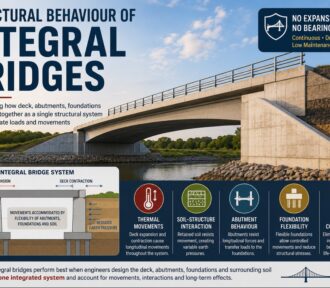
Buildings are never completely still. They move continuously due to loads, temperature changes, soil conditions, and time. These movements are natural and expected in structural systems.
With computational design, the role of the structural engineer is shifting from manual calculation to model development, validation, and interpretation. The focus is no longer on solving equations alone, but on understanding how structures behave as integrated systems.
Critical detailing zones are regions within a structural member where stress concentrations, force transfers, or geometric discontinuities occur.
Force redistribution is a defining feature of indeterminate structures, enabling them to adapt to changes in stiffness, material behaviour, and loading conditions.
Serviceability limit states refer to conditions beyond which specified service requirements for a structure are no longer met. These requirements may relate to usability, comfort, appearance, or long-term durability.