Vertical expansion offers an attractive solution for increasing usable space without acquiring additional land, but it introduces substantial structural demands that cannot be ignored.
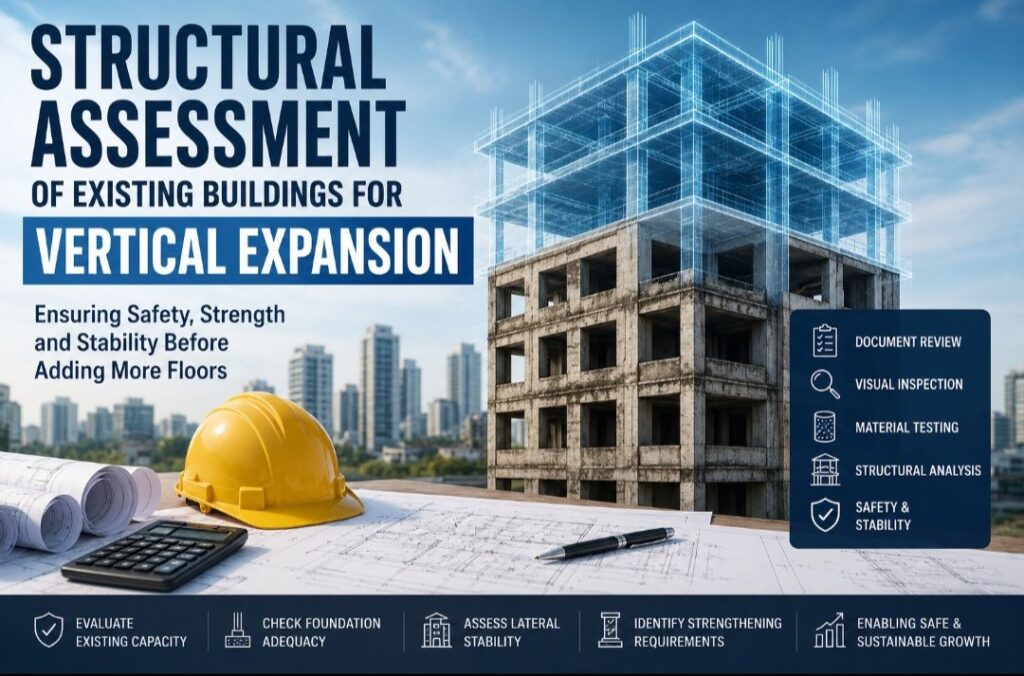
The increasing cost of land, rapid urbanisation, and growing demand for usable space have led many property owners and developers to consider vertical expansion as an alternative to acquiring new land. Adding one or more floors to an existing building can provide significant economic benefits, but it also introduces substantial structural challenges. Before any vertical extension proceeds, engineers must determine whether the existing structure possesses adequate capacity to safely support the additional loads.
A common misconception among building owners is that if a structure has remained stable for many years, it can automatically support additional floors. Structural engineering principles do not support such assumptions. Every building is designed for specific loading conditions, and introducing additional storeys alters the magnitude and distribution of loads throughout the structural system. Elements that were originally adequate may become overstressed once new dead, live, and environmental loads are introduced.
For this reason, structural assessment forms the foundation of every vertical expansion project. The assessment process involves evaluating the existing structure, determining its current condition, establishing its available reserve capacity, and identifying any deficiencies that may require strengthening. A comprehensive assessment ensures that proposed modifications do not compromise structural safety, serviceability, or durability throughout the remaining life of the building.
Structural Assessment is Necessary
Vertical expansion fundamentally changes the loading regime of a building. Additional floors increase gravity loads acting on slabs, beams, columns, walls, and foundations. They also increase the building’s overall height, which can significantly alter its response to wind and other lateral actions.
Even when a structure appears to be performing satisfactorily, hidden limitations may exist. The original designer may have optimised member sizes for the intended number of floors without providing substantial reserve capacity. Construction practices, material degradation, unauthorised modifications, or changes in usage over time may have further reduced available strength.
Without a detailed structural assessment, adding new floors becomes a high-risk undertaking. Excessive deflections, cracking, settlement, overstressed members, and even progressive collapse can occur if structural limitations are overlooked. The purpose of the assessment is therefore to replace assumptions with engineering evidence.
Review of Existing Documentation
The assessment process typically begins with the collection and review of available documentation. Original structural drawings, architectural drawings, geotechnical reports, design calculations, and construction records provide valuable information about the building’s intended behaviour.
These documents help engineers understand the structural system, member sizes, reinforcement arrangements, foundation types, design loads, and material specifications. They also reveal whether previous alterations have been made that could influence structural performance.
Unfortunately, many older buildings have incomplete or missing records. In such situations, engineers must rely more heavily on field investigations and testing to establish the structural characteristics of the building.
The review stage often reveals important details regarding the original design philosophy and helps determine the extent of further investigations required.
Visual Structural Inspection
A detailed visual inspection is one of the most important components of the assessment process. The inspection provides insight into the current condition of structural elements and may reveal evidence of distress, deterioration, or previous modifications.
Engineers typically inspect slabs, beams, columns, walls, foundations, and connections for signs of cracking, excessive deflection, corrosion, spalling, settlement, moisture ingress, or structural movement. Particular attention is given to load-bearing elements because any existing deficiencies may become more significant after vertical expansion.
The inspection also helps identify discrepancies between the constructed building and available drawings. It is not uncommon to discover modifications, openings, removed walls, or altered load paths that differ from the original design intent.
Visual observations alone cannot establish structural capacity, but they provide essential information that guides subsequent investigations and analysis.
Determining the Existing Structural System
Understanding the load-carrying system is critical when evaluating a building for vertical expansion. Engineers must establish how gravity and lateral loads are transferred from the roof to the foundations.
Different structural systems behave differently under increased loading. Reinforced concrete frames, load-bearing masonry structures, steel frames, flat slab systems, and composite structures each have unique strengths and limitations.
The assessment must identify primary load-bearing members, load transfer mechanisms, lateral stability systems, and critical structural components. Any proposed additional floor must integrate effectively with the existing structural framework without creating unintended load concentrations.
A thorough understanding of the structural system allows engineers to develop realistic analytical models and accurately predict the effects of the proposed expansion.
Material Investigation and Testing
The structural capacity of a building depends heavily on the properties of the materials used during construction. Since actual material strengths often differ from design assumptions, testing becomes an essential part of many assessment projects.
For reinforced concrete buildings, engineers may use non-destructive testing methods such as rebound hammer testing, ultrasonic pulse velocity testing, cover meter surveys, and ground-penetrating radar. These techniques provide valuable information regarding concrete quality, reinforcement location, and member dimensions.
Where greater accuracy is required, concrete cores may be extracted for laboratory testing. Reinforcement samples may also be tested to establish yield strength and material characteristics.
For steel structures, material testing may include hardness testing, coupon testing, and inspection for corrosion or section loss.
Reliable material data allows engineers to determine realistic structural capacities rather than relying solely on assumptions.
Assessment of Existing Loading Conditions
Many buildings experience changes in usage during their service life. Spaces originally designed for residential occupancy may later serve commercial or storage purposes, resulting in significantly higher loading conditions.
Engineers must therefore establish current loading conditions before evaluating the effects of vertical expansion. This includes determining dead loads, imposed loads, partition loads, equipment loads, and any special loading requirements.
An accurate understanding of existing loads ensures that the assessment reflects actual conditions rather than original design assumptions that may no longer be valid.
The proposed expansion loads must then be superimposed on existing loads to determine the total demand acting on the structure.
Evaluation of Slabs, Beams, and Columns
The primary structural members must be assessed to determine whether they can safely resist the additional loads introduced by the proposed expansion.
Slabs are evaluated for flexural capacity, punching shear resistance, serviceability performance, and deflection behaviour. Engineers verify whether the slab system can continue to perform adequately under increased loading.
Beams are assessed for bending resistance, shear capacity, deflection limits, and reinforcement adequacy. Particular attention is given to highly loaded beams that transfer significant loads to supporting columns.
Columns often become the most critical elements in vertical expansion projects because they carry cumulative loads from all floors above. Engineers evaluate axial capacity, combined bending effects, slenderness behaviour, and stability requirements.
Where deficiencies are identified, strengthening measures may be required before expansion can proceed.
Foundation Assessment
The foundation system frequently governs the feasibility of vertical expansion. Even if the superstructure possesses sufficient reserve capacity, inadequate foundations can render an expansion project impractical without significant strengthening works.
Engineers must determine the type, size, depth, and condition of existing foundations. The assessment includes evaluating bearing pressures, settlement behaviour, and overall foundation capacity under increased loading.
Where original geotechnical reports are unavailable, supplementary site investigations may be required to establish soil properties and foundation performance.
Foundation strengthening can be technically challenging and expensive. Consequently, foundation capacity often becomes one of the most decisive factors in determining whether vertical expansion is feasible.
Assessment of Lateral Stability
Increasing building height affects more than gravity load resistance. Additional floors increase exposure to wind forces and alter the building’s lateral response characteristics.
Engineers must evaluate the adequacy of the existing lateral stability system, including shear walls, braced frames, moment-resisting frames, and diaphragms. The increased overturning moments and lateral displacements associated with a taller structure may exceed the capacity of the original design.
Particular attention is required in regions where wind actions govern structural design. Even relatively small increases in height can significantly increase lateral demands.
Failure to assess lateral stability properly can result in excessive sway, serviceability problems, or inadequate structural robustness.
Structural Modelling and Analysis
Following data collection and investigations, engineers develop structural models representing the existing building and proposed expansion. Modern structural analysis software enables detailed evaluation of load paths, member forces, deflections, and stability behaviour.
The model incorporates verified material properties, member dimensions, loading conditions, and support characteristics. Engineers then analyse both existing and proposed configurations to determine whether structural demands remain within acceptable limits.
The analysis identifies critical elements, reserve capacity, and areas requiring strengthening. It also provides a rational basis for design decisions and engineering recommendations.
Accurate modelling is essential because the reliability of the assessment depends heavily on the quality of the assumptions and input data.
Strengthening Strategies for Deficient Structures
When assessment reveals insufficient capacity, strengthening may allow the project to proceed safely. The appropriate strengthening method depends on the nature and extent of the deficiencies identified.
Columns may be strengthened through reinforced concrete jacketing, steel jacketing, or fibre-reinforced polymer systems. Beams may require additional reinforcement, external steel plates, or composite strengthening solutions.
Foundation strengthening may involve underpinning, enlargement, micropiles, or other specialised techniques. Lateral stability deficiencies may be addressed through the introduction of shear walls, bracing systems, or enhanced frame action.
The selection of strengthening measures must consider structural effectiveness, constructability, cost, and long-term durability.
Engineering Judgement and Feasibility
Structural assessment is not simply a mathematical exercise. Engineering judgement plays a crucial role in interpreting results and determining project feasibility.
A structure may technically support additional floors yet require strengthening measures that make the project economically unattractive. Conversely, moderate deficiencies may be corrected through relatively simple interventions that enable safe expansion.
Engineers must therefore balance safety, practicality, cost, and long-term performance when making recommendations. The ultimate objective is not merely to determine whether expansion is possible, but whether it can be achieved safely, economically, and sustainably.
Conclusion
Vertical expansion offers an attractive solution for increasing usable space without acquiring additional land, but it introduces substantial structural demands that cannot be ignored. Every additional floor affects the behaviour of slabs, beams, columns, foundations, and lateral stability systems throughout the building.
A comprehensive structural assessment provides the information required to evaluate existing capacity, identify deficiencies, and develop appropriate strengthening strategies where necessary. Through document review, inspection, testing, analysis, and engineering judgement, structural engineers establish whether a building can safely accommodate additional storeys.
Also See: A Background to the Appraisal of Existing Buildings
Sources & Citations
- EN 1990: Eurocode – Basis of Structural Design. European Committee for Standardization (CEN).
- EN 1992-1-1: Eurocode 2 – Design of Concrete Structures – Part 1-1: General Rules and Rules for Buildings. European Committee for Standardization (CEN).
- ISO 13822:2010. Bases for Design of Structures – Assessment of Existing Structures. International Organization for Standardization.
- Institution of Structural Engineers (IStructE). Appraisal of Existing Structures.
- fib Bulletin 80. Partial Factor Methods for Existing Concrete Structures. Fédération Internationale du Béton (fib).
