Deep foundation foundation system transfers structural loads to deeper layers of soil or rock that possess sufficient strength and stiffness to support the structure.
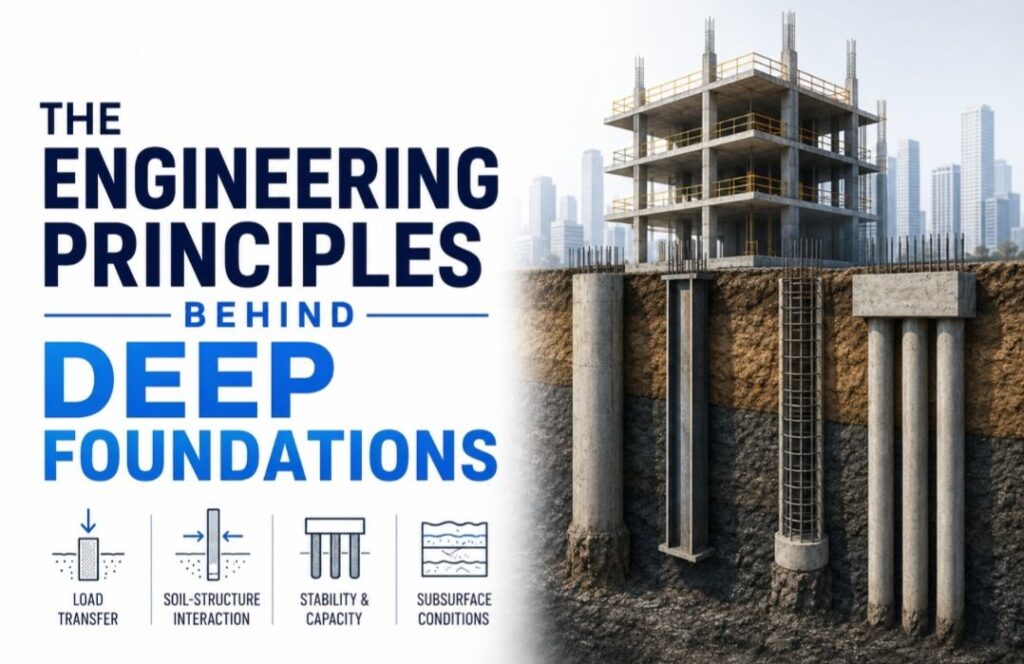
The success of any structure depends on its ability to transfer loads safely to the ground. While many buildings can be supported by shallow foundations such as pad footings, strip footings, and rafts, certain site conditions require loads to be transferred to deeper and more competent soil or rock strata. In such situations, engineers rely on deep foundations.
Deep foundations play a critical role in modern construction, enabling the safe support of high-rise buildings, bridges, industrial facilities, marine structures, and other heavily loaded projects. Their design requires a thorough understanding of soil mechanics, structural behaviour, load transfer mechanisms, and construction techniques.
Although deep foundations are often hidden from view once construction is completed, they remain among the most important components of any structure.
What Are Deep Foundations?
A deep foundation is a foundation system that transfers structural loads to deeper layers of soil or rock that possess sufficient strength and stiffness to support the structure.
Unlike shallow foundations, which distribute loads near the ground surface, deep foundations extend significantly below the surface to reach more suitable bearing strata.
The choice of a deep foundation is usually influenced by:
- Weak surface soils.
- High structural loads.
- Significant settlement concerns.
- Presence of expansive soils.
- High groundwater conditions.
- Marine or waterfront construction.
- Limited site space.
Where shallow foundations become impractical or uneconomical, deep foundations provide a reliable alternative.
Why Deep Foundations Are Needed
One of the primary functions of any foundation is to prevent excessive settlement.
In many locations, the upper soil layers consist of loose sands, soft clays, organic deposits, fill materials, or other soils that lack the strength necessary to support structural loads safely.
Constructing directly on such soils may result in:
- Excessive settlement.
- Differential settlement.
- Tilting of structures.
- Cracking of structural elements.
- Serviceability problems.
- Structural instability.
Deep foundations bypass these weak layers and transfer loads to stronger strata located at greater depths.
This enables structures to remain stable while maintaining acceptable settlement levels throughout their service life.
Types of Deep Foundations
Several forms of deep foundations are used in engineering practice.
Pile Foundations
Pile foundations are the most common type of deep foundation.
Piles are long, slender structural members installed into the ground to transfer loads to deeper soil or rock layers.
They may be constructed from:
- Reinforced concrete.
- Prestressed concrete.
- Steel.
- Timber.
- Composite materials.
Pile foundations can be installed using driving, boring, drilling, or jacking methods depending on site conditions and project requirements.
Drilled Shafts
Drilled shafts, sometimes referred to as bored piles or caissons, are large-diameter foundations constructed by excavating a hole and filling it with reinforced concrete.
These foundations are commonly used for:
- High-rise buildings.
- Bridges.
- Heavy industrial structures.
Their large diameter allows them to support substantial loads while minimizing settlement.
Caisson Foundations
Caissons are deep foundation systems often used in marine and bridge construction.
They are particularly useful where foundations must be installed below water levels.
Caissons may be constructed as:
- Open caissons.
- Box caissons.
- Pneumatic caissons.
These systems allow engineers to reach suitable bearing strata beneath rivers, lakes, and coastal environments.
How Deep Foundations Transfer Loads
Deep foundations transfer loads through several mechanisms.
End Bearing
In end-bearing foundations, loads are transferred directly to a strong soil layer or rock formation at the base of the foundation.
The foundation behaves similarly to a column, transmitting loads through weak upper soils until reaching a competent bearing stratum.
This mechanism is common where dense sand, gravel, or bedrock exists at accessible depths.
Skin Friction
In many situations, piles derive capacity from friction developed along their sides.
As the pile interacts with the surrounding soil, shear resistance develops between the pile surface and the soil.
This frictional resistance contributes significantly to the overall load-carrying capacity.
For long piles installed in cohesive soils, skin friction often provides the majority of the pile resistance.
Combined Action
Most deep foundations rely on a combination of end-bearing resistance and skin friction.
The relative contribution of each mechanism depends on:
- Soil type.
- Pile length.
- Pile diameter.
- Construction method.
- Groundwater conditions.
Understanding this interaction is essential for accurate foundation design.
Settlement Considerations
Settlement remains a critical factor in deep foundation design.
Although deep foundations are generally used to reduce settlement problems, they do not eliminate settlement entirely.
Engineers must evaluate:
- Immediate settlement.
- Consolidation settlement.
- Long-term creep effects.
- Group settlement behaviour.
Particular attention is required when piles are installed in groups because the behaviour of a pile group may differ significantly from that of an individual pile.
Failure to account for settlement can lead to structural damage even when foundation strength requirements have been satisfied.
Pile Group Behaviour
Large structures often require multiple piles working together as a pile group.
The load from the superstructure is distributed through a pile cap into individual piles.
Pile groups introduce additional considerations such as:
- Group efficiency.
- Overlapping stress zones.
- Differential settlement.
- Load sharing between piles.
The interaction between piles can significantly influence foundation performance.
Consequently, pile group analysis forms an essential part of deep foundation design.
Lateral Loading on Deep Foundations
Deep foundations frequently resist more than vertical loads.
Structures such as bridges, towers, retaining systems, and offshore facilities may experience substantial lateral forces arising from:
- Wind.
- Seismic actions.
- Earth pressures.
- Water currents.
- Vessel impacts.
Under such conditions, piles must possess sufficient stiffness and strength to resist bending and lateral displacement.
Engineers therefore evaluate both axial and lateral behaviour during design.
Construction Challenges
Deep foundation construction presents numerous technical challenges.
Common construction issues include:
- Groundwater control.
- Borehole instability.
- Obstructions underground.
- Construction tolerances.
- Concrete quality control.
- Reinforcement placement.
- Noise and vibration concerns.
For driven piles, vibration may affect adjacent structures.
For bored piles, collapse of excavation sides may compromise foundation integrity if appropriate precautions are not taken.
Quality assurance and construction supervision are therefore critical throughout installation.
The Importance of Geotechnical Investigation
The performance of any deep foundation depends heavily on the accuracy of the geotechnical information available.
Before design begins, engineers typically undertake site investigations involving:
- Boreholes.
- Trial pits.
- In-situ testing.
- Laboratory testing.
These investigations provide information regarding:
- Soil stratification.
- Groundwater levels.
- Shear strength.
- Compressibility.
- Bearing characteristics.
Without adequate geotechnical data, foundation design becomes highly uncertain and potentially unsafe.
Economic Considerations
Deep foundations generally involve higher construction costs than shallow foundations.
Additional costs arise from:
- Specialized equipment.
- Geotechnical investigations.
- Skilled labour.
- Longer construction periods.
- Quality control requirements.
However, when poor ground conditions exist, deep foundations often provide the most economical solution over the life of the structure by reducing risks associated with settlement and instability.
The objective of foundation design is therefore not to minimize initial cost alone but to achieve the safest and most reliable solution for the project.
Conclusion
Deep foundations are among the most important systems in structural and geotechnical engineering. By transferring loads to competent soil or rock strata located at depth, they enable the safe construction of structures that would otherwise be impossible to support using shallow foundations.
Their successful design requires a comprehensive understanding of soil behaviour, load transfer mechanisms, settlement, pile interaction, and construction methods. While hidden below ground after completion, deep foundations remain fundamental to the long-term performance, safety, and stability of countless structures worldwide.
Also See: When Pile Capacity is Governed by construction and Not Soil
Sources & Citations
- EN 1997-1:2004+A1:2013 – Eurocode 7: Geotechnical Design – General Rules.
- Tomlinson, M. J., & Woodward, J. (2014). Pile Design and Construction Practice.
- Das, B. M., & Sobhan, K. (2018). Principles of Foundation Engineering.
- Bowles, J. E. (1996). Foundation Analysis and Design.
- Poulos, H. G., & Davis, E. H. (1980). Pile Foundation Analysis and Design.
