Fatigue failure differs fundamentally from conventional structural failure because it develops gradually through repeated loading rather than a single overload event.
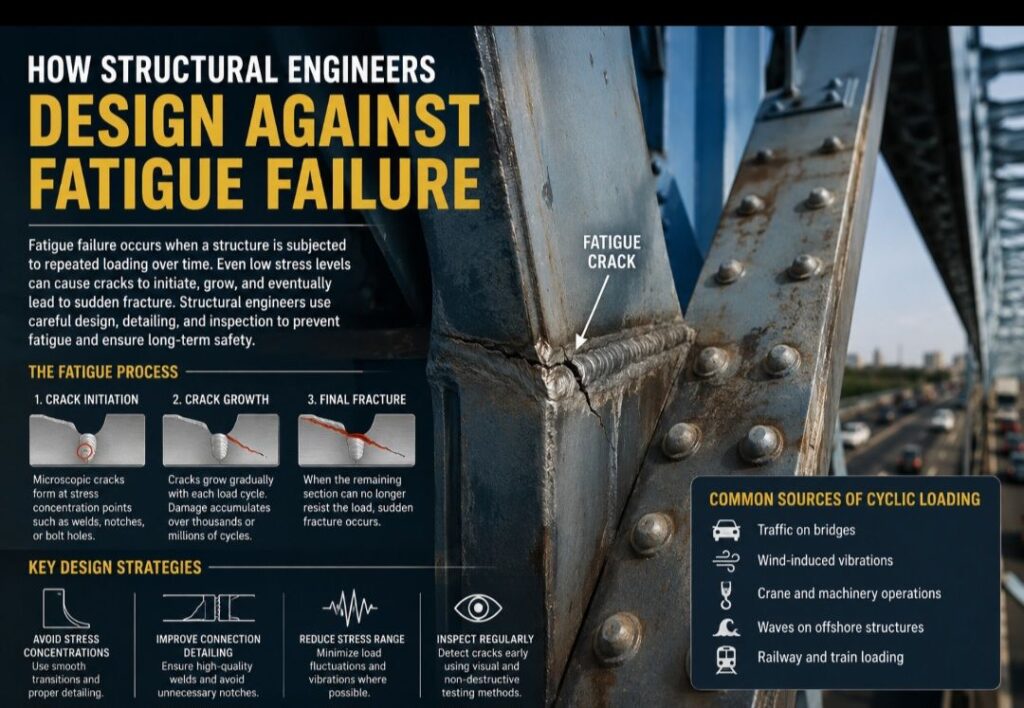
Structural engineering is often associated with designing buildings and infrastructure to resist extreme loads such as earthquakes, strong winds, heavy traffic, and other exceptional actions. While these loading conditions are undoubtedly important, many structural failures do not result from a single overload event. Instead, they occur gradually after a structure has been subjected to repeated loading over an extended period. This phenomenon is known as fatigue failure.
Fatigue failure is one of the most critical considerations in the design of bridges, offshore structures, crane girders, industrial buildings, railway infrastructure, aircraft, wind turbines, and numerous other engineering systems. Unlike conventional structural failure, fatigue can develop even when the stresses acting on a structural member remain well below its ultimate strength. This characteristic makes fatigue particularly dangerous because damage accumulates progressively over time, often without obvious warning until the structure has already been significantly weakened.
For structural engineers, designing against fatigue is therefore not simply a matter of providing sufficient strength. It requires understanding how materials behave under repeated loading, identifying locations where fatigue cracks are likely to initiate, and detailing structures in a manner that minimizes the risk of progressive crack growth throughout the structure’s service life.
Understanding Fatigue Failure
Fatigue failure is the progressive deterioration of a material caused by repeated or cyclic loading. Instead of failing under one exceptionally large load, the material experiences thousands, millions, or even billions of relatively small load cycles. Each cycle produces microscopic damage that gradually accumulates until the material can no longer resist the applied stresses.
The important distinction between fatigue failure and conventional failure lies in the magnitude of the applied load. Conventional failure occurs when the applied stress exceeds the strength of the material. Fatigue failure, however, can occur under stresses that are considerably lower than the material’s yield or ultimate strength, provided those stresses are repeated frequently enough.
This explains why a bridge that safely carries thousands of vehicles every day for decades may eventually develop fatigue cracks despite never having been overloaded. The cumulative effect of repeated loading, rather than the magnitude of any individual load, becomes the governing factor.
For this reason, fatigue is often described as a time-dependent mode of structural deterioration.
Mechanism of Fatigue Failure
Fatigue failure generally develops through three distinct stages.
The first stage involves the initiation of microscopic cracks. These cracks typically originate at locations where stresses are concentrated, such as welds, bolt holes, abrupt changes in cross-section, or surface imperfections. At this stage, the cracks are often too small to be detected through routine visual inspection.
As loading continues, these microscopic cracks begin to grow. With each load cycle, the crack extends slightly further into the material. Although the amount of crack growth during each cycle is extremely small, the cumulative effect over thousands or millions of cycles can become significant.
Eventually, the remaining intact section of the structural member becomes too small to safely resist the applied loads. At this point, sudden fracture occurs. Because much of the damage has already accumulated internally, the final fracture often appears abrupt even though the deterioration has been progressing for many years.
This progressive nature makes fatigue one of the most challenging structural problems to manage.
Sources of Cyclic Loading
Virtually every structure experiences some degree of repeated loading throughout its service life. However, certain structures are particularly susceptible because the magnitude and frequency of loading are exceptionally high.
Highway bridges are among the most common examples. Every vehicle crossing a bridge produces stress cycles within the structural members. Although each individual vehicle may represent only a small fraction of the bridge’s design capacity, millions of vehicle crossings over several decades generate substantial cumulative fatigue effects.
Railway bridges experience even more severe cyclic loading due to the concentrated axle loads imposed by trains. The repeated passage of heavy locomotives creates stress fluctuations that must be carefully considered during design.
Industrial buildings containing overhead cranes are also highly susceptible. Each lifting operation subjects crane girders and supporting members to repeated loading and unloading cycles that continue throughout the operational life of the facility.
Offshore structures face continuous wave loading, while wind turbines experience cyclic stresses resulting from rotating blades and fluctuating wind forces. Transmission towers, chimneys, and tall buildings may also be subjected to repeated wind-induced vibrations that contribute to fatigue damage.
In all these cases, the repeated nature of loading, rather than its maximum value, governs the fatigue performance of the structure.
Why Stress Concentrations Matter
Fatigue cracks rarely develop randomly within a structural member. Instead, they almost always originate at locations where stresses become concentrated.
Stress concentrations occur wherever there is a sudden change in geometry or a discontinuity in the material. Common examples include bolt holes, welded connections, sharp corners, notches, cut-outs, and abrupt changes in member thickness.
Although the average stress within a member may remain relatively low, the local stress at these discontinuities can be considerably higher. Under repeated loading, these localized stress peaks create ideal conditions for crack initiation.
Welded structures deserve particular attention because weld toes often contain small geometric irregularities that naturally increase stress concentration. Consequently, fatigue design frequently focuses more on the quality and detailing of welded connections than on the strength of the base material itself.
Good structural detailing therefore plays a vital role in improving fatigue performance.
Material Behaviour Under Fatigue Loading
Different structural materials respond differently to cyclic loading.
Structural steel generally possesses excellent fatigue resistance when properly detailed. However, welded steel structures require careful attention because weld quality, joint configuration, and residual stresses significantly influence fatigue performance.
Reinforced concrete structures also experience fatigue effects, particularly where reinforcement is subjected to repeated tensile stresses. Highway bridges, parking structures, and industrial floors carrying repeated heavy loads require fatigue considerations during design.
Prestressed concrete members benefit from the compressive stresses introduced during prestressing, which help reduce tensile stress ranges and improve fatigue performance. Nevertheless, the prestressing tendons themselves remain susceptible to fatigue if subjected to repeated stress fluctuations.
Aluminium structures exhibit different fatigue characteristics from steel because they do not possess a true endurance limit. Consequently, fatigue design for aluminium requires careful consideration regardless of stress magnitude.
Understanding these material characteristics enables engineers to select appropriate structural systems for fatigue-sensitive applications.
Designing Against Fatigue Failure
Preventing fatigue failure begins during the design stage. Rather than relying solely on member strength, engineers seek to minimize stress fluctuations throughout the structure.
One of the most effective approaches is improving structural detailing. Smooth transitions between members reduce stress concentrations, while avoiding abrupt geometric changes minimizes localized stress peaks.
Connection design is equally important. Bolted and welded joints should be detailed to distribute stresses as uniformly as possible. Poorly detailed connections often become the weakest points in fatigue-sensitive structures.
Engineers also seek to reduce vibration wherever possible. Excessive vibration increases the number and magnitude of stress cycles, accelerating fatigue damage. Increasing structural stiffness, improving damping characteristics, or modifying natural frequencies can significantly enhance fatigue performance.
Where repeated loading cannot be avoided, selecting materials with appropriate fatigue properties becomes essential.
Fatigue Design Using Modern Codes
Modern structural design standards contain specific provisions for fatigue assessment.
Rather than considering only ultimate strength, fatigue design evaluates the relationship between stress range and the expected number of load cycles during the structure’s service life.
Engineers estimate the loading history of the structure, calculate stress ranges within critical members, and compare these values with fatigue resistance curves established through experimental testing.
For steel structures, Eurocode 3 provides detailed fatigue design procedures that classify welded and non-welded details according to their fatigue performance.
These provisions ensure that structural members possess adequate resistance throughout their intended design life.
Inspection and Maintenance
Even the best fatigue-resistant design cannot completely eliminate the possibility of fatigue damage.
Consequently, fatigue-sensitive structures require periodic inspection throughout their operational life.
Engineers commonly inspect welded connections, bolted joints, bridge details, crane girders, and other critical components where fatigue cracks are most likely to develop.
Modern inspection techniques include ultrasonic testing, magnetic particle inspection, dye penetrant testing, and other forms of non-destructive testing capable of identifying cracks before they become visible to the naked eye.
Early detection allows repairs to be undertaken before cracks propagate to critical dimensions, thereby extending structural life while reducing maintenance costs.
Inspection therefore forms an essential component of fatigue management rather than simply a maintenance activity.
Real-World Applications of Fatigue Design
Fatigue considerations influence the design of numerous engineering structures.
Steel highway bridges are among the most fatigue-sensitive structures because of continuous traffic loading. Railway bridges require even greater attention due to heavy axle loads and frequent load repetitions.
Industrial crane girders experience repeated loading during lifting operations, making fatigue assessment a fundamental design requirement.
Offshore platforms must withstand millions of wave-induced loading cycles throughout their design life, while wind turbine towers experience continuous cyclic stresses resulting from rotating blades and changing wind conditions.
Transmission towers, stadium roofs, airport structures, and communication masts may also require fatigue assessment depending on their loading characteristics.
These examples illustrate that fatigue is not confined to a single branch of engineering but represents a universal design consideration across numerous structural systems.
Conclusion
Fatigue failure differs fundamentally from conventional structural failure because it develops gradually through repeated loading rather than a single overload event. Although the stresses involved may remain well below the strength of the material, the cumulative effect of millions of load cycles can eventually produce cracks that lead to sudden fracture.
For structural engineers, designing against fatigue requires far more than simply increasing member sizes. It involves understanding cyclic loading, minimizing stress concentrations, selecting appropriate materials, providing effective structural detailing, controlling vibration, and implementing inspection programmes capable of detecting damage before it becomes critical.
Also See: Fatigue Failure in Structures
Sources & Citations
- EN 1993-1-9:2005 – Eurocode 3: Design of Steel Structures – Fatigue.
- EN 1990:2002+A1:2005 – Eurocode: Basis of Structural Design.
- Maddox, S. J. (1991). Fatigue Strength of Welded Structures. Woodhead Publishing.
- Stephens, R. I., Fatemi, A., Stephens, R. R., & Fuchs, H. O. (2000). Metal Fatigue in Engineering. John Wiley & Sons.
- Dowling, N. E. (2013). Mechanical Behavior of Materials: Engineering Methods for Deformation, Fracture, and Fatigue. McGraw-Hill.
