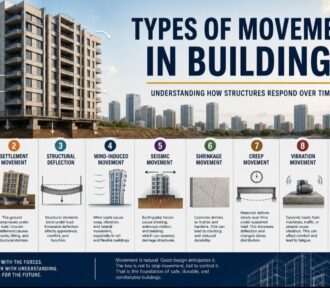
Buildings are never completely still. They move continuously due to loads, temperature changes, soil conditions, and time. These movements are natural and expected in structural systems.
Structures from first principles!
Buildings are never completely still. They move continuously due to loads, temperature changes, soil conditions, and time. These movements are natural and expected in structural systems.
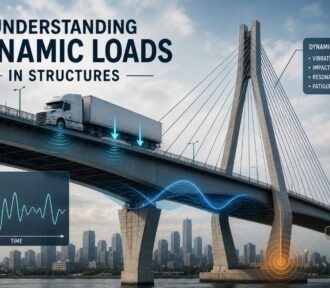
The response of a structure under dynamic conditions is influenced by mass, stiffness, damping, and the characteristics of the applied load.

With computational design, the role of the structural engineer is shifting from manual calculation to model development, validation, and interpretation. The focus is no longer on solving equations alone, but on understanding how structures behave as integrated systems.
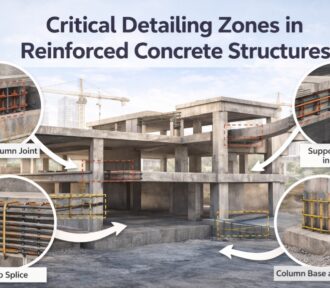
Critical detailing zones are regions within a structural member where stress concentrations, force transfers, or geometric discontinuities occur.
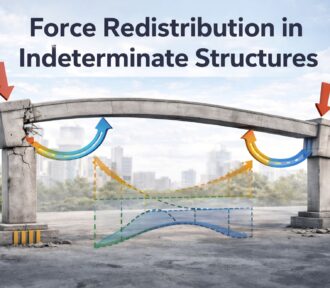
Force redistribution is a defining feature of indeterminate structures, enabling them to adapt to changes in stiffness, material behaviour, and loading conditions.

Serviceability limit states refer to conditions beyond which specified service requirements for a structure are no longer met. These requirements may relate to usability, comfort, appearance, or long-term durability.
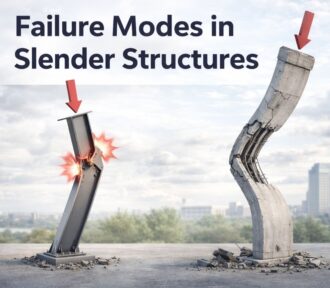
What makes buckling particularly dangerous is that it is not always preceded by visible signs of distress. A column may appear stable under increasing load until it suddenly deflects and fails
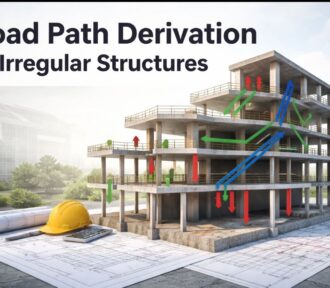
Loads are assumed to travel along straight, predictable routes through clearly defined elements. While this is useful for conceptual understanding, real structures behave differently, especially when irregularities are present.