Understanding construction sequence allows engineers to anticipate temporary conditions, manage risks, and ensure that structural safety is maintained from the first stage of construction to the completed project
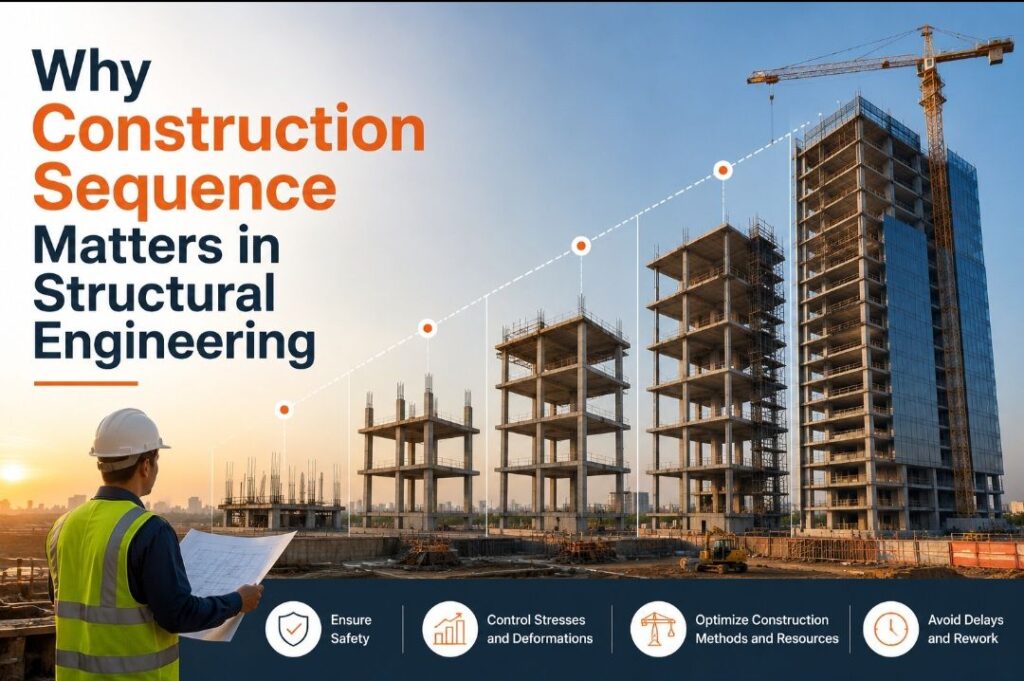
Structural engineering is often associated with the analysis and design of completed structures. Engineers calculate loads, size structural members, and verify that buildings, bridges, and other facilities can safely resist the forces they will encounter throughout their service life. However, an important reality is frequently overlooked: structures do not appear in their completed form overnight.
Every structure passes through a series of intermediate stages before completion. During these stages, the structure behaves differently from its final configuration, and the order in which structural elements are constructed can significantly influence performance, safety, and stability. This order of construction, commonly referred to as construction sequence, is therefore a critical consideration in structural engineering.
Although construction sequence is often viewed as a site management issue, it is fundamentally an engineering concern because it directly affects how loads are transferred, how forces develop within structural members, and how the structure behaves during construction.
Structures Behave Differently During Construction
A completed structure functions as an integrated system. Beams, slabs, columns, walls, foundations, and bracing elements work together to resist loads and maintain stability.
During construction, however, this complete system does not yet exist.
At any given stage, some structural elements may have been constructed while others are still absent. As a result, the load paths available in the completed structure may not yet be fully established.
This means that forces acting on the structure during construction can be distributed very differently from those assumed in the final design.
A beam that will eventually receive support from a floor slab may initially act alone. A steel frame may temporarily lack the bracing that provides stability in the completed building. A concrete structure may be carrying loads before all supporting elements have achieved their design strength.
Consequently, structural behaviour during construction can differ substantially from structural behaviour after completion.
Construction Sequence Influences Load Paths
One of the most important principles in structural engineering is the concept of load paths.
Every load acting on a structure must be transferred safely to the foundation through a continuous series of structural elements. Engineers carefully design these load paths to ensure that forces are distributed efficiently and safely.
However, load paths are not static during construction.
As structural elements are added, removed, or temporarily supported, the routes through which loads travel may change. The order in which components are constructed therefore determines how forces move through the structure at different stages.
If the construction sequence does not account for these temporary conditions, certain members may experience forces that exceed those anticipated in the completed structure.
This is particularly important in large buildings, bridges, transfer structures, and long-span systems where load redistribution can be significant.
Construction Sequence and Structural Stability
Stability is another area where construction sequence plays a critical role.
Many structural systems derive stability from the interaction of multiple components. Until all of these components are in place, the structure may be more vulnerable to instability.
Steel structures provide a clear example of this behaviour.
A completed steel frame may possess excellent lateral stability due to the presence of bracing systems, floor diaphragms, and interconnected members. During erection, however, individual members may remain unstable until the complete system is assembled.
The sequence in which these elements are installed therefore becomes an important determinant of structural safety.
Similarly, precast concrete structures often require temporary supports and bracing until permanent connections have been completed. Without proper sequencing, elements may become unstable despite being adequately designed for their final condition.
The Relationship Between Construction Sequence and Concrete Behaviour
Construction sequence is particularly important in reinforced concrete structures because concrete develops strength gradually.
Unlike steel, which generally achieves its design properties before installation, concrete gains strength over time through hydration. A recently cast slab or beam may have only a fraction of its intended strength even though it appears complete.
The timing of subsequent construction activities therefore becomes critical.
If formwork is removed too early, the structure may be forced to resist loads before sufficient strength has developed. If construction materials are stockpiled on newly cast floors, excessive stresses may occur. If additional floors are constructed before lower levels have adequately matured, load redistribution may lead to excessive deflection or cracking.
In such situations, the issue is not necessarily poor design but inappropriate sequencing of construction activities.
Long-Term Effects of Construction Sequence
The influence of construction sequence does not end when construction is completed.
The order in which loads are applied can affect the long-term behaviour of a structure for many years after occupation.
In reinforced concrete structures, staged loading influences creep and shrinkage behaviour. Members subjected to loads at an early age may experience different long-term deflections compared to those loaded later.
Similarly, differential loading during construction can influence settlement patterns within foundations and supporting soils.
These effects may not become apparent immediately, yet they can affect structural performance long after construction has ended.
For this reason, modern structural analysis increasingly considers the history of load application rather than focusing solely on the final loading condition.
Why Engineers Perform Construction Stage Analysis
Recognising the importance of construction sequence, engineers increasingly perform construction stage analyses as part of the design process.
Rather than analysing only the completed structure, construction stage analysis evaluates structural behaviour at various stages throughout the construction process.
This approach allows engineers to identify potential problems before construction begins.
By examining each stage individually, engineers can assess temporary load paths, evaluate stability requirements, predict construction-stage deflections, and determine whether temporary supports are necessary.
The result is a more comprehensive understanding of structural behaviour throughout the entire life cycle of the project.
Construction Sequence Is a Design Consideration
There is sometimes a tendency to view construction sequence as solely the responsibility of contractors. While contractors play a crucial role in planning and executing construction activities, structural engineers also have a responsibility to consider how their designs will be built.
Certain structural forms are highly sensitive to construction sequence. Long-span roofs, transfer structures, cantilevered buildings, bridges, and complex steel frames often require careful consideration of the order in which elements are erected.
Ignoring construction sequence during design can lead to difficulties during execution, increased costs, excessive temporary works, and in some cases structural failure.
Successful projects therefore require close coordination between design and construction teams to ensure that structural behaviour remains acceptable throughout every stage of construction.
Conclusion
Construction sequence is far more than the order in which activities are carried out on site. It is a fundamental factor that influences load transfer, structural stability, member forces, deflections, and long-term performance.
A structure that performs perfectly in its completed state may experience entirely different behaviour during construction. For this reason, structural engineers must consider not only the final structure but also the path by which that structure comes into existence.
Thus, understanding construction sequence allows engineers to anticipate temporary conditions, manage risks, and ensure that structural safety is maintained from the first stage of construction to the completed project. Ultimately, successful structural engineering depends not only on what is built, but also on how it is built.
Also See: Idealisation of Supports in Structural Analysis
Sources & Citations
- EN 1990:2002+A1:2005 – Eurocode: Basis of Structural Design.
- EN 1991-1-6:2005 – Eurocode 1: Actions on Structures – Actions During Execution.
- EN 13670:2009 – Execution of Concrete Structures.
- Illingworth, J. R. (2014). Construction Methods and Planning.
- Chudley, R., & Greeno, R. (2020). Building Construction Handbook.
