Structural Health Monitoring involves the systematic observation of a structure throughout its service life to determine whether it continues to perform as intended.
Modern structures are designed to withstand a wide range of loading conditions throughout their service life. Engineers carefully analyse buildings, bridges, dams, tunnels, and other infrastructure to ensure they possess adequate strength, stability, and serviceability under expected loading conditions. However, regardless of how well a structure is designed and constructed, it will inevitably experience deterioration over time. Environmental exposure, repeated loading, material ageing, corrosion, accidental actions, and changing usage conditions gradually influence structural performance.
For this reason, structural engineering does not end when construction is completed. Ensuring that a structure remains safe throughout its service life requires continuous assessment of its condition. This is where Structural Health Monitoring (SHM) plays a vital role.
Structural Health Monitoring is the process of evaluating the condition and performance of a structure using inspections, sensors, data acquisition systems, and engineering analysis. Rather than waiting until visible defects appear, SHM enables engineers to identify changes in structural behaviour at an early stage, allowing maintenance and repairs to be carried out before significant damage develops.
As infrastructure continues to age and engineering projects become more complex, Structural Health Monitoring has become an essential component of modern infrastructure management.
Understanding Structural Health Monitoring
Structural Health Monitoring involves the systematic observation of a structure throughout its service life to determine whether it continues to perform as intended. Unlike traditional inspections, which are conducted at specific intervals, SHM may provide continuous or periodic information about a structure’s behaviour under actual operating conditions.
The principle behind SHM is relatively straightforward. When a structure begins to deteriorate, its behaviour changes. Damage may reduce stiffness, alter vibration characteristics, increase deflections, widen cracks, or modify the way loads are transferred through structural members. These changes often occur long before visible signs of distress become apparent.
By measuring these behavioural changes, engineers can identify developing problems before they become critical. This allows maintenance decisions to be based on the actual condition of the structure rather than relying solely on scheduled inspections or visible deterioration.
Importamce of Structural Health Monitoring
Every structure undergoes gradual changes throughout its life. Concrete experiences creep and shrinkage, steel may corrode, foundations may settle, and repeated loading can lead to fatigue damage. Environmental factors such as temperature fluctuations, moisture, wind, and aggressive chemicals further accelerate deterioration.
Traditional visual inspections remain an important part of structural maintenance, but they have limitations. Many forms of deterioration originate internally and cannot be detected until considerable damage has already occurred. Fatigue cracks may develop inside welded joints, reinforcement corrosion may progress beneath concrete surfaces, and excessive stresses may exist without obvious external symptoms.
Structural Health Monitoring overcomes many of these limitations by continuously evaluating structural behaviour instead of relying solely on visual observations. Engineers can monitor how a structure responds to loads over time, identify abnormal trends, and intervene before deterioration compromises safety or serviceability.
This proactive approach improves structural reliability while reducing the likelihood of unexpected failures.
Components of a Structural Health Monitoring System
An effective Structural Health Monitoring system consists of several integrated components working together to evaluate structural performance.
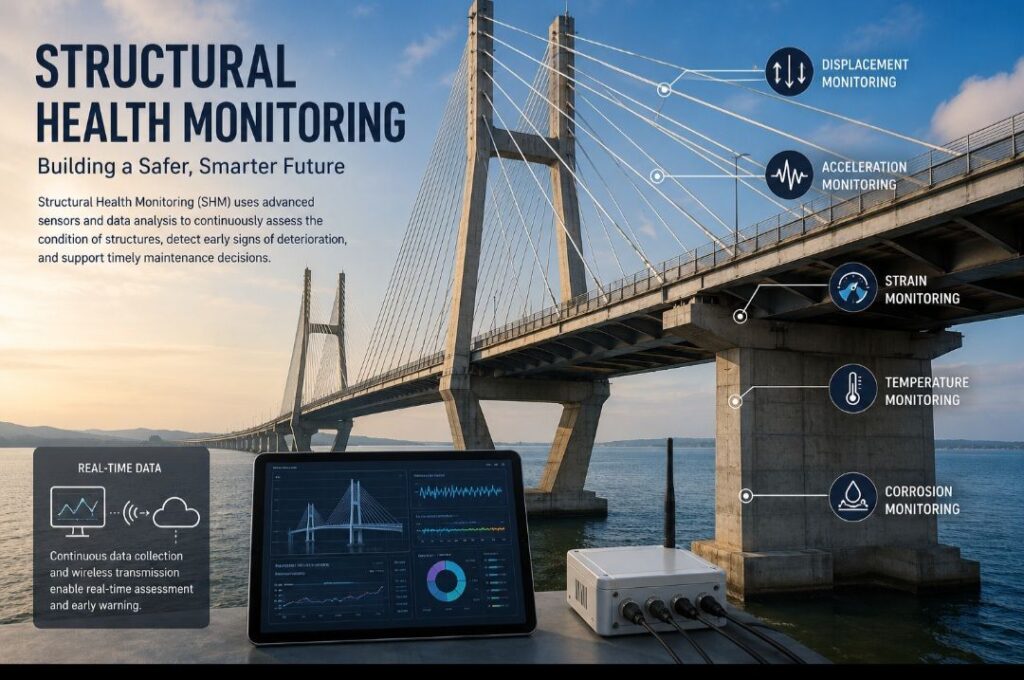
Sensors installed at critical locations measure quantities such as strain, displacement, acceleration, vibration, temperature, inclination, or crack movement. These measurements are transmitted to data acquisition systems where they are processed and stored for analysis.
Specialised software then evaluates the collected information to identify changes in structural behaviour. If monitored values exceed predetermined limits or unusual trends develop, engineers are alerted so that further investigations can be undertaken.
Modern monitoring systems often provide real-time access to structural data, allowing engineers to evaluate structural performance remotely without requiring frequent site visits.
Common Monitoring Technologies
The effectiveness of any monitoring system depends on selecting appropriate sensors for the structure being monitored.
Strain gauges measure deformation within structural members and help engineers evaluate stress distribution. Accelerometers monitor structural vibrations and are widely used on bridges, towers, and high-rise buildings. Displacement sensors record movement between structural components, while inclinometers detect changes in inclination that may indicate foundation movement or structural instability.
Crack monitoring devices are used to determine whether existing cracks remain stable or continue to propagate over time. Temperature sensors help distinguish between movements caused by thermal expansion and those resulting from structural deterioration.
More recently, fibre optic sensors have become increasingly popular because they provide highly accurate measurements over long distances while remaining resistant to electromagnetic interference and harsh environmental conditions.
By combining multiple sensing technologies, engineers obtain a comprehensive understanding of structural performance under varying operating conditions.
Applications of Structural Health Monitoring
Structural Health Monitoring is now widely used across numerous sectors of civil engineering.
Long-span bridges are among the most extensively monitored structures because they experience continuous traffic loading, thermal movements, wind effects, and environmental exposure. Monitoring systems help engineers evaluate bridge performance in real time and identify deterioration before it becomes critical.
High-rise buildings also benefit from SHM, particularly in regions susceptible to strong winds or earthquakes. Sensors installed throughout the structure measure acceleration, sway, and vibration, allowing engineers to verify that the building performs as intended during extreme loading events.
Similarly, dams, tunnels, offshore platforms, industrial facilities, stadiums, transmission towers, and heritage structures increasingly rely on Structural Health Monitoring to support maintenance planning and ensure long-term safety.
The Role of Structural Health Monitoring in Preventing Structural Failure
One of the greatest advantages of Structural Health Monitoring is its ability to detect structural problems before they develop into serious failures. Most structural failures do not occur without warning. Instead, they are preceded by gradual changes such as increasing deflections, abnormal vibrations, crack propagation, corrosion, or foundation movement. These changes may be too subtle to identify during routine visual inspections but can often be detected through continuous monitoring.
By analysing data collected from monitoring systems, engineers can identify unusual trends and investigate their causes before structural safety is compromised. This proactive approach allows repairs to be carried out at an early stage, reducing maintenance costs, minimising disruption, and significantly extending the service life of the structure.
Structural Health Monitoring is therefore not intended to replace engineering inspections but to complement them by providing continuous information about how a structure behaves under real operating conditions. Together, monitoring systems and periodic inspections provide a more complete assessment of structural integrity than either approach can achieve independently.
The Future of Structural Health Monitoring
Rapid technological advancements are transforming the way structures are monitored and maintained. Wireless sensors, cloud computing, fibre optic technology, unmanned aerial vehicles, and artificial intelligence are making Structural Health Monitoring systems more accurate, efficient, and accessible than ever before.
One of the most significant developments is the use of digital twins, which are virtual models continuously updated using real-time data collected from the physical structure. These models enable engineers to compare predicted behaviour with actual performance, assess deterioration, and make informed maintenance decisions throughout a structure’s life cycle.
Conclusion
Structural Health Monitoring has become an indispensable tool in modern structural engineering. By continuously assessing the condition and behaviour of structures, it enables engineers to identify deterioration at an early stage, optimise maintenance strategies, and improve the safety, reliability, and longevity of critical infrastructure.
Rather than relying solely on periodic inspections or visible signs of damage, Structural Health Monitoring provides valuable insight into how structures perform throughout their service life. This shift from reactive maintenance to proactive asset management allows engineers to make better-informed decisions, reduce life-cycle costs, and minimise the risk of unexpected failures.
Also See: Appraisal of Historic Masonry Structures – Non Invasive Techniques
Sources & Citations
- EN 1990:2002+A1:2005 – Eurocode: Basis of Structural Design.
- Farrar, C. R., & Worden, K. (2013). Structural Health Monitoring: A Machine Learning Perspective. John Wiley & Sons.
- Sohn, H., Farrar, C. R., Hemez, F. M., et al. (2004). A Review of Structural Health Monitoring Literature. Los Alamos National Laboratory.
- ISO 18649:2018 – Mechanical Vibration — Evaluation of Measurement Results from Dynamic Tests and Investigations on Bridges.
- Worden, K., & Farrar, C. R. (2007). Structural Health Monitoring: A Machine Learning Perspective. Philosophical Transactions of the Royal Society A.
