A piled raft foundation becomes particularly valuable when a conventional raft can no longer provide the required settlement performance efficiently, but a conventional piled foundation would involve more piles than necessary.
Foundation selection is one of the most important decisions made during the early stages of structural design. The choice affects the safety, serviceability, construction cost, programme, and long-term performance of the entire building. For relatively low-rise structures, isolated footings, strip foundations, or conventional rafts may provide simple and economical solutions. As building loads increase or ground conditions become more challenging, however, the engineer may need to consider more sophisticated foundation systems.
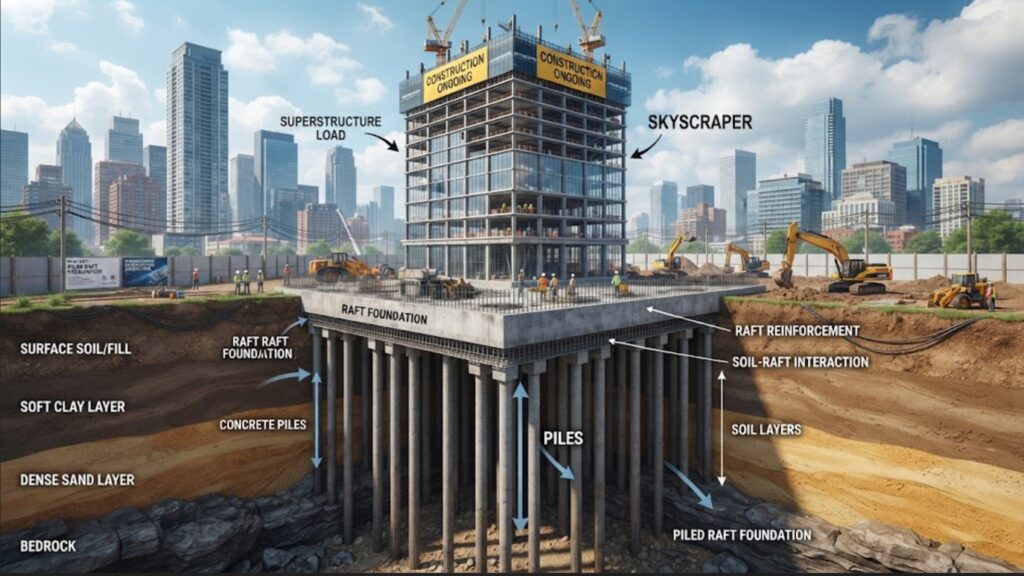
A piled raft foundation is one such system. It combines a raft with piles so that both components contribute to the overall behaviour of the foundation. This arrangement can provide significant advantages where settlement, rather than ultimate bearing capacity alone, controls the design. It can also offer a more economical alternative to a conventional pile foundation because the piles do not necessarily need to carry the entire building load.
The important question, therefore, is not simply whether piles can support the building. The real question is whether the combination of a raft and a smaller number of strategically positioned piles can provide better overall performance than a conventional raft or a fully piled foundation. Understanding this distinction is essential when deciding whether a piled raft is appropriate for a particular project.
Understanding the Conventional Raft Foundation
A raft foundation consists of a large reinforced concrete slab that supports several columns, walls, or, in some cases, virtually the entire building footprint. Instead of transferring each column load through an individual footing, the raft spreads the loads over a much larger area of soil.
This approach can be particularly effective when columns are closely spaced or when individual footings would occupy a significant proportion of the available foundation area. By increasing the contact area between the foundation and the ground, the average pressure imposed on the soil can be reduced.
However, reducing bearing pressure does not mean that settlement disappears. The soil beneath the raft will still deform under the building load, and the magnitude of that deformation depends on the stiffness and compressibility of the ground. For this reason, a raft that satisfies an ultimate bearing capacity check may still be unsuitable if the predicted settlement is excessive.
This distinction becomes increasingly important as the building becomes larger. A heavily loaded structure can impose substantial stresses on the ground even when those stresses remain below the ultimate bearing capacity of the soil. If the supporting soil is compressible, the resulting deformation can govern the foundation design.
A raft can often accommodate some differential movement because its structural continuity allows loads to redistribute between different parts of the foundation. Nevertheless, the raft itself must be designed to resist the resulting bending moments, shear forces, and local concentrations around columns and walls.
Our earlier article, Comprehensive Guide to Piled Raft Foundations, examines the behaviour and analysis of piled rafts in greater detail. The focus here is different: determining when the additional complexity of piles is actually justified.
What Makes a Piled Raft Different?
A piled raft combines three interacting components: the raft, the piles, and the supporting soil. The distinction between this system and a conventional pile foundation is particularly important.
In a conventional pile foundation, the pile cap is often designed primarily to transfer structural loads into the piles. The contribution of the soil directly beneath the cap may be neglected or treated as secondary. The design philosophy is therefore based largely on the capacity of the pile group.
A piled raft works differently. The raft is intentionally allowed to transfer part of the building load directly into the soil, while the piles provide additional stiffness and load-carrying capacity. The piles can therefore be used to improve the foundation’s load-settlement response rather than simply replacing the soil-supported raft mechanism.
This can result in a significant reduction in the number of piles required compared with a conventional piled foundation.
The concept becomes easier to understand by considering the load path. When the building applies a vertical load to the raft, some of that load is transmitted directly through the underside of the raft into the soil. As the raft settles, the piles interact with the surrounding soil and begin to carry additional load. The final distribution depends on the relative stiffness of the raft, piles, and soil.
There is therefore no fixed percentage of the load that must be carried by the raft or piles. The load-sharing mechanism develops from the characteristics of the complete foundation system.
Why Would an Engineer Add Piles to a Raft?
The most important reason is often settlement control.
This point deserves emphasis because piles are frequently introduced into foundation designs for the wrong reason. Engineers may initially think that piles are necessary only when the soil cannot provide sufficient ultimate bearing capacity. In reality, a raft can have adequate bearing capacity while still producing unacceptable settlement.
Suppose a large building is founded on a relatively stiff soil layer. A conventional raft may have enough bearing capacity to support the structure safely, but the predicted settlement could still be excessive because of the magnitude of the applied load.
Increasing the raft dimensions may not solve the problem efficiently. Also, the raft area reduces average contact pressure, but it does not necessarily eliminate the underlying compressibility problem. Increasing raft thickness can improve structural stiffness, but this increases concrete and reinforcement quantities and may eventually become uneconomical.
Piles can provide another mechanism for controlling the foundation response. By extending into deeper soil, they can increase the stiffness of the overall system and reduce the settlement produced by the building load.
The objective is therefore not necessarily to make the piles carry the entire building. Instead, the engineer can use a relatively limited number of piles to achieve a substantial improvement in foundation performance.
Bearing Capacity and Settlement Are Different Problems
Understanding the difference between bearing capacity and settlement is essential when selecting a foundation.
Ultimate bearing capacity relates to the ability of the ground to resist a failure mechanism under the applied load. Settlement concerns how much the foundation moves while the soil remains within an acceptable stress range.
A foundation can therefore pass one check and fail the other.
For example, consider a building founded on a broad raft. The calculated contact pressure may remain well below the ultimate bearing capacity of the soil. From a purely ultimate limit state perspective, the foundation may appear satisfactory.
However, if the soil is compressible, the same loading may produce significant settlement. If different areas of the building impose different pressures, the resulting differential settlement may become even more important.
This is where a piled raft can become attractive.
The piles increase the stiffness of the foundation system and can reduce the amount of settlement associated with the applied building loads. Their effect can be particularly valuable beneath heavily loaded areas, where settlement would otherwise be concentrated.
Differential Settlement Can Be More Important Than Total Settlement
Engineers should not focus only on the total downward movement of a building. The difference in settlement between two parts of the structure can be more damaging than uniform settlement of the entire foundation.
Imagine a building where the central core carries a large proportion of the vertical load while the perimeter columns carry smaller loads. A conventional raft may therefore experience different levels of deformation beneath different parts of the building.
The problem can become more pronounced where transfer structures, heavily loaded columns, or large structural walls are present.
If one part of the foundation settles significantly more than another, the building may experience distortion. This can produce cracking in walls, damage to finishes, misalignment of doors and windows, and additional forces within structural members.
Strategically positioned piles can help reduce these differences in settlement.
The objective is not necessarily to prevent all movement. That would rarely be realistic. The objective is to control the movement so that the resulting deformation remains compatible with the structural and architectural requirements of the building.
Heavy Buildings Are Not Automatically Piled Foundations
It is tempting to assume that a tall or heavily loaded building automatically requires piles. This is not necessarily true.
The foundation decision depends on the relationship between the structural loads and the geotechnical characteristics of the site.
A large building on competent, stiff soil may be capable of being supported satisfactorily by a raft. Conversely, a much smaller building on weak or highly compressible soil may require deep foundations.
Building height therefore provides useful preliminary information, but it should not determine the foundation system by itself.
The geotechnical investigation is critical because the engineer needs to understand the soil profile, groundwater conditions, stiffness, strength, compressibility, and variation across the site before making a reliable foundation decision.
When a Conventional Raft May Be the Better Solution
A piled raft should not be regarded as an upgrade to a conventional raft. It is simply another foundation system with its own advantages, limitations, and construction requirements.
If a conventional raft can satisfy the required ultimate and serviceability criteria, adding piles may provide little additional value.
Consider a building where the soil has adequate stiffness, the applied pressures are moderate, and predicted differential settlement is small. A properly designed raft may provide an effective and economical solution.
Introducing piles in such a situation would increase construction complexity without necessarily producing a proportionate improvement in performance.
Piling also involves specialist equipment, additional concrete and reinforcement, pile testing, excavation coordination, and more complicated construction sequencing. These factors can have significant financial and programme implications.
The simplest foundation that satisfies the design requirements is often the most appropriate one.
When a Piled Raft Becomes More Attractive
The case for a piled raft becomes stronger when settlement begins to control the design of a conventional raft.
This may occur when the building imposes large loads on a soil profile with limited stiffness. It can also occur when the building contains significant differences in column or wall loads, creating a risk of excessive differential settlement.
Large commercial buildings, high-rise structures, industrial facilities, and structures with heavily loaded cores can therefore be candidates for piled raft solutions.
However, the building itself does not make the decision.
The interaction between the building and the ground does.
A piled raft becomes particularly attractive when the raft can still provide meaningful load transfer while a relatively small number of piles can substantially improve stiffness and settlement performance.
This is the fundamental economic advantage of the system.
Pile Arrangement Is Part of the Design Strategy
Once a piled raft has been selected, the engineer must decide where the piles should be located.
This is not necessarily a simple exercise in creating a uniform grid.
If the purpose of the piles is partly to control settlement, their location should reflect the distribution of structural loads and the stiffness requirements of the foundation.
Heavily loaded columns may require additional support beneath them. A heavily loaded central core may also benefit from piles positioned beneath or around the core.
At the same time, excessive concentration of piles can alter the interaction between neighbouring piles and the surrounding soil.
Pile spacing must therefore be selected with consideration for both geotechnical behaviour and structural requirements. The engineer must also consider pile installation, construction tolerances, pile group effects, and the practical requirements of reinforcement and excavation.
An apparently efficient pile arrangement on a computer model may not necessarily be the most practical arrangement on site.
Piled Raft Versus Conventional Pile Foundation
The comparison becomes particularly interesting when a piled raft is assessed against a conventional pile foundation.
Suppose the building load is sufficiently large that a conventional pile foundation would require a substantial number of piles. If the raft is ignored as a load-bearing component, every pile must be designed to accommodate a greater proportion of the total structural load.
A piled raft can take advantage of the soil directly beneath the raft.
This can reduce the demand placed on the pile group and potentially reduce the number of piles required.
The saving can be substantial on large projects because piling is often one of the most expensive elements of foundation construction.
However, this should not lead to an assumption that fewer piles always represent a better design. The designer must still demonstrate that the combined system satisfies the required ultimate and serviceability criteria.
The economic advantage comes from optimising the entire foundation, not simply from reducing the pile count.
Soil-Structure Interaction Cannot Be Ignored
The interaction between the piles, raft, and soil is one of the defining characteristics of a piled raft.
The behaviour is more complicated than designing the raft and piles independently and then placing them together.
When the building loads are applied, the raft begins to deform and transmit pressure into the soil. The piles interact with the surrounding soil and develop resistance. The deformation of the raft influences the piles, while pile stiffness influences the settlement pattern of the raft.
The soil therefore forms an essential part of the structural system.
For preliminary design, simplified analytical approaches can provide useful estimates of load sharing and settlement. More complex projects may require numerical modelling to capture the three-dimensional interaction between the foundation and the ground.
The sophistication of the analysis should reflect the importance and complexity of the project.
A complicated numerical model does not automatically produce a better design if the underlying soil parameters are uncertain.
When Should You Choose a Piled Raft?
There is no single building height, column load, or soil bearing capacity that defines when a piled raft should be used.
The decision should emerge from a comparison of foundation alternatives.
The engineer should first determine whether conventional shallow foundations can satisfy the project requirements. If they cannot, a raft may provide a suitable alternative.
The raft should then be assessed for bearing capacity, settlement, differential settlement, structural strength, and serviceability.
If the raft performs adequately, there may be little justification for introducing piles.
If the raft satisfies ultimate bearing capacity but produces excessive settlement, the engineer should investigate whether increasing the raft size or stiffness provides an economical solution.
Also, if those measures become inefficient, a piled raft can then be considered.
The number, length, diameter, and arrangement of piles should be optimised based on the required improvement in foundation performance.
This approach is more rational than beginning with a predetermined pile quantity.
A Piled Raft Is a Performance-Based Solution
The greatest advantage of the piled raft concept is that it allows engineers to think beyond the traditional distinction between shallow and deep foundations.
The raft does not need to be treated as completely responsible for the building load, while the piles do not need to be designed as though the raft contributes nothing.
Instead, the two systems can work together.
This creates an opportunity to optimise the foundation around the actual performance requirements of the building.
For some projects, the raft may carry a substantial proportion of the load while the piles primarily control settlement. For others, the piles may carry a larger proportion of the load because of the ground conditions or structural requirements.
The correct balance is project-specific.
This is why the design of a piled raft should focus on the behaviour of the combined system rather than simply calculating individual pile capacities.
Conclusion
A piled raft foundation becomes particularly valuable when a conventional raft can no longer provide the required settlement performance efficiently, but a conventional piled foundation would involve more piles than necessary. By allowing the raft and piles to share the foundation response, the system can provide increased stiffness, improved settlement control, and potentially significant savings in pile quantities.
However, a piled raft is not automatically a better foundation than a conventional raft. Where the soil is sufficiently competent and the raft can satisfy both ultimate and serviceability requirements, adding piles may only introduce unnecessary cost and construction complexity.
Also See
- Comprehensive Guide to Piled Raft Foundations
- Foundation Types: Criteria for Selection
- Comparing Raft Foundations and Pile Foundations in Soft Soils
Sources & Citations
- Poulos, H. G. (2001). Piled Raft Foundations: Design and Applications. Géotechnique, 51(2), 95–113.
- Randolph, M. F. (1994). Design Methods for Pile Groups and Piled Rafts. Proceedings of the 13th International Conference on Soil Mechanics and Foundation Engineering.
- Poulos, H. G., & Bunce, G. (2008). Foundation Design for the Burj Dubai—The World’s Tallest Building. Proceedings of the 6th International Conference on Case Histories in Geotechnical Engineering.
- Burland, J. B., Broms, B. B., & de Mello, V. F. B. (1977). Behaviour of Foundations and Structures. Proceedings of the 9th International Conference on Soil Mechanics and Foundation Engineering.
- Das, B. M., & Sobhan, K. (2019). Principles of Foundation Engineering, 9th Edition. Cengage Learning.
- EN 1997-1. Eurocode 7: Geotechnical Design – Part 1: General Rules.
