Removing a column changes the load path through an entire part of a building. The loads previously carried by the removed column must be transferred through surrounding beams, slabs, columns, walls, and connections.
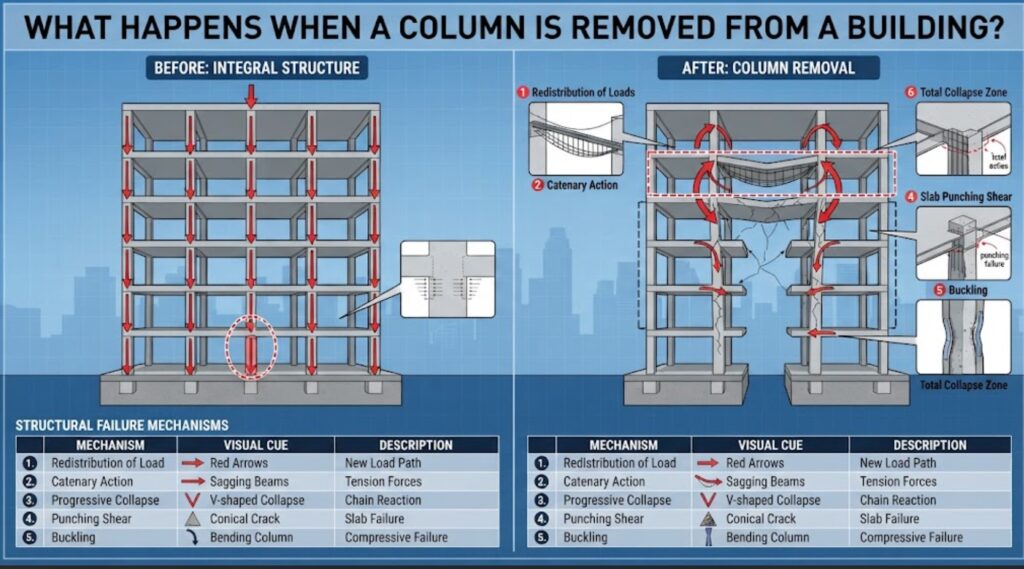
A building depends on a continuous network of structural elements to transfer loads safely to the ground. Columns form an important part of this system because they carry loads from floors, beams, walls, and other structural elements down to the foundations.
When a column is removed, the load carried by that column does not simply disappear. The surrounding structure must find another way to transfer those forces. Beams, slabs, columns, walls, and connections must therefore redistribute the load through alternative structural paths.
The ability of a building to accommodate this sudden change depends on its strength, continuity, stiffness, ductility, and redundancy. If sufficient alternative load paths exist, the damage may remain localised. If they do not, the initial column loss can trigger additional failures and potentially develop into progressive collapse.
The Normal Load Path
Under normal conditions, gravity loads follow a relatively predictable path through a building. Loads from occupants, finishes, partitions, equipment, and the structure itself are transferred through the floor system into beams, columns, walls, and eventually the foundations.
The exact arrangement depends on the structural system. In a conventional reinforced concrete frame, slabs transfer loads to beams, while beams transfer their reactions to columns. The columns then carry these forces through the lower floors and into the foundation.
This creates a continuous vertical load path.
Removing a column interrupts that path. The structure must then redistribute the forces through the surrounding members. This is where the concept of an alternate load path becomes important.
An alternate load path is simply another route through which the building can transfer loads after the original route becomes unavailable.
What Happens Immediately After Column Removal?
The structural response depends on the position of the removed column and the arrangement of the surrounding members.
Consider a beam supported by three columns, with one column located near its centre. Under normal conditions, the middle column provides an intermediate support. If that column is removed, the beam must bridge across the newly unsupported region.
Its effective span increases, resulting in higher bending moments and greater deflection. The reactions at the remaining columns also increase because they must now carry loads that were previously transferred through the removed column.
The surrounding slab may also participate in the redistribution.
The important point is that the load does not remain at the location of the removed column. It moves through the structural system.
This means that members which were satisfactory under normal loading can suddenly experience significantly higher forces.
Load Redistribution Through the Building
The effects of column removal can extend beyond the floor where the damage occurs.
Suppose an upper-floor column is removed. The beams and slab above the missing column redistribute the load to adjacent columns. Those columns then transfer their increased forces to the floors below.
The additional loads can therefore propagate down through the structure.
The redistribution will not necessarily be equal between neighbouring members. Stiffer elements generally attract more load, while the geometry and connectivity of the structure also influence the final distribution.
This is why progressive collapse assessment requires consideration of the structural system as a whole.
A column cannot be assessed in isolation when another column has already been removed.
The Role of Beams and Slabs
The beam directly above the removed column is often one of the most critical members in the initial response.
It may first resist the redistributed load through conventional bending. If the resulting forces remain within its capacity, the beam can bridge the damaged area and transfer the load to neighbouring supports.
The floor slab can also contribute to this process.
In reinforced concrete structures, the slab can distribute forces across adjacent areas and provide additional resistance around the damaged region. As deformation increases, membrane action can develop, allowing the slab to carry loads through in-plane forces.
However, this additional resistance depends on reinforcement continuity, anchorage, connections, and the ability of the structure to undergo significant deformation without sudden failure.
The engineer should therefore not assume that slab participation will automatically provide sufficient protection.
Catenary Action
One of the important mechanisms that can develop after column removal is catenary action.
A beam initially responds mainly through bending. As its deflection becomes large, it can develop significant tensile forces along its length. The beam begins to behave more like a tension member, allowing it to carry additional load across the missing support.
Catenary action can provide an important alternate load path, particularly when conventional flexural capacity has become insufficient.
However, it requires substantial deformation capacity. The surrounding columns and connections must also be capable of resisting the forces generated by this mechanism.
This is why ductility and connection detailing are important considerations in progressive collapse resistance.
From Local Failure to Progressive Collapse
The main concern with column removal is not necessarily the failure of the column itself. The greater concern is what happens after that initial failure.
Imagine that the removal of a column causes the beam above it to become overloaded. If the beam subsequently fails, its load must be redistributed again.
The surrounding members then experience another increase in demand.
If another member fails, the process can continue.
This creates a cascading sequence in which local damage develops into a much larger structural failure. This phenomenon is generally referred to as progressive collapse or disproportionate collapse.
The defining feature is the relationship between the initial damage and the resulting extent of failure.
A relatively local failure can become much more serious if the building lacks sufficient alternate load paths.
Why Column Location Matters
The consequences of removing a column depend strongly on its location.
An internal column, edge column, and corner column provide different structural arrangements and therefore produce different redistribution mechanisms when removed.
An internal column may support several surrounding bays, allowing loads to redistribute in multiple directions. However, its removal can also affect a relatively large area of floor.
A corner column has fewer surrounding members available to participate in redistribution, which can make the local response more critical.
The building’s geometry, span arrangement, floor system, and structural connections therefore influence the consequences of column loss.
For this reason, a progressive collapse assessment should consider the locations that could produce the most critical structural response.
Structural Robustness
Column removal demonstrates why structural safety depends on more than the strength of individual members.
A building with adequate redundancy can redistribute forces when one member becomes unavailable. Continuity allows forces to move between connected elements, while ductility allows members to undergo deformation without sudden failure.
Connections are equally important.
A beam may have sufficient strength to bridge a missing column, but its connection may fail before the beam can develop that capacity. Similarly, reinforcement must have sufficient continuity and anchorage to transfer the forces generated by redistribution.
Structural robustness is therefore a system property.
It comes from the combined effect of strength, continuity, redundancy, ductility, and reliable connections.
How Engineers Assess Column Removal
Engineers can study the effects of column removal by introducing a column-loss scenario into a structural model and examining how the remaining structure responds.
The analysis can reveal increases in bending moments, shear forces, axial forces, and deflections in the surrounding members.
For relatively simple assessments, linear analysis can provide useful information about the initial redistribution of forces. More complex structures may require nonlinear analysis to capture yielding, large deformation, catenary action, and other post-elastic mechanisms.
Dynamic effects may also be important where column loss occurs suddenly.
The objective of the assessment is not simply to determine whether the removed column was important. It is to establish whether the remaining structure can develop a reliable alternate load path without suffering disproportionate damage.
Designing for Column Loss
Engineers do not normally design a building to remain completely undamaged after every conceivable accidental event. Instead, the objective is to prevent local damage from developing into widespread collapse.
This requires consideration of the overall structural arrangement.
Continuous beams and slabs can provide alternative routes for load redistribution. Adequate reinforcement continuity allows members to develop their available resistance. Ductile connections can accommodate deformation, while a sufficiently redundant structural layout reduces dependence on individual critical members.
These principles are particularly important in buildings where the consequences of progressive collapse could be severe.
Eurocode 1 addresses accidental actions and provides provisions relevant to robustness and disproportionate collapse. Other standards, including the GSA and UFC guidelines, provide more detailed approaches for alternate-path assessments.
Conclusion
Removing a column changes the load path through an entire part of a building. The loads previously carried by the removed column must be transferred through surrounding beams, slabs, columns, walls, and connections.
The initial response usually involves increased forces and deformation in the surrounding structural members. As deformation increases, additional mechanisms such as membrane action and catenary action may contribute to the building’s resistance.
The critical question is whether these alternative mechanisms can develop before other members reach their capacity. If the remaining structure can redistribute the loads successfully, column loss may remain a localised event. If the redistribution causes successive failures, the damage can develop into progressive collapse.
Also See
- What Happens When a Column Fails in a Building?
- Designing for the Unexpected: Why Robustness Is More Than a Code Requirement
- Load Path Derivation in Irregular Structures
Sources & Citations
- EN 1991-1-7, Eurocode 1: Actions on Structures – Part 1-7: Accidental Actions.
- EN 1992-1-1, Eurocode 2: Design of Concrete Structures – Part 1-1: General Rules and Rules for Buildings.
- General Services Administration, Alternate Path Analysis and Design Guidelines for Progressive Collapse Resistance.
- UFC 4-023-03, Design of Buildings to Resist Progressive Collapse.
- Starossek, U. (2009). Progressive Collapse of Structures. Thomas Telford.
- Izzuddin, B. A., Vlassis, A. G., Elghazouli, A. Y., & Nethercot, D. A. (2008). Progressive Collapse of Multi-Storey Buildings due to Sudden Column Loss. Engineering Structures.
