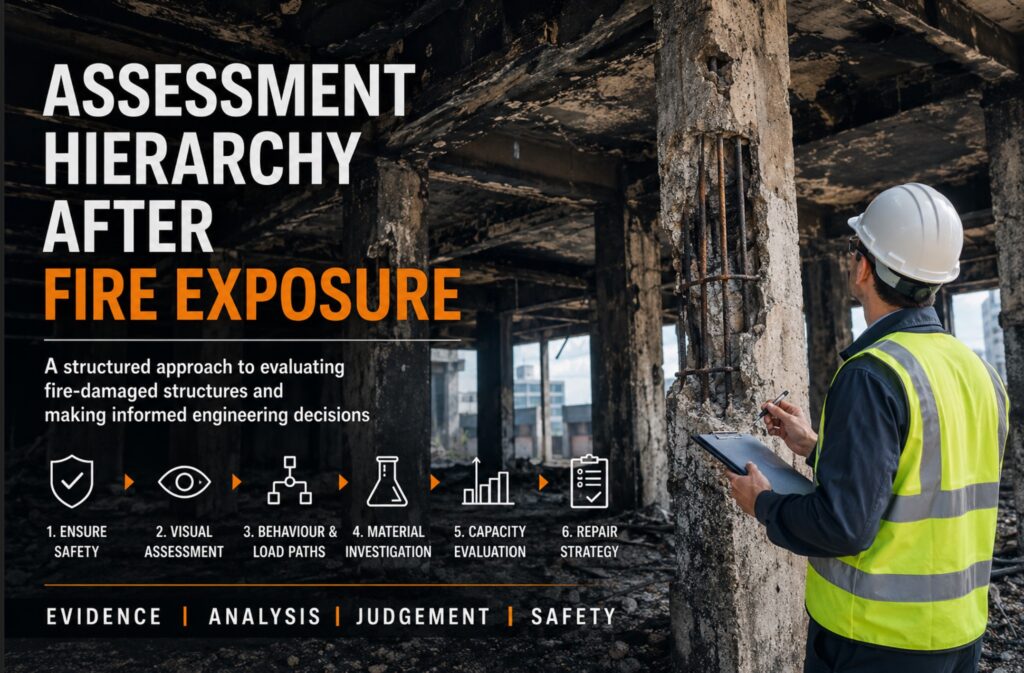
Assessment of fire-exposed structures is not a single investigation but a progressive process through which uncertainty is systematically reduced. Each stage builds upon the information obtained during the previous stage, creating a logical hierarchy that guides engineers from initial safety concerns to final repair decisions
Fire is one of the most destructive actions a structure can experience because it simultaneously affects materials, geometry, load paths, and structural behaviour. Unlike many other forms of structural deterioration that develop gradually over years, fire can alter the performance of a structural system within a matter of minutes. The effects are often complex and difficult to interpret because the visible damage observed after a fire rarely reflects the true extent of structural degradation. A concrete beam may appear relatively intact despite significant loss of material strength, while a steel member may show little visual damage yet have undergone substantial changes in its mechanical properties due to elevated temperatures. This disconnects between appearance and actual performance makes post-fire structural assessment one of the most demanding tasks in engineering practice.
The challenge is further complicated by the fact that fire rarely affects a structure uniformly. Temperature distribution within a building depends on numerous factors, including fuel load, ventilation conditions, compartment geometry, fire duration, and firefighting activities. As a result, adjacent structural elements can experience significantly different thermal histories during the same fire event. Some members may reach temperatures capable of causing severe degradation, while others remain largely unaffected. Consequently, engineers cannot rely on broad assumptions regarding the condition of a fire-damaged structure. Every assessment must be based on a systematic investigation that progressively reduces uncertainty and establishes the actual residual capacity of the structural system.
This necessity gives rise to what may be described as an assessment hierarchy. Rather than treating fire assessment as a single inspection exercise, engineers should approach it as a structured sequence of investigations in which each stage provides information that supports the next. Such an approach ensures that conclusions are based on evidence rather than assumptions and that repair, strengthening, or demolition decisions are made with a clear understanding of the structure’s residual performance. The hierarchy presented in this article reflects the logical progression that should guide structural engineers when evaluating fire-exposed buildings and other infrastructure.
Understanding the Nature of Fire Damage
Before discussing the hierarchy itself, it is important to appreciate why fire damage assessment requires a fundamentally different approach from many other forms of structural evaluation. Structural deterioration resulting from corrosion, fatigue, or settlement generally follows identifiable patterns that develop over time. Engineers can often establish the cause of damage and estimate future behaviour with a reasonable degree of confidence. Fire behaves differently. It introduces rapid and often extreme temperature changes that trigger a series of physical and chemical transformations within structural materials.
In reinforced concrete structures, elevated temperatures can cause dehydration of cement hydrates, thermal cracking, loss of bond between reinforcement and surrounding concrete, and explosive spalling. These mechanisms do not occur independently. They interact with one another and often produce damage that extends beyond what is visible at the surface. A member that appears only lightly affected may contain extensive internal cracking that significantly reduces stiffness and strength.
Steel structures present a different challenge. Steel does not burn, but its mechanical properties deteriorate rapidly as temperature increases. Yield strength and elastic modulus reduce significantly at elevated temperatures, and prolonged exposure can lead to permanent deformation. Even after cooling, residual stresses and microstructural changes may remain. Consequently, a steel member that survives a fire without collapse may still possess substantially reduced structural capacity.
Timber structures behave differently again. Charring provides a degree of protection by insulating the underlying material, yet prolonged fire exposure progressively reduces the effective cross-section available to resist loads. The visible char layer may therefore represent only part of the story, particularly where heat penetration has affected the strength of the timber beneath.
These material-specific responses highlight an important reality: fire damage assessment is not simply about identifying what has been damaged. It is about understanding how the fire altered the structural behaviour of the entire system.
Establishing Immediate Structural Safety
The first stage of any post-fire assessment concerns safety rather than diagnosis. Before engineers attempt to understand the extent of damage, they must ensure that the structure can be approached and investigated without creating additional risks.
This requirement may seem obvious, yet many post-fire failures occur during or shortly after the firefighting phase rather than during the fire itself. Structural elements weakened by heat may continue to support loads temporarily, only to fail when disturbed by debris removal, inspection activities, or changes in support conditions. The apparent survival of a structure immediately after a fire should therefore never be interpreted as evidence of safety.
Engineers must initially assume that critical load-bearing elements have suffered degradation until investigations demonstrate otherwise. Areas showing significant deformation, extensive cracking, exposed reinforcement, or partial collapse require particular attention. Temporary support systems may be necessary to stabilise vulnerable portions of the structure before further assessment can proceed.
At this stage, the objective is not to determine whether the building can be repaired. The objective is simply to establish a safe environment in which a meaningful assessment can take place. Any conclusions regarding structural adequacy would be premature because insufficient information is available to support them.
Visual Assessment as a Tool for Understanding Fire Behaviour
Once immediate safety concerns have been addressed, attention shifts towards understanding how the fire affected the structure. Visual assessment represents the first opportunity to develop this understanding, but its value extends far beyond the identification of obvious damage.
A common misconception is that visual inspection serves primarily to identify failed elements. In reality, its greatest value lies in helping engineers reconstruct the thermal history of the fire. Patterns of damage often reveal how temperatures developed throughout the structure and how different structural components responded during the event.
For example, severe concrete spalling may indicate rapid heating and moisture-related pressure build-up within concrete elements. Extensive steel deformation may suggest prolonged exposure to elevated temperatures, while localised damage may point towards concentrated fuel loads or ventilation effects. Changes in concrete colour can provide clues regarding peak temperatures reached in different areas of the structure, while soot distribution may help identify fire spread patterns.
Through careful observation, engineers begin to establish zones of varying damage severity. These zones are not merely administrative classifications. They provide the framework for all subsequent investigations. Areas that experienced the highest thermal exposure will require more detailed examination and testing, while areas that appear less affected may require only limited verification.
The importance of this stage lies in its ability to guide resources effectively. Fire-damaged structures often cover large areas, and comprehensive testing of every element is rarely practical. Visual assessment helps identify where detailed investigations will provide the greatest value.
Evaluating Structural Behaviour and Load Redistribution
As understanding of the fire’s impact improves, the assessment must move beyond individual elements and consider the behaviour of the structure as a whole. This stage is often overlooked, yet it frequently determines whether a building can be successfully repaired.
Structural systems derive their performance not only from the strength of individual members but also from the way loads are distributed throughout the structure. During a fire, this distribution often changes dramatically. As temperatures rise, some members lose stiffness and strength more rapidly than others, forcing loads to redistribute through alternative paths.
In many cases, a structure survives precisely because such redistribution occurs. Reinforced concrete slabs may develop membrane action, steel beams may exhibit catenary behaviour, and frame systems may mobilise redundancy that was not explicitly considered during design. These mechanisms can prevent collapse during the fire, but they may also mask significant underlying damage.
Consequently, engineers must determine whether the structure remains capable of carrying loads through stable and reliable load paths. A building that survived the fire may still be vulnerable if its ability to redistribute loads has been compromised. Understanding these behavioural changes requires a combination of engineering judgement, structural analysis, and knowledge of how fire influences structural response.
This stage effectively bridges the gap between visual observations and detailed material investigations. It transforms damage patterns into an understanding of structural performance.
Determining Residual Material Properties
The next stage involves establishing the residual properties of the materials themselves. This represents one of the most technically demanding aspects of post-fire assessment because material degradation often extends beyond visible damage.
For reinforced concrete, laboratory testing frequently becomes necessary to determine the extent of strength loss. Core samples may reveal reductions in compressive strength that are not apparent from surface observations alone. Engineers must also consider the condition of embedded reinforcement and, perhaps more importantly, the bond between reinforcement and concrete. Even where individual materials retain substantial capacity, deterioration of the bond interface can significantly reduce structural performance.
Steel structures require a different approach. Although visible distortion provides valuable information, it does not always correlate directly with residual strength. Engineers often need to combine visual observations with material testing and dimensional surveys to determine whether elevated temperatures have produced unacceptable reductions in capacity.
The assessment of timber structures similarly requires careful consideration of both visible and hidden damage. Charring can be measured relatively easily, but heat penetration beyond the char layer may also influence structural performance. Determining the effective residual section therefore requires a deeper understanding of timber behaviour under fire conditions.
The purpose of this stage is not simply to obtain test results. Rather, it is to establish realistic material properties that can be used in evaluating the future performance of the structure. Without this information, subsequent analysis would be based largely on assumptions.
Reassessing Structural Capacity
Once residual material properties have been established, engineers can begin the process of reassessing structural capacity. This stage effectively answers the question that owners, insurers, and stakeholders are most interested in: can the structure continue to perform its intended function safely?
The answer is rarely straightforward. Fire-damaged structures do not behave like newly designed systems, and traditional analysis methods may not fully capture the complexities introduced by thermal degradation. Engineers must therefore exercise considerable judgement when interpreting analytical results.
Structural analysis should incorporate the reduced material properties established through testing and should account for any loss of section, deformation, or connection damage identified during earlier investigations. The objective is not merely to determine whether individual members satisfy code requirements but to evaluate whether the structural system as a whole possesses sufficient reliability for continued use.
This stage often reveals that different portions of the structure require different responses. Some elements may retain adequate capacity with little or no intervention, while others may require strengthening or replacement. The resulting assessment provides the technical basis for all subsequent decisions.
Developing a Repair Strategy
Repair decisions should emerge naturally from the findings of the assessment rather than from predetermined objectives. The engineer’s responsibility is to identify solutions that restore safety and functionality while remaining technically and economically justified.
In some cases, localised repairs may be sufficient. Damaged concrete may be removed and reinstated, protective coatings may be replaced, and isolated structural deficiencies may be corrected through strengthening measures. In other situations, more substantial interventions become necessary.
The challenge lies in recognising that repair design for fire-damaged structures differs fundamentally from design for new construction. Existing materials may exhibit variable properties, and residual uncertainties often remain even after extensive investigation. Consequently, repair strategies must be developed with an appreciation of these uncertainties and should avoid relying excessively on assumptions regarding existing conditions.
The most successful repair schemes are those that acknowledge the limitations of available information while providing robust and reliable structural performance.
Conclusion
Assessment of fire-exposed structures is not a single investigation but a progressive process through which uncertainty is systematically reduced. Each stage builds upon the information obtained during the previous stage, creating a logical hierarchy that guides engineers from initial safety concerns to final repair decisions.
The effectiveness of this hierarchy lies in its ability to prevent premature conclusions. Visual observations alone cannot reveal the true condition of a fire-damaged structure, just as material testing alone cannot explain how the structure behaved during the fire. Meaningful assessment emerges only when observations, testing, structural behaviour, and engineering judgement are integrated into a coherent evaluation process.
Ultimately, the purpose of post-fire assessment is not merely to identify damage. It is to establish confidence in future performance. By following a structured hierarchy of investigation, engineers can ensure that decisions regarding repair, strengthening, or replacement are supported by evidence and guided by sound engineering principles.
Also See: Fire Safety in Modern Timber Buildings
Sources & Citations
- Institution of Structural Engineers (2023). Manual for the Structural Assessment of Existing Buildings. London: IStructE.
- Institution of Structural Engineers (2021). Guide to Structural Fire Engineering. London: IStructE.
- ISO (2012). ISO 834-1: Fire Resistance Tests – Elements of Building Construction. International Organization for Standardization, Geneva.
- Society of Fire Protection Engineers (SFPE) (2016). SFPE Handbook of Fire Protection Engineering. 5th Edition. Springer, New York.
- CROSS-UK (2023). Fire Damage and Structural Assessment Reports. Collaborative Reporting for Safer Structures UK.
