The difference between structural and non-structural cracks lies not in appearance but in engineering behavior. Structural cracks indicate stress conditions that exceed safe limits, while non-structural cracks reflect normal material responses to environmental and time-dependent effects.
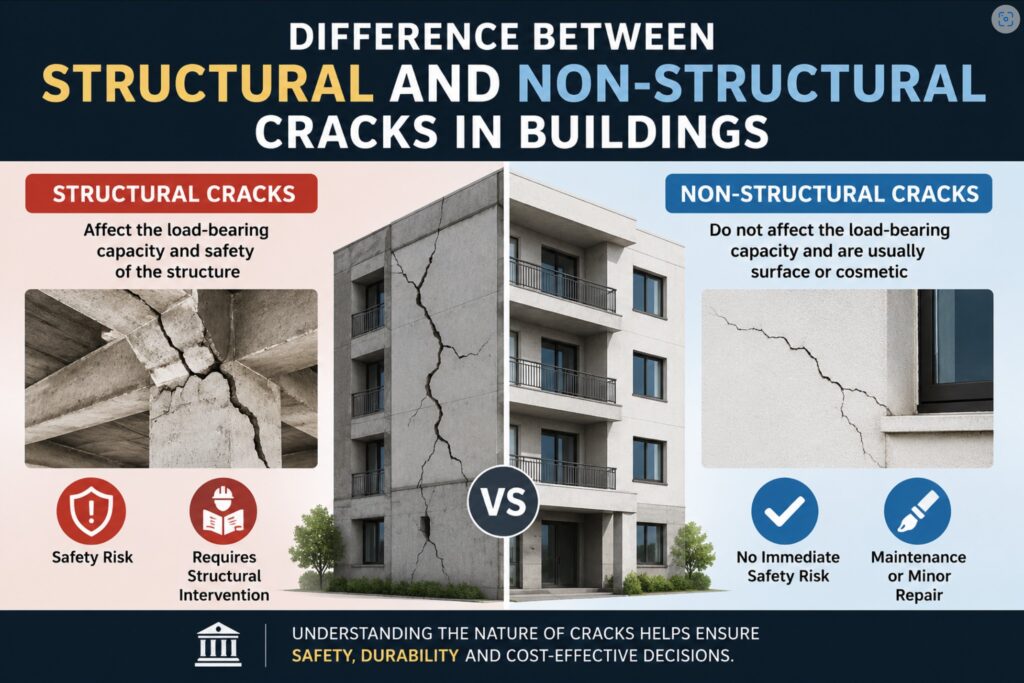
Cracks in buildings often trigger concern long before any technical assessment begins. A homeowner sees a diagonal line on a wall, a contractor notices a fracture near a beam, or a facility manager observes hairline cracking on a slab, and the immediate assumption is usually structural failure. In reality, not all cracks indicate danger. Some cracks develop from normal material behavior, while others signal genuine structural distress. The ability to distinguish between these two categories defines sound engineering judgment.
In reinforced concrete and masonry structures, cracking is inevitable due to material properties, environmental exposure, and load effects. Concrete has high compressive strength but very low tensile capacity, meaning it will crack once tensile stresses exceed its limit. Similarly, masonry responds poorly to movement and restraint. These behaviors do not necessarily indicate failure; instead, they reflect how materials naturally respond under real-world conditions such as shrinkage, temperature variation, and long-term loading.
For engineers, the critical task is not to eliminate cracks entirely but to understand their origin and control their implications. Codes of practice such as Eurocode 2 do not aim for crack-free structures but for acceptable crack widths that do not compromise safety or durability. This makes crack classification an essential skill in structural engineering, particularly when deciding whether a defect is purely cosmetic or structurally significant.
What Are Structural Cracks?
Structural cracks are those that directly affect the load-carrying capacity, stability, or safety of a building element. These cracks develop when internal stresses exceed the resistance of concrete, reinforcement, or masonry in a way that compromises structural performance. They are not superficial defects but indicators that the structure is responding beyond its intended design limits.
In reinforced concrete members, structural cracks commonly appear due to bending, shear, axial overload, or foundation movement. A deep diagonal crack in a beam may indicate shear distress, while wide vertical cracks in a column may suggest axial overstress or instability. These cracks usually follow predictable stress paths and tend to widen under increased loading or continued movement.
Structural cracks are critical because they reflect a reduction in structural integrity. If left unaddressed, they may propagate and lead to progressive damage or even failure. Engineers therefore treat them as priority defects, requiring immediate investigation, load evaluation, and sometimes strengthening measures such as jacketing, external reinforcement, or structural redesign.
What Are Non-Structural Cracks?
Non-structural cracks are cracks that do not affect the load-bearing capacity of a structure. Instead, they occur due to surface effects, restrained deformation, or environmental influences such as shrinkage and temperature variation. While they may appear concerning, they do not compromise structural safety.
These cracks are commonly found in plaster finishes, wall surfaces, slabs, and architectural elements. They often result from drying shrinkage, thermal expansion and contraction, or differential movement between different materials. For example, a fine crack in plaster may be caused by moisture loss during curing rather than any issue within the structural concrete beneath it.
Non-structural cracks are generally stable and do not significantly grow under service loads. They are typically random or occur at weak points such as joints, corners, or material interfaces rather than following structural stress paths. Although they are not structurally dangerous, they can affect aesthetics and durability if they allow moisture ingress or long-term deterioration.
Key Differences Between Structural and Non-Structural Cracks
The distinction between structural and non-structural cracks lies primarily in their cause, behavior, and consequences. Structural cracks are load-related and arise when structural capacity is exceeded or redistributed in an unsafe manner. Non-structural cracks arise from material movement, shrinkage, or environmental effects without compromising load resistance.
Their patterns also differ significantly. Structural cracks align with stress distribution within the member. They appear in tension zones of beams, shear paths in supports, or stress concentration areas in columns and slabs. Non-structural cracks, on the other hand, tend to appear randomly or along weak interfaces such as finishes and joints.
Crack progression provides another important indicator. Structural cracks often widen with time or increased loading, signaling active structural behavior. Non-structural cracks are usually stable after initial formation, particularly once shrinkage or thermal movement has stabilized.
Causes of Structural Cracks in Buildings
Structural cracks develop when applied loads or movements exceed the capacity of structural members. Overloading is one of the most direct causes, often occurring when buildings are subjected to higher-than-designed loads due to change of use or construction errors.
Foundation settlement is another major cause. When different parts of a structure settle unevenly, additional stresses are introduced into beams, slabs, and walls, leading to cracking. These cracks often appear diagonally or originate from support points where stress concentration is highest.
Poor detailing and construction errors also contribute significantly. Insufficient reinforcement, incorrect bar placement, inadequate anchorage, or low concrete strength can all reduce structural capacity and create weak zones where cracks form under normal service conditions.
Causes of Non-Structural Cracks in Buildings
Non-structural cracks are primarily driven by material behavior rather than structural failure. Shrinkage is one of the most common causes, especially in concrete and plaster. As moisture evaporates, the material contracts, and restrained movement leads to surface cracking.
Thermal effects also play a major role. Daily and seasonal temperature variations cause expansion and contraction in building materials. When this movement is restrained, cracks develop at vulnerable locations such as edges, corners, and joints.
Differential movement between different materials further contributes to non-structural cracking. Concrete, masonry, plaster, and finishes all respond differently to environmental changes, and this mismatch creates stress concentrations at interfaces over time.
Why Proper Crack Classification Matters
Correct classification of cracks is essential for safe and efficient engineering decisions. Misinterpreting non-structural cracks as structural defects can lead to unnecessary repairs and cost, while ignoring structural cracks can compromise safety and durability.
Engineers use crack classification to determine the appropriate response. Structural cracks require detailed assessment, possible load reduction, and structural strengthening. Non-structural cracks typically require maintenance solutions such as sealing, patching, or improved detailing to prevent recurrence.
This classification also improves long-term durability planning. Understanding the cause of cracking helps engineers refine design assumptions, improve detailing practices, and reduce future maintenance issues.
Conclusion
The difference between structural and non-structural cracks lies not in appearance but in engineering behavior. Structural cracks indicate stress conditions that exceed safe limits, while non-structural cracks reflect normal material responses to environmental and time-dependent effects.
A well-performing structure may contain both types of cracks without compromising safety. The responsibility of the engineer is to interpret these cracks correctly and respond based on mechanics rather than visual impression. Ultimately, crack classification is a fundamental part of structural engineering judgment. It ensures that buildings remain safe, durable, and economically maintained throughout their service life.
Also See: Diagnosing Structural Cracks: Pattern Recognition and Interpretation
Sources & Citations
- EN 1992-1-1: Eurocode 2 – Design of Concrete Structures, Part 1-1: General Rules and Rules for Buildings, CEN.
- Neville, A. M. (2011). Properties of Concrete, 5th Edition, Pearson.
- Mehta, P. K., & Monteiro, P. J. M. (2014). Concrete: Microstructure, Properties, and Materials, McGraw-Hill Education.
- fib (2010). fib Model Code for Concrete Structures 2010, Fédération Internationale du Béton.
- Carson, D. A. (2018). Cracking in Reinforced Concrete Structures: Causes, Evaluation and Repair, ICE Publishing.
