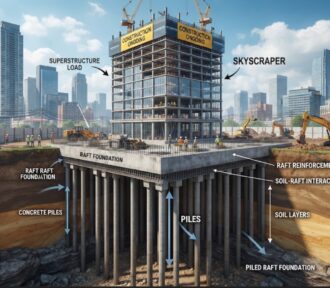
A piled raft foundation becomes particularly valuable when a conventional raft can no longer provide the required settlement performance efficiently, but a conventional piled foundation would involve more piles than necessary.
Structures from first principles!
A piled raft foundation becomes particularly valuable when a conventional raft can no longer provide the required settlement performance efficiently, but a conventional piled foundation would involve more piles than necessary.
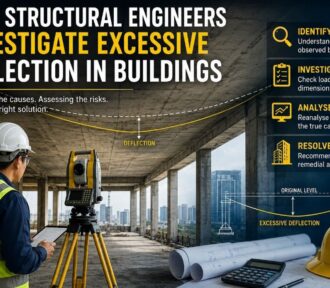
Excessive deflection requires more than a simple comparison between measured movement and a code limit.
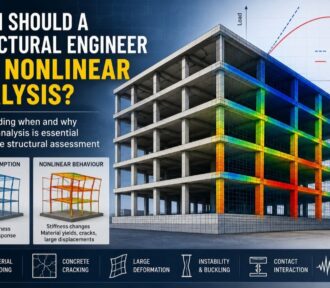
Nonlinear analysis becomes valuable when structural behaviour departs significantly from the assumptions of linear elastic analysis.
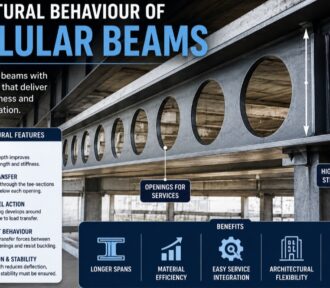
Cellular beams provide an efficient solution for long-span structures by combining increased structural depth with reduced steel weight and regular openings for building services.
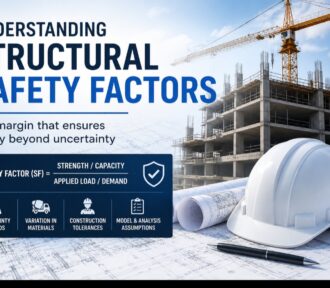
Structural safety factors form the foundation of safe structural design by accounting for the uncertainties that exist in loads, material properties, construction quality, and structural analysis.
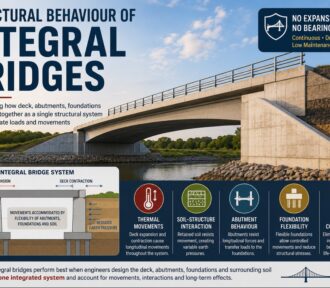
Designing an integral bridge requires engineers to consider the interaction of multiple structural and geotechnical factors rather than designing each component independently.
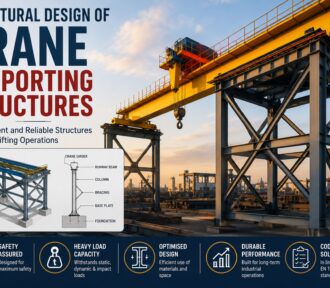
Crane supporting structures are among the most demanding structural systems encountered in industrial engineering because they must safely resist complex combinations of static, dynamic, horizontal, and cyclic loads throughout their operational life.
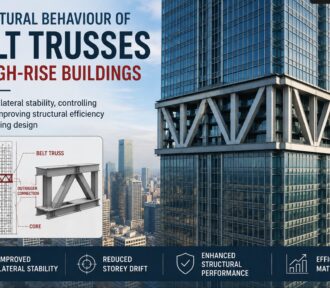
Belt trusses have become one of the defining structural systems in modern high-rise engineering because they significantly enhance the lateral behaviour of tall buildings without requiring excessive increases in member sizes.
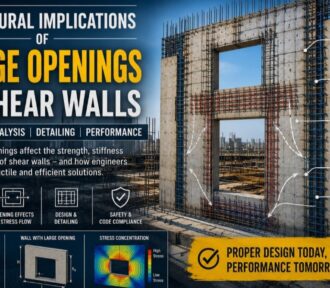
Large openings in shear walls present one of the most challenging design situations in reinforced concrete structures because they interrupt the natural flow of forces and alter the wall’s stiffness, strength, and deformation characteristics.
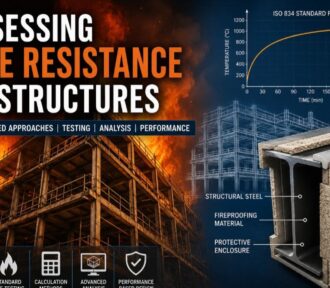
Fire is one of the most severe accidental actions that a structure may experience during its service life. Unlike conventional design loads such as dead,…