Serviceability limit states refer to conditions beyond which specified service requirements for a structure are no longer met. These requirements may relate to usability, comfort, appearance, or long-term durability.
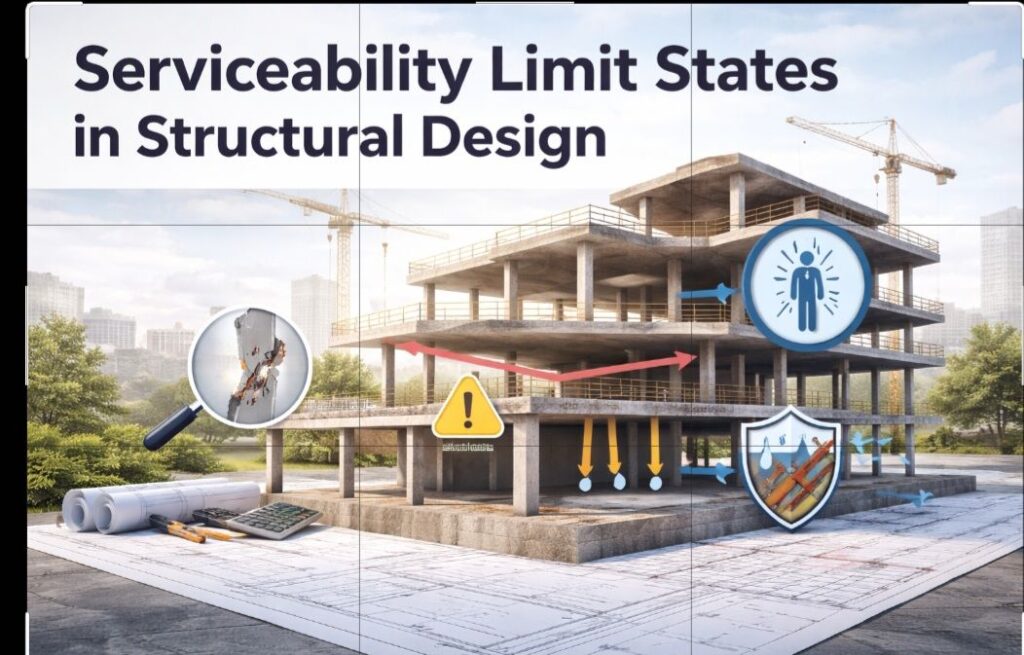
Structural design is often perceived as a process governed primarily by strength. Engineers calculate loads, determine internal forces, and ensure that structural members possess sufficient capacity to resist failure. While this ultimate limit state approach is fundamental, it does not by itself guarantee that a structure will perform satisfactorily in service.
A building may be strong enough to avoid collapse yet still be unfit for use. Excessive deflection, visible cracking, uncomfortable vibrations, or durability issues can render a structure unacceptable long before it reaches its ultimate capacity. These considerations fall under what is known as the serviceability limit state (SLS), a critical but sometimes underappreciated aspect of structural engineering.
Serviceability is concerned not with survival, but with performance. It ensures that structures remain functional, comfortable, and durable throughout their intended lifespan. In modern design practice, achieving a balance between ultimate strength and serviceability performance is essential.
The Concept of Serviceability
Serviceability limit states refer to conditions beyond which specified service requirements for a structure are no longer met. These requirements may relate to usability, comfort, appearance, or long-term durability. Unlike ultimate limit states, which are associated with collapse or failure, serviceability issues often develop gradually and may not pose an immediate safety risk. However, their impact on the usability and perception of a structure can be significant.
The distinction between ultimate and serviceability behaviour is important. Ultimate limit states are typically governed by extreme loading conditions and material strength, whereas serviceability limit states are governed by normal usage conditions and structural stiffness. This means that a structure designed solely for strength may still perform poorly under everyday loads if serviceability is not adequately addressed.
Deflection and Its Implications
One of the most common serviceability concerns in structural design is deflection. When structural members such as beams or slabs are subjected to loads, they deform. While some level of deflection is inevitable and acceptable, excessive deflection can lead to functional and aesthetic problems.
In floor systems, excessive deflection can cause cracking of finishes, misalignment of partitions, and discomfort for occupants. In long-span beams, visible sagging can create a perception of weakness, even if the structure is safe. Deflection is therefore not only a technical issue but also a psychological one, influencing how users perceive the structure.
Deflection behaviour is influenced by several factors, including span length, stiffness, loading conditions, and time-dependent effects such as creep. In reinforced concrete structures, long-term deflection can be significantly greater than initial elastic deflection due to sustained loading.
Cracking in Reinforced Concrete
Cracking is an inherent characteristic of reinforced concrete structures. Due to the low tensile strength of concrete, cracks form when tensile stresses exceed the material capacity. While cracking does not necessarily indicate failure, uncontrolled cracking can compromise both durability and appearance.
From a serviceability perspective, crack width is more important than the mere presence of cracks. Wide cracks can allow the ingress of moisture and aggressive agents, leading to corrosion of reinforcement and long-term deterioration. In exposed structures, visible cracks can also affect aesthetics and user confidence.
Controlling crack width involves careful consideration of reinforcement detailing, bar spacing, cover, and stress levels. The objective is not to eliminate cracking, but to ensure that it remains within acceptable limits.
Vibration and Human Comfort
In certain structures, particularly floors in offices, residential buildings, and pedestrian bridges, vibration can become a governing serviceability criterion. Even when structural strength is adequate, excessive vibration can cause discomfort to occupants.
Human sensitivity to vibration varies depending on frequency, amplitude, and duration. Structures with low natural frequencies are particularly susceptible to resonance, where dynamic loads such as walking or machinery can induce noticeable oscillations.
Designing for vibration control requires an understanding of structural dynamics. Increasing stiffness, altering mass distribution, or introducing damping mechanisms can help mitigate vibration issues. Unlike strength design, which is often governed by static analysis, vibration control requires consideration of dynamic behaviour.
Durability and Long-Term Performance
Serviceability is closely linked to durability. A structure that deteriorates prematurely due to environmental exposure or material degradation cannot be considered serviceable, even if it remains structurally stable.
Factors such as corrosion of reinforcement, chemical attack, freeze-thaw cycles, and carbonation can all affect long-term performance. These processes are often influenced by serviceability-related parameters such as crack width and concrete cover.
Ensuring durability requires a holistic approach that integrates material selection, detailing, and environmental considerations. Serviceability design therefore plays a key role in extending the lifespan of structures.
Time-Dependent Effects
Unlike ultimate limit states, which are typically concerned with peak loading conditions, serviceability must account for time-dependent behaviour. In materials such as concrete, creep and shrinkage can lead to gradual increases in deformation over time.
Creep causes additional deflection under sustained loads, while shrinkage induces internal stresses that can lead to cracking. These effects are influenced by factors such as humidity, temperature, and material properties.
Accurate prediction of long-term behaviour is challenging, but essential for ensuring that structures remain serviceable throughout their design life. Engineers must consider not only the immediate response of the structure, but also how it will evolve over time.
Code-Based Serviceability Criteria
Design codes provide guidance on acceptable serviceability limits, including maximum deflection, allowable crack widths, and vibration criteria. These limits are often based on empirical observations and practical experience rather than purely theoretical considerations.
For example, deflection limits are typically expressed as a fraction of the span length, while crack width limits depend on exposure conditions. These criteria provide a practical framework for ensuring acceptable performance without requiring excessive complexity in analysis.
However, code provisions should not be applied blindly. Engineers must interpret them in the context of the specific structure, considering factors such as usage, sensitivity, and environmental conditions.
Interaction Between Strength and Serviceability
Although ultimate and serviceability limit states are conceptually distinct, they are closely related in practice. Measures taken to improve serviceability, such as increasing stiffness or reinforcement, can also enhance strength. Conversely, designs optimized solely for strength may lead to poor serviceability performance.
Achieving an efficient design requires balancing these two aspects. Overly conservative serviceability design can lead to uneconomical structures, while neglecting serviceability can result in user dissatisfaction and long-term issues.
The challenge for engineers is to achieve a design that is both safe and functional, meeting all performance requirements without unnecessary material use.
Conclusion
Serviceability limit states play a fundamental role in ensuring that structures are not only safe, but also functional, comfortable, and durable. While ultimate limit states protect against collapse, serviceability ensures that structures perform as intended throughout their lifespan.
Deflection, cracking, vibration, and durability are all interconnected aspects of structural behaviour that must be carefully managed. These factors are influenced by material properties, geometry, loading conditions, and time-dependent effects.
Also See: Differ3ntial Temperature Effects in Long Soan Bridges
Sources & Citations
- EN 1992-1-1. Eurocode 2: Design of Concrete Structures.
- ASCE/SEI 7-16. Minimum Design Loads for Buildings and Other Structures.
- ACI 318-19. Building Code Requirements for Structural Concrete.
- Neville, A.M. Properties of Concrete. Pearson Education.
