Belt trusses have become one of the defining structural systems in modern high-rise engineering because they significantly enhance the lateral behaviour of tall buildings without requiring excessive increases in member sizes.
As building height increases, lateral loads arising from wind and earthquakes become increasingly dominant, often governing the design more than gravity loads. Thus, controlling lateral displacement, limiting inter-storey drift, and ensuring occupant comfort are therefore fundamental objectives in the structural design of tall buildings. Conventional moment-resisting frames may become uneconomical or insufficiently stiff for very tall structures. Therefore it necessitates the adoption of more efficient lateral load-resisting systems.
Among the various structural systems developed for tall buildings, belt trusses have emerged as an effective means of enhancing lateral stiffness and improving the overall structural behaviour of the building. Belt trusses are commonly used together with outrigger systems to improve the interaction between the building core and perimeter columns. By mobilizing the exterior columns to participate in resisting overturning moments, belt trusses significantly increase the efficiency of the structural system without substantially increasing the size of the primary structural members.
Although belt trusses are frequently associated with outrigger systems, they also provide independent structural benefits by redistributing forces, improving torsional performance, increasing redundancy, and enhancing overall structural stability. Their importance has grown with the increasing construction of supertall buildings. For instamce, where structural efficiency, material economy, and serviceability requirements are paramount.
What Are Belt Trusses?
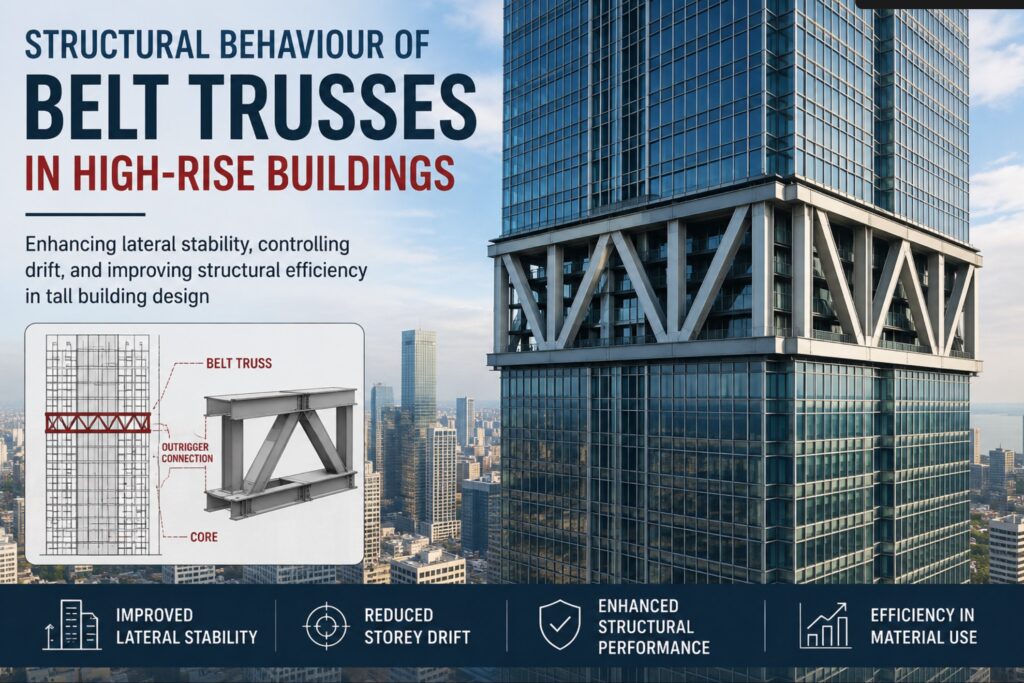
A belt truss is a horizontal truss system installed around the perimeter of a high-rise building, typically at one or more mechanical or refuge floors. Unlike conventional floor framing, the belt truss connects the perimeter columns together, forming a stiff structural ring around the building.
In many tall buildings, the belt truss works together with one or more outrigger trusses that extend from the central core to the perimeter columns. While the outrigger transfers overturning forces from the core to the exterior columns, the belt truss distributes these forces efficiently among multiple perimeter columns, preventing excessive force concentration in individual columns.
However, belt trusses are not solely dependent on outriggers. Even in the absence of outrigger systems, they can improve structural continuity, enhance lateral load distribution, and increase the global stiffness of the building.
Depending on the architectural requirements and structural system adopted, belt trusses may be constructed using structural steel, reinforced concrete, composite members, or a combination of these materials.
Why Belt Trusses Are Used in High-Rise Buildings
As buildings become taller, lateral loads produce increasingly large overturning moments at the base of the structure. If these moments are resisted solely by the central core, the resulting deflections, drift, and member forces may become excessive.
Belt trusses address this challenge by enabling perimeter columns to participate more effectively in resisting overturning forces. Rather than concentrating lateral resistance within the core, the structural system mobilises a much larger portion of the building, thereby increasing its efficiency.
The use of belt trusses offers several important advantages:
- Increased lateral stiffness.
- Reduced building drift.
- Improved resistance to overturning.
- Better distribution of axial forces among perimeter columns.
- Enhanced torsional stability.
- Improved structural redundancy.
- More economical member sizes.
- Greater flexibility for architectural planning.
These benefits make belt trusses particularly attractive for buildings exceeding approximately 40 to 50 storeys, where serviceability requirements often govern structural design.
Structural Behaviour of Belt Trusses
The structural behaviour of a belt truss is governed by its interaction with the building core, perimeter columns, floor diaphragms, and, where applicable, outrigger trusses. Rather than acting as an isolated structural element, the belt truss functions as part of an integrated lateral load-resisting system.
Redistribution of Overturning Forces
One of the primary functions of a belt truss is to redistribute overturning forces generated by wind and seismic actions.
When lateral loads act on a tall building, the central core tends to rotate about its base. If connected to an outrigger system, this rotation induces compression in windward perimeter columns and tension in leeward columns. The belt truss distributes these forces around the perimeter, ensuring that multiple columns participate in resisting overturning rather than only those directly connected to the outrigger.
This redistribution reduces stress concentrations, improves structural efficiency, and lowers the demand on individual columns.
Increase in Lateral Stiffness
Belt trusses significantly increase the global lateral stiffness of tall buildings.
By tying perimeter columns together, the belt truss is able to reduce differential movement between adjacent columns and enables them to act collectively when resisting lateral loads. This increased stiffness reduces horizontal displacement under wind loading and improves the overall serviceability of the structure.
The effectiveness of the belt truss depends on factors such as truss depth, stiffness, connection rigidity, and its elevation within the building.
Reduction of Inter-Storey Drift
Limiting inter-storey drift is one of the most important serviceability requirements in high-rise design because excessive drift can damage façades, partitions, glazing systems, mechanical services, and architectural finishes.
By increasing the stiffness of the structural system, belt trusses reduce relative displacement between adjacent floors. This improves both structural performance and occupant comfort, particularly under frequent wind loading where excessive movement may be perceptible even without compromising structural safety.
Interaction with the Building Core
The central reinforced concrete or composite core generally provides the primary resistance against lateral loads in modern high-rise buildings.
The belt truss enhances this resistance by improving the interaction between the core and the perimeter structural system. Rather than allowing the core to resist lateral loads independently, the belt truss enables the entire building width to contribute to overturning resistance.
This interaction substantially improves structural efficiency while reducing the bending moments developed within the core walls.
Behaviour Under Wind Loading
Wind loading is often the governing design action for tall buildings, particularly in regions of low to moderate seismicity. Unlike gravity loads, wind acts repeatedly throughout the life of a building and can produce significant lateral deflections, inter-storey drift, and dynamic accelerations that affect both structural performance and occupant comfort.
Belt trusses play an important role in improving the wind performance of high-rise buildings by increasing the overall stiffness of the structural system. When wind-induced overturning moments develop, the belt truss distributes axial forces among a larger number of perimeter columns, reducing the concentration of compressive and tensile forces in individual members. This more uniform distribution of forces improves the efficiency of the lateral load-resisting system and reduces the demand on the central core.
In addition to limiting overall building sway, belt trusses help reduce differential movement between adjacent perimeter columns. This contributes to better façade performance by minimising excessive deformation that could otherwise damage curtain walls, glazing systems, and building services connected to the exterior envelope.
For supertall buildings, reducing lateral displacement is only one aspect of structural performance. Wind-induced accelerations must also be controlled to ensure occupant comfort. Although belt trusses are not damping devices, the increased stiffness they provide often leads to lower structural accelerations by reducing the amplitude of building movement under service wind conditions.
Behaviour Under Seismic Loading
The behaviour of belt trusses during earthquakes differs from their response to wind because seismic actions are dynamic and involve inertia forces generated throughout the structure.
During seismic excitation, belt trusses contribute to a more uniform distribution of lateral forces between the core and perimeter columns, reducing excessive deformation in individual structural elements. This improves the overall integrity of the lateral load-resisting system and enhances the building’s ability to redistribute forces when local yielding occurs.
In seismic regions, however, excessive stiffness is not always desirable. Highly rigid structures may attract larger seismic forces, increasing design demands. Consequently, engineers seek an appropriate balance between stiffness and ductility, ensuring that the structural system possesses sufficient strength while maintaining adequate energy dissipation capacity.
Where belt trusses are combined with outrigger systems, special attention must be given to connection detailing, member ductility, and capacity design principles to prevent brittle failure during strong ground motions. Proper detailing in accordance with seismic design standards ensures that the structure can undergo controlled inelastic deformation while maintaining its overall stability.
Influence of Belt Truss Location
The effectiveness of a belt truss depends significantly on its position within the height of the building.
A belt truss located near the top of the building is generally effective in reducing overturning rotation because it provides a larger lever arm relative to the foundation. However, placing the truss too close to the roof may not produce the optimum structural response for every building.
Many high-rise structures incorporate belt trusses at mechanical floors located approximately mid-height or at two or more elevations. Multiple belt trusses improve stiffness over the full building height and distribute structural forces more evenly than a single system.
For supertall buildings exceeding 300 metres, engineers frequently adopt multiple outrigger and belt truss levels to maximise structural efficiency while satisfying increasingly stringent drift and acceleration limits.
The optimum location is usually established through detailed structural analysis and optimisation rather than relying on fixed design rules.
Types of Belt Trusses
Several belt truss configurations are used in practice depending on architectural requirements, structural efficiency, fabrication considerations, and construction methodology.
Steel Belt Trusses are the most common due to their high strength-to-weight ratio, ease of fabrication, and ability to span large distances with relatively small member sizes.
Reinforced Concrete Belt Trusses are occasionally used where reinforced concrete forms the primary structural system, particularly in buildings requiring improved fire resistance or architectural integration.
Composite Belt Trusses combine structural steel and reinforced concrete to exploit the advantages of both materials. Composite systems often provide improved stiffness, durability, and fire performance while maintaining construction efficiency.
The truss geometry may also vary, with diagonal, K-type, X-type, Warren, and Pratt arrangements selected according to structural requirements and architectural constraints.
Structural Design Considerations
Designing an effective belt truss requires careful consideration of several interrelated factors.
One of the most important is structural stiffness compatibility. The belt truss, outrigger (where provided), core, and perimeter columns must deform compatibly to ensure efficient load sharing. Significant stiffness mismatches can reduce the effectiveness of the overall system and generate unintended force concentrations.
Connection design is equally critical because large axial forces and bending moments are transferred between the belt truss and perimeter columns. These connections must be capable of safely transmitting design forces while accommodating construction tolerances and differential shortening of vertical members.
Differential shortening is another important consideration in tall reinforced concrete and composite buildings. Time-dependent effects such as creep, shrinkage, and elastic shortening may produce vertical movements that influence the behaviour of belt trusses if not properly accounted for during design.
Engineers must also consider construction sequence. Temporary support conditions, staged loading, and the timing of belt truss installation can significantly affect force development within the structural system. Construction stage analysis is therefore commonly performed for complex high-rise buildings incorporating belt trusses.
Practical Applications
Belt trusses are now widely adopted in some of the world’s tallest buildings because they provide an efficient means of improving structural performance while accommodating demanding architectural designs.
They are particularly common in buildings exceeding 40 storeys, where lateral stiffness becomes a dominant design consideration. Many supertall towers utilise multiple belt trusses located at mechanical floors to maximise the interaction between the central core and perimeter columns.
Although the specific configurations vary from project to project, the underlying objective remains the same: to improve the efficiency of the entire structural system by enabling more of the building to participate in resisting lateral loads.
Conclusion
Belt trusses have become one of the defining structural systems in modern high-rise engineering because they significantly enhance the lateral behaviour of tall buildings without requiring excessive increases in member sizes. Their contribution is particularly significant when integrated with outrigger systems, although belt trusses also provide valuable independent benefits in terms of structural continuity, redundancy, and torsional stability.
Also See: Outrigger Structural Systems in Tall Buildings
Sources & Citations
- EN 1990:2002 – Eurocode: Basis of Structural Design.
- EN 1991-1-4:2005 – Eurocode 1: Actions on Structures – Wind Actions.
- EN 1993-1-1:2005 – Eurocode 3: Design of Steel Structures.
- EN 1998-1:2004 – Eurocode 8: Design of Structures for Earthquake Resistance.
- Council on Tall Buildings and Urban Habitat (CTBUH). Outriggers in Tall Buildings and related technical guidance.
