With computational design, the role of the structural engineer is shifting from manual calculation to model development, validation, and interpretation. The focus is no longer on solving equations alone, but on understanding how structures behave as integrated systems.
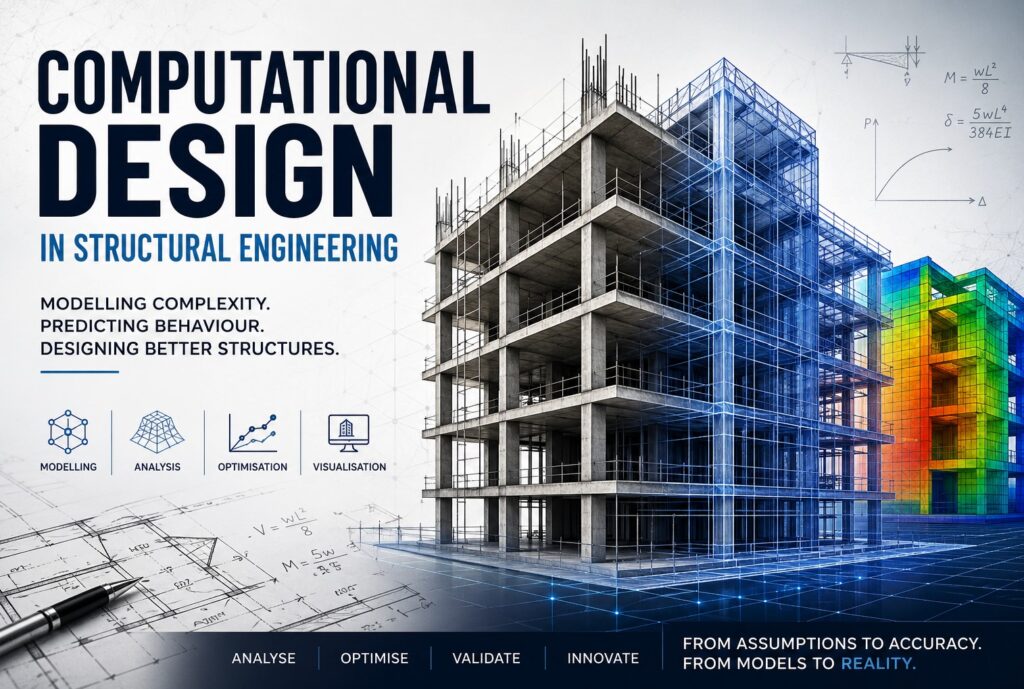
Structural design has undergone a profound transformation over the past few decades. What was once a discipline dominated by hand calculations, simplified assumptions, and linear thinking has evolved into a highly sophisticated field driven by computation, simulation, and data. Modern design is no longer defined solely by the ability to solve equations, but by the capacity to model, predict, and optimise structural behaviour under increasingly complex conditions.
Computational design methods now sit at the core of engineering practice. They allow engineers to move beyond approximation and engage directly with the nonlinear, dynamic, and often uncertain nature of real structures. However, these methods are not uniform. They represent a spectrum of approaches, each grounded in different philosophies of modelling, analysis, and decision-making.
Understanding how these computational methods are categorised is essential, not only for effective application but also for appreciating their limitations. The power of modern design lies not in the tools themselves, but in how they are understood and used.
The Evolution from Deterministic to Computational Thinking
Traditional structural design was grounded in deterministic methods, where problems were simplified into clearly defined loads, boundary conditions, and structural responses. Engineers relied on closed-form solutions and established formulae to calculate internal forces and size members accordingly. The process was inherently linear, with behaviour assumed to be proportional and predictable. While effective, this approach required significant simplification of real structural behaviour, often leading to conservative designs that prioritised safety over efficiency.
These simplifications were not merely convenient, they were necessary. The limitations of manual calculation meant that complex interactions within structures, such as stiffness variation, load redistribution, and nonlinear material response, were either ignored or treated in highly approximate ways. As a result, the design process focused more on solving idealised problems than capturing the true behaviour of structural systems.
With the advent of computational methods, this constraint has been fundamentally removed. Modern design no longer depends on reducing complexity but instead embraces it. Engineers can now model entire structures as integrated systems, accounting for interactions between members, realistic boundary conditions, and varying material behaviour. What was once treated as secondary, such as deformation compatibility, time-dependent effects, or localised stress concentrations, can now be directly incorporated into analysis.
This shift has transformed structural design from a problem-solving exercise into a system-based investigation. The emphasis is no longer on isolated calculations, but on understanding how structures behave as a whole under different conditions. Engineers are now able to explore multiple scenarios, test assumptions, and refine designs iteratively, leading to solutions that are not only safe but also more efficient and responsive to real-world demands.
However, this transition also introduces a new layer of responsibility. Computational models, while powerful, are only as accurate as the assumptions and inputs that define them.
Linear Computational Methods
At the foundation of computational design lie linear analysis methods. These approaches assume proportionality between loads and responses, as well as small deformations. They form the basis of most structural software and are often the starting point for analysis.
Linear methods are efficient and relatively easy to implement, making them suitable for a wide range of routine design problems. They provide clear insight into force distribution and structural behaviour under typical loading conditions.
However, their limitations are significant. Real structures rarely behave in a perfectly linear manner. Cracking, yielding, and large deformations introduce nonlinearities that cannot be captured within this framework. As a result, linear methods must often be supplemented by more advanced approaches.
Nonlinear Analysis Methods
Nonlinear computational methods represent a more realistic approach to structural behaviour. They account for both material and geometric nonlinearities, allowing engineers to model phenomena such as cracking in concrete, yielding in steel, and instability in slender members.
These methods provide a deeper understanding of how structures behave as they approach failure. They reveal not only the ultimate capacity of a system but also the path taken to reach that state.
Despite their advantages, nonlinear methods are computationally intensive and require careful calibration. Results are highly sensitive to input parameters, and misinterpretation can lead to incorrect conclusions. The engineer must therefore exercise judgement in both modelling and analysis.
Finite Element Modelling
Finite element analysis (FEA) is one of the most powerful tools in modern computational design. It involves discretising a structure into smaller elements, each governed by fundamental equations of mechanics. By assembling these elements, engineers can simulate complex geometries and loading conditions with high accuracy.
FEA allows for detailed investigation of stress distribution, deformation patterns, and localised effects. It is particularly useful in regions where analytical solutions are not feasible, such as irregular geometries or complex boundary conditions.
However, the accuracy of finite element models depends heavily on the quality of the mesh, boundary conditions, and material models. Poor modelling assumptions can produce results that appear precise but are fundamentally incorrect. This underscores the importance of engineering insight in interpreting computational outputs.
Parametric and Algorithmic Design
Parametric design introduces a different dimension to computational methods. Instead of analysing a single fixed model, engineers define relationships between variables, allowing the structure to evolve based on input parameters.
This approach enables rapid exploration of design alternatives. By adjusting parameters such as geometry, material properties, or loading conditions, engineers can observe how the structure responds and identifies optimal configurations.
Algorithmic design extends this concept further by embedding logic and rules into the design process. Structures are not merely analysed—they are generated through computational procedures. This blurs the boundary between design and analysis, creating a more integrated workflow.
Optimisation-Based Design
Optimisation methods represent a shift from analysis to decision-making. Rather than evaluating a predefined design, these methods seek the best possible solution based on specified criteria.
In structural engineering, optimisation may involve minimising material usage, reducing cost, or maximising performance. Computational algorithms iteratively adjust design variables, converging toward an optimal solution.
While powerful, optimisation methods depend on the definition of objectives and constraints. An improperly defined problem can lead to solutions that are mathematically optimal but practically unsuitable. Engineering judgement remains essential in guiding the optimisation process.
Probabilistic and Reliability-Based Methods
Traditional design approaches often rely on safety factors to account for uncertainty. Probabilistic methods, however, attempt to quantify uncertainty directly. They consider variability in loads, material properties, and modelling assumptions, providing a more rigorous assessment of structural reliability.
These methods enable engineers to evaluate the likelihood of failure and design structures with a specified level of confidence. They are particularly relevant in critical infrastructure and high-risk applications.
Despite their theoretical strength, probabilistic methods are not yet widely adopted in routine practice due to their complexity and data requirements. However, they represent an important direction for the future of structural design.
Data-Driven and AI-Assisted Design
The emergence of data-driven methods and artificial intelligence is reshaping computational design. Machine learning algorithms can analyse large datasets, identify patterns, and make predictions about structural behaviour.
These methods have the potential to enhance design efficiency, automate routine tasks, and uncover insights that may not be apparent through traditional analysis. However, they also introduce new challenges related to transparency, interpretability, and reliability.
Engineering design cannot rely solely on data. It must be grounded in physical principles. The integration of AI into structural engineering therefore requires a careful balance between innovation and fundamental understanding.
The Role of the Engineer
With computational design, the role of the structural engineer is shifting from manual calculation to model development, validation, and interpretation. The focus is no longer on solving equations alone, but on understanding how structures behave as integrated systems. This places greater responsibility on the engineer to define realistic models, appropriate loads, and meaningful boundary conditions.
Modern tools can produce highly detailed results with apparent precision, but this precision can be misleading. The greatest risk in computational design is not lack of capability, but overconfidence in outputs that are only as accurate as the assumptions behind them. A flawed model can generate convincing but fundamentally incorrect results.
The engineer must therefore remain critical at every stage of the process. Results must be questioned, checked against expected behaviour, and validated through simplified calculations or engineering judgement. Interpretation becomes as important as analysis itself.
Computational methods do not remove uncertainty; they shift it into modelling choices and assumptions. Understanding this is essential to using these tools responsibly.
Ultimately, the effectiveness of modern structural design depends not on software, but on the engineer’s ability to think critically, model realistically, and interpret results with clarity and discipline.
Conclusion
Modern methods of design represent a convergence of computation, theory, and practical judgement. From linear analysis to nonlinear simulation, from parametric modelling to data-driven approaches, each method offers unique capabilities and insights. However, no single method provides a complete solution. Effective design requires the integration of multiple approaches, guided by a clear understanding of their strengths and limitations.
Also See: A Background to Parametric Design and Visual Scripting
Sources & Citations
- Bathe, K.J. Finite Element Procedures. Prentice Hall, 1996.
- Hibbeler, R.C. Structural Analysis. Pearson Education, latest edition.
- Bendsøe, M.P., & Sigmund, O. Topology Optimization: Theory, Methods, and Applications. Springer, 2003.
- Melchers, R.E., & Beck, A.T. Structural Reliability Analysis and Prediction. Wiley, 2018.
