What makes buckling particularly dangerous is that it is not always preceded by visible signs of distress. A column may appear stable under increasing load until it suddenly deflects and fails
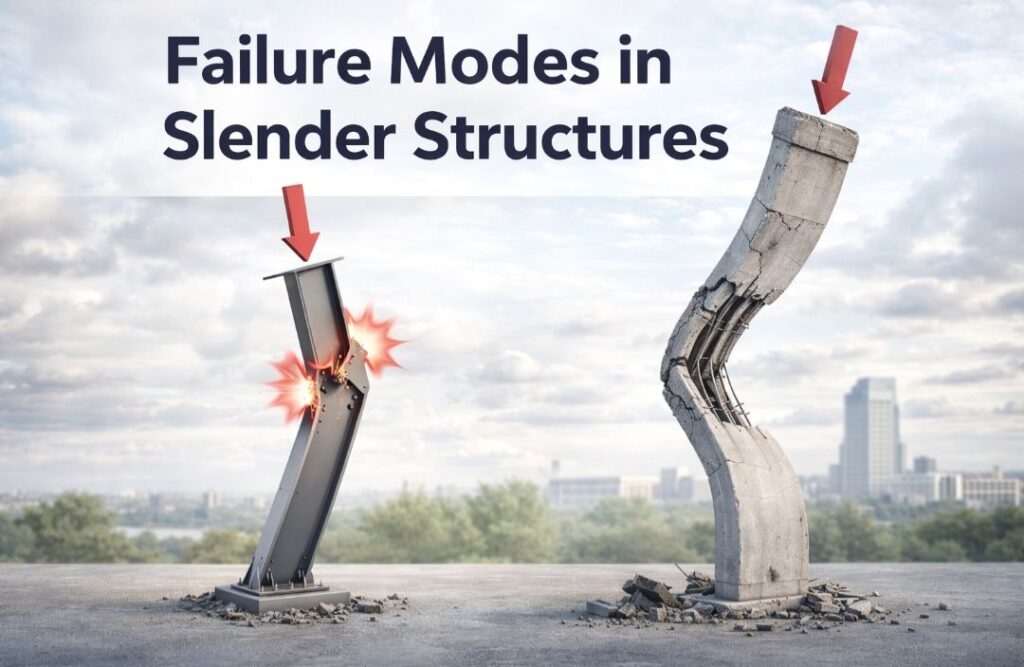
Slender structures occupy a unique and often critical position in structural engineering. Unlike stocky members that derive their strength primarily from material capacity, slender elements are governed largely by stability. Their behaviour is highly sensitive to geometry, imperfections, and load application, making their failure mechanisms fundamentally different and often less intuitive.
Slenderness is not limited to columns alone. It applies to beams, walls, towers, bridge piers, and even entire structural systems where one dimension significantly exceeds the others. As structures become more slender—either due to architectural demands, material optimization, or height requirements—their susceptibility to instability increases. In such cases, failure is rarely a result of simple material yielding; instead, it is often triggered by instability phenomena that can occur suddenly and with little warning.
Historic failures such as the Tacoma Narrows Bridge collapse highlight how slender systems can behave unpredictably when stability is not adequately addressed. Understanding the failure modes of slender structures is therefore essential for safe and efficient design.
Understanding Slenderness and Structural Stability
Slenderness in structural engineering is typically quantified through the slenderness ratio, which relates the effective length of a member to its cross-sectional dimensions. As this ratio increases, the member becomes more prone to lateral deformation under load.
In a slender member, even small lateral displacements can significantly alter the internal force distribution. This introduces additional moments that were not present in the initial loading condition. The structure, therefore, does not simply resist applied loads, it also responds to its own deformation. This interaction between axial load and lateral displacement lies at the heart of instability.
Unlike short members, where failure is governed by material strength, slender structures are governed by equilibrium. When the structure can no longer maintain equilibrium under applied loads, instability occurs, often leading to rapid and catastrophic failure.
Buckling as the Primary Failure Mode
Buckling is the most fundamental failure mode associated with slender structures. It occurs when a structural member subjected to compressive forces experiences a sudden lateral deflection. This deflection can grow rapidly even without an increase in load, leading to collapse.
In its simplest form, buckling can be described by Euler’s theory, which defines a critical load at which a perfectly straight, elastic column becomes unstable. However, real structures are never perfect. Initial imperfections, residual stresses, and material nonlinearity reduce the actual buckling capacity significantly below the theoretical value.
What makes buckling particularly dangerous is that it is not always preceded by visible signs of distress. A column may appear stable under increasing load until it suddenly deflects and fails. This lack of warning distinguishes buckling from other failure modes such as yielding or cracking.
Local vs Global Buckling
In slender structures, buckling can occur at different scales, broadly classified as local or global.
Global buckling involves the entire member deforming as a single unit. This is typical in long columns or tall structural systems where the overall geometry governs behaviour. The entire structure bends laterally, leading to loss of load-carrying capacity.
Local buckling, on the other hand, occurs within individual components of a member, such as the flange or web of a steel section. Even if the overall member remains stable, local instability can reduce its effective strength, leading to premature failure.
The interaction between local and global buckling is a critical aspect of slender structure design. A member may initially experience local buckling, which reduces stiffness and triggers global instability. Engineers must therefore consider both phenomena simultaneously.
Second-Order Effects and Instability
One of the defining characteristics of slender structures is the significance of second-order effects. As a member deflects under load, the line of action of the load shifts, creating additional bending moments. This phenomenon, often referred to as the P–Δ effect, amplifies internal forces and accelerates instability.
In slender systems, second-order effects are not negligible, they are central to the behaviour of the structure. Ignoring them can lead to unconservative designs and unexpected failures.
The interaction between axial load and bending becomes increasingly nonlinear as deformation grows. This nonlinearity must be accounted for in both analysis and design, particularly in tall buildings and long-span structures.
Material Behaviour and Its Influence
While instability governs slender structures, material behaviour still plays a significant role. The ductility of the material determines how the structure responds as it approaches failure.
Ductile materials such as structural steel can undergo significant deformation before failure, providing some warning and allowing redistribution of stresses. Brittle materials, however, may fail abruptly once instability is triggered.
In reinforced concrete, the presence of cracking further complicates behaviour. As cracks develop, stiffness is reduced, increasing susceptibility to buckling and second-order effects. This interaction between material nonlinearity and geometric instability must be carefully considered.
Imperfections and Their Amplified Effects
No real structure is perfectly straight or perfectly loaded. Initial imperfections, such as slight curvature, misalignment, or eccentric loading, are always present. In slender structures, these imperfections play a dominant role.
Even small deviations from the ideal geometry can significantly reduce the load-carrying capacity. Under compressive load, these imperfections are amplified, leading to increased bending and earlier onset of instability.
Dynamic Instability and Slender Systems
Slender structures are also more sensitive to dynamic effects such as wind, vibration, and resonance. Their reduced stiffness makes them more susceptible to oscillations, which can lead to fatigue or dynamic instability.
The Tacoma Narrows Bridge collapse remains one of the most notable examples of dynamic instability. The bridge, due to its slender design, experienced aeroelastic flutter under wind loading, leading to its dramatic collapse.
Real Structural Behaviour
In practice, failure in slender structures is rarely due to a single mechanism. Instead, it is the result of interaction between multiple factors—buckling, material nonlinearity, imperfections, and second-order effects.
Consider a slender steel column in a high-rise building. Under increasing axial load, the column begins to deflect slightly due to imperfections. This deflection introduces additional bending moments, which further increase deformation. At the same time, local buckling may occur in the flanges, reducing stiffness. Eventually, the combined effects lead to global instability and failure.
Design Implications
Designing slender structures requires a shift from strength-based thinking to stability-based design. Engineers must consider not only the capacity of materials but also the ability of the structure to maintain equilibrium under load.
This involves accounting for second-order effects, incorporating realistic imperfections, and ensuring adequate stiffness. Advanced analysis methods are often required to capture the nonlinear behaviour of slender systems.
Conclusion
Failure modes in slender structures are governed by instability rather than material strength. Buckling, second-order effects, imperfections, and dynamic behaviour all play critical roles in determining structural performance.
Unlike more robust systems, slender structures can fail suddenly and without warning, making their design particularly challenging. Understanding the interplay of these factors is essential for ensuring safety and reliability.
Also See: Initial Imperfections and Slender Column Design
Sources & Citations
- Timoshenko, S.P., & Gere, J.M. Theory of Elastic Stability. McGraw-Hill, 1961.
- Bazant, Z.P., & Cedolin, L. Stability of Structures. Oxford University Press, 2010.
- Trahair, N.S. Flexural-Torsional Buckling of Structures. CRC Press, 1993.
- EN 1993-1-1. Eurocode 3: Design of Steel Structures.
