Critical detailing zones are regions within a structural member where stress concentrations, force transfers, or geometric discontinuities occur.
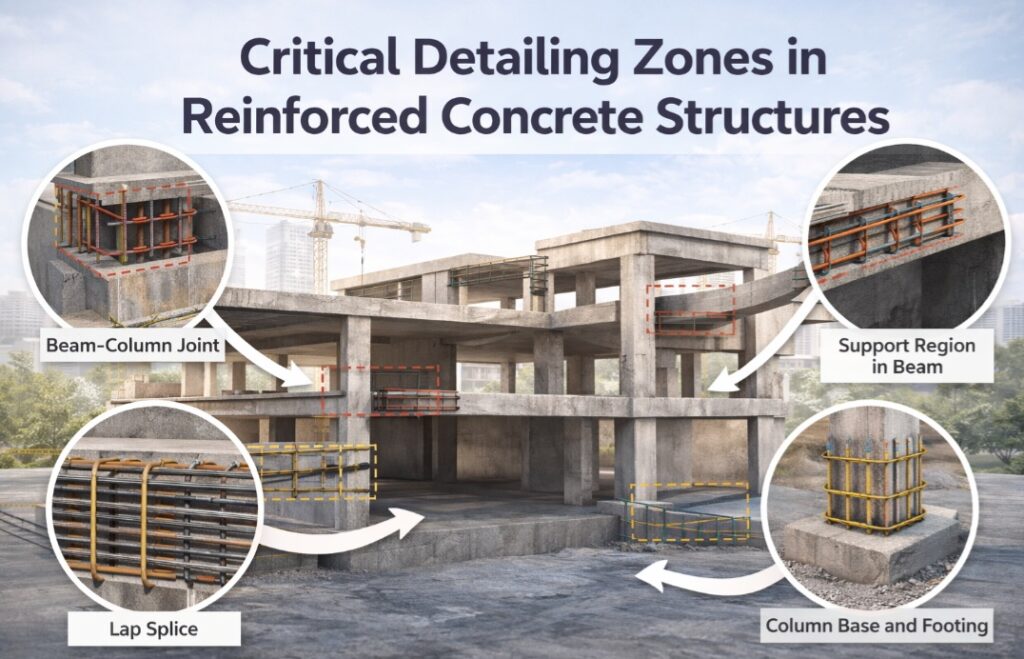
Reinforced concrete design is often approached from the perspective of analysis and member sizing, where bending moments, shear forces, and axial loads are calculated and resisted through appropriate reinforcement. However, structural performance is not governed by analysis alone. The way reinforcement is arranged, anchored, and confined within critical regions of a structure plays an equally important role.
Failures in reinforced concrete structures rarely originate in regions of uniform stress. Instead, they occur in zones where forces are transferred, concentrated, or disrupted. These are the critical detailing zones—regions where structural behaviour becomes complex and where inadequate detailing can override otherwise sound design.
Understanding these zones and detailing them correctly is essential to ensuring ductility, strength, and long-term performance.
Nature of Critical Zones
Critical detailing zones are regions within a structural member where stress concentrations, force transfers, or geometric discontinuities occur. In these areas, assumptions made during analysis, such as uniform stress distribution or linear behaviour—are no longer valid.
These zones are characterised by high strain gradients, complex stress states, and often the presence of cracking or inelastic behaviour. The role of detailing in such regions is to ensure that forces can be safely transferred and that the structure can undergo deformation without sudden failure.
Unlike regular regions where reinforcement primarily resists bending, critical zones demand attention to anchorage, confinement, and load transfer mechanisms.
Beam-Column Joints
Beam-column joints are among the most critical regions in reinforced concrete frames. These joints serve as the interface through which forces from beams are transferred into columns and vice versa. Under loading, especially lateral loads, these regions experience high shear stresses and complex stress interactions.
Inadequate detailing in beam-column joints can lead to joint shear failure, which is typically brittle and catastrophic. Proper confinement using closely spaced stirrups or ties is necessary to maintain integrity and ensure that the joint can sustain cyclic loading.
The anchorage of beam reinforcement within the joint is equally important. Insufficient development length or improper bar placement can compromise the ability of the joint to transfer forces effectively.
Support Regions in Beams
The regions near supports in beams are critical due to the presence of high shear forces and negative bending moments. These conditions create a combination of tensile stresses at the top fibres and diagonal tension within the web.
Shear reinforcement, typically in the form of stirrups, must be adequately provided and properly anchored in these regions. Poor detailing can lead to diagonal shear cracking and eventual shear failure, which occurs suddenly and without significant warning.
In addition, top reinforcement must be properly anchored to resist negative moments. Curtailment of reinforcement in these regions must be carefully controlled to avoid premature failure.
Lap Splice Zones
Lap splices are used to transfer forces between reinforcing bars, but they represent potential failure ppints if not properly detailed. In splice regions, stresses must be transferred through bond between steel and concrete, making these zones highly sensitive to detailing quality.
Improper lap length, insufficient confinement, or placing splices in regions of high stress can lead to bond failure. This results in slip of reinforcement and loss of structural capacity.
Best practice requires that lap splices be located in regions of lower stress and be adequately confined with transverse reinforcement. In heavily loaded members, mechanical couplers may be preferred to reduce congestion and improve performance.
Column Base and Footing Interface
The interface between columns and foundations is another critical zone where forces are transferred from the superstructure to the ground. This region must resist axial loads, bending moments, and sometimes shear forces.
Proper anchorage of column reinforcement into the footing is essential to ensure continuity of load transfer. Inadequate development length can result in pull-out failure or cracking at the base.
Additionally, confinement reinforcement at the base of columns helps improve ductility and resistance to local crushing, particularly under high compressive loads.
Openings and Discontinuities
Openings in slabs, beams, or walls introduce disruptions in load paths, creating local stress concentrations. These regions require special detailing to ensure that forces are redistributed around the opening.
Reinforcement must be arranged to provide alternative load paths, often through additional bars placed around the perimeter of the opening. Failure to account for these effects can lead to cracking or localized collapse.
Discontinuities such as sudden changes in section or stiffness also create critical zones where detailing must address stress concentration and force transfer.
Confinement Zones in Columns
In columns, particularly in seismic or heavily loaded structures, confinement zones are critical for maintaining structural integrity. These are typically located at the ends of columns where plastic hinges may form under extreme loading.
Confinement reinforcement, in the form of closely spaced ties or spirals, enhances the ductility of concrete by preventing lateral expansion and delaying crushing. This allows the column to sustain large deformations without losing its load-carrying capacity.
Inadequate confinement can lead to brittle failure, especially under cyclic loading conditions.
Anchorage Zones
Anchorage zones are regions where reinforcement terminates or changes direction, and where forces are transferred between steel and concrete. These zones are critical because failure often occurs through bond loss or splitting of concrete.
Proper detailing involves ensuring sufficient development length, adequate concrete cover, and the use of hooks or bends where necessary. In regions of high stress, additional confinement may be required to prevent splitting cracks.
Anchorage failure is particularly dangerous because it can occur without significant visible warning.
Real Structural Behaviour
In real structures, critical detailing zones are where most problems originate. Cracks, excessive deformation, and even collapse often trace back to poor detailing rather than inadequate design calculations.
For example, a beam designed with sufficient flexural capacity may still fail if reinforcement is not properly anchored at the supports. Similarly, a column may lose capacity if confinement is insufficient in critical regions.
These examples highlight that structural performance depends as much on detailing as on analysis.
Design Approach to Critical Zones
Designing critical zones requires a shift from simplified analysis to a more realistic understanding of structural behaviour. Engineers must consider how forces flow through these regions and how materials interact under stress.
Codes provide guidelines for detailing, but they are often based on empirical observations and may not cover all scenarios. Engineering judgement is therefore essential in identifying and addressing critical zones.
Close coordination between design and construction is also necessary to ensure that detailing is correctly implemented on site.
Conclusion
Critical detailing zones represent the most vulnerable regions in reinforced concrete structures. They are the the where forces are transferred, stresses are concentrated, and structural behaviour becomes complex.
Proper detailing in these zones ensures that the structure can safely carry loads, redistribute forces, and undergo deformation without sudden failure. Neglecting these regions can compromise the entire structural system, regardless of how well the rest of the design is executed.
Also See:
Sources & Citations
- ACI 318-19. Building Code Requirements for Structural Concrete.
- EN 1992-1-1. Eurocode 2: Design of Concrete Structures.
- Park, R., & Paulay, T. Reinforced Concrete Structures.
- Nilson, A.H. Design of Concrete Structures.
