Buildings are never completely still. They move continuously due to loads, temperature changes, soil conditions, and time. These movements are natural and expected in structural systems.
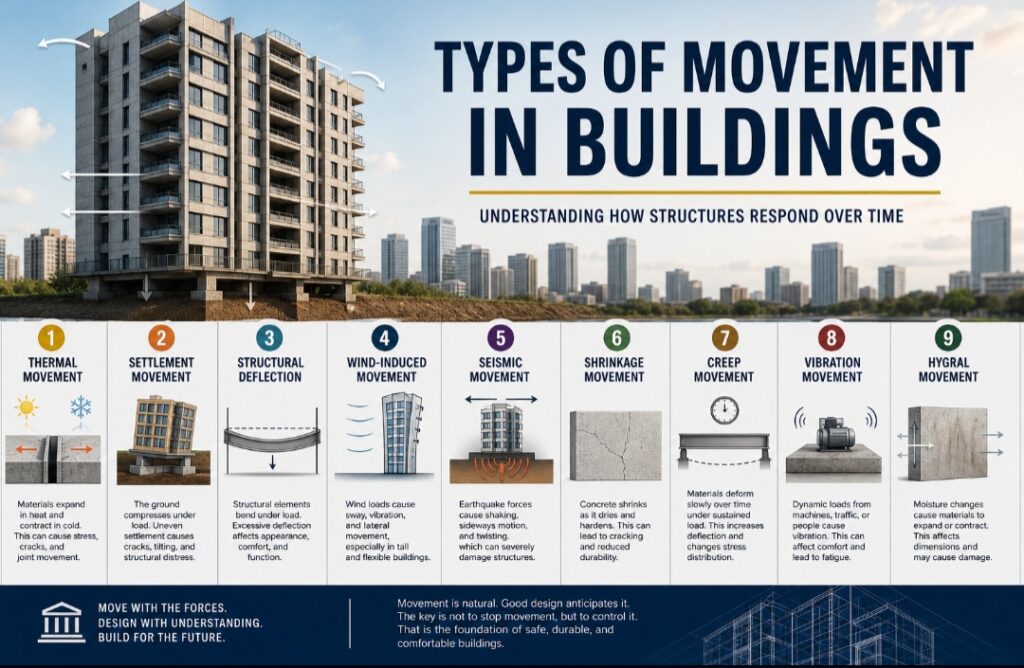
Buildings are dynamic structures. They constantly respond to environmental changes, loads, and ground conditions. Engineers understand this and design buildings to withstand inevitable movements over time. Every structure, no matter how well engineered, experiences some form of movement. This knowledge is crucial because it helps avoid damage, ensures safety, and enhances long-term durability.
Movement in buildings occurs for many reasons. Some movements are subtle and slow, while others are sudden and visible. These movements may be permanent or reversible. By understanding the types of movement, engineers predict how structures behave. They also design systems that allow buildings to adapt and remain stable over time. In this article, we discuss nine key types of movement in buildings, their causes, effects, and control methods.
Every building responds to internal and external forces. These forces include temperature changes, ground conditions, and applied loads. Engineers plan carefully so that structures remain safe under these influences. They introduce joints, reinforcement systems, and foundation solutions to manage movement effectively.
Thermal Movement
Thermal movement occurs when materials expand or contract due to temperature changes. Steel, concrete, and masonry all respond to heat and cold. When temperature rises, materials expand. When temperature falls, they contract. This continuous cycle creates stress in structural elements over time.
Long structures experience thermal movement more intensely. This happens because expansion accumulates along their length. Daily heating from the sun and cooling at night intensifies the effect. Seasonal changes also contribute significantly.
Engineers control thermal movement by introducing expansion joints. These joints allow controlled movement without damaging structural elements. Without proper control, cracks may appear in walls, slabs, and finishes. Over time, this can reduce durability and performance.
Structural Deflection
Deflection refers to bending or displacement of structural members under load. Beams, slabs, and cantilevers all deflect when they carry weight. This movement is expected and forms part of normal structural behavior.
The amount of deflection depends on material stiffness, span length, and load intensity. Longer spans and heavier loads produce greater deflection. Engineers carefully calculate this during design.
Excessive deflection affects both appearance and functionality. Floors may sag visibly, and finishes may crack. Doors and windows may also misalign. Engineers limit deflection using design codes to maintain serviceability.
Settlement Movement
Settlement occurs when soil beneath a building compresses under load. Almost all buildings experience some settlement after construction. The key concern is not settlement itself but uneven settlement.
Uniform settlement is usually harmless because the building moves evenly. Differential settlement, however, causes structural distortion. It leads to cracks, tilting, and stress in structural members.
Soil conditions play a major role in settlement. Weak soils, poor compaction, and uneven loading increase risk. Engineers perform soil investigations before construction. They design foundations that distribute loads evenly to reduce settlement issues.
Shrinkage Movement
Shrinkage occurs mainly in concrete as it loses moisture over time. This volume reduction continues after hardening. It is a slow but continuous process.
Plastic shrinkage occurs early when concrete is still fresh. Drying shrinkage happens later as moisture evaporates from hardened concrete. Both types contribute to cracking if not controlled.
Engineers manage shrinkage by ensuring proper curing. They also design concrete mixes that reduce water loss. Without control, shrinkage cracks can reduce durability and allow moisture penetration.
Creep Movement
Creep is the long-term deformation of a material under constant load. Concrete is especially affected by this phenomenon. Even when the load remains unchanged, deformation increases over time.
Creep develops slowly and may continue for months or years. It depends on load duration, material quality, and environmental conditions.
Engineers consider creep in structural design, especially for long-span beams and high-rise buildings. If ignored, it can lead to excessive long-term deflection and serviceability problems.
Wind-Induced Movement
Wind applies lateral forces on buildings, especially tall and slender structures. This causes sway and vibration. The movement is usually more noticeable at higher elevations.
Wind direction, speed, and building shape influence the level of movement. Flexible buildings experience more sway compared to rigid structures.
Engineers reduce wind movement using shear walls, bracing systems, and stiff cores. These systems improve stability and reduce occupant discomfort.
Seismic Movement
Seismic movement occurs during earthquakes when the ground shakes violently. It produces sudden horizontal and vertical forces on structures. This type of movement is highly unpredictable and destructive.
Buildings may experience cracking, foundation failure, or collapse if not properly designed. The intensity of damage depends on building design and seismic force magnitude.
Engineers use ductile detailing, energy dissipation systems, and base isolation to reduce seismic effects. These systems allow buildings to absorb and distribute energy safely.
Vibration Movement
Vibration occurs when dynamic loads act on a structure. These loads may come from machinery, traffic, or human activity. Even small vibrations can become noticeable over time.
Continuous vibration affects comfort and may lead to structural fatigue. Floors and bridges are especially vulnerable.
Engineers control vibration by increasing stiffness and adding damping systems. Proper design ensures that vibration remains within acceptable limits.
Foundation Heave and Ground Movement
Foundation heave occurs when soil expands and pushes a structure upward. This is common in expansive clay soils that react to moisture changes.
Unlike settlement, which pulls structures downward, heave pushes them upward or sideways. This movement can distort floors and crack walls.
Engineers control ground movement by improving drainage, stabilizing soil, or using deep foundations. These methods help anchor structures and prevent damage.
Conclusion
Buildings are never completely still. They move continuously due to loads, temperature changes, soil conditions, and time. These movements are natural and expected in structural systems. Engineers design buildings to accommodate and control these movements safely. They use joints, reinforcement, and foundation systems to manage structural response.
Also See: Movement Joints in Concrete Buildings
Sources & Citations
- Neville, A.M. (2011). Properties of Concrete. Pearson Education.
- MacGregor, J.G. & Wight, J.K. (2005). Reinforced Concrete: Mechanics and Design. Prentice Hall.
- Chen, W.F. & Lui, E.M. (2005). Handbook of Structural Engineering. CRC Press.
- Park, R. & Paulay, T. (1975). Reinforced Concrete Structures. Wiley.
- BS 8110: Structural Use of Concrete (British Standards Institution).
- Eurocode 2: Design of Concrete Structures (EN 1992).
