Force redistribution is a defining feature of indeterminate structures, enabling them to adapt to changes in stiffness, material behaviour, and loading conditions.
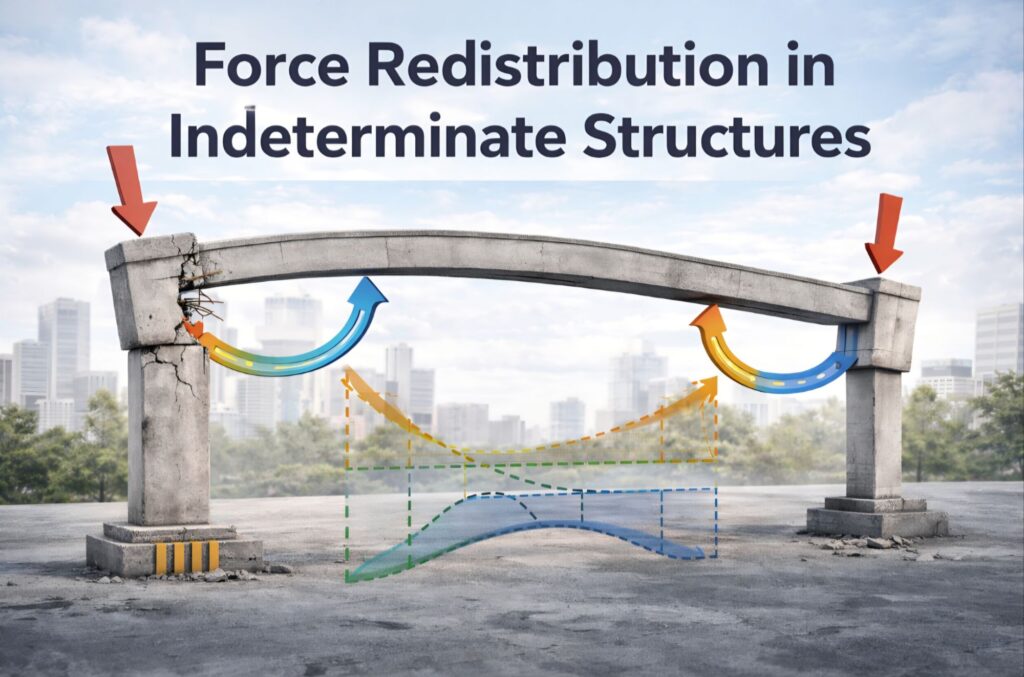
Structural systems are rarely perfectly determinate in real-world engineering. Most practical structures, continuous beams, rigid frames, slabs, and multi-storey buildings, are statically indeterminate. This indeterminacy allows structures to develop internal redundancy, enabling them to redistribute forces when local conditions change.
Force redistribution refers to the ability of a structure to alter its internal force distribution in response to cracking, yielding, stiffness variation, or support conditions. Unlike determinate structures, where internal forces are fixed by equilibrium alone, indeterminate structures possess the capacity to adapt. This adaptability is one of the most powerful and beneficial characteristics of modern structural systems, but it also introduces complexity in analysis and design.
Understanding how and why forces redistribute is essential for safe, efficient, and realistic structural design.
Nature of Indeterminacy
In statically indeterminate structures, equilibrium equations alone are insufficient to determine internal forces. Compatibility of deformation and member stiffness must also be considered. This means that internal forces are not only a function of loading but also of how the structure deforms under that loading.
Because of this, any change in stiffness, whether due to cracking, yielding, or temperature effects, alters the internal force distribution. The structure continuously seeks a new equilibrium state that satisfies both force balance and deformation compatibility.
This behaviour forms the basis of force redistribution.
Mechanism of Force Redistribution
Force redistribution occurs when a structural element experiences a reduction in stiffness or strength, causing forces to shift to other parts of the structure.
In reinforced concrete beams, for example, cracking in tension zones reduces stiffness. As a result, moments initially resisted by the cracked section are partially transferred to adjacent regions that remain stiffer. Similarly, when reinforcement yields, the member can no longer sustain increasing moment at the same rate, and additional load is redistributed to other parts of the structure.
This process is gradual and depends on the ductility of the material. Ductile systems allow significant redistribution before failure, while brittle systems have limited capacity for redistribution.
Redistribution in Continuous Beams
Continuous beams provide a clear illustration of force redistribution. Under elastic analysis, negative moments typically develop over supports, while positive moments occur at midspans. However, as loading increases, cracking and yielding reduce stiffness at critical sections, particularly over supports.
As these regions soften, some of the moment is redistributed toward the spans. This results in a more uniform moment distribution compared to the elastic case. Design codes often allow a controlled amount of moment redistribution to account for this behaviour, enabling more economical reinforcement layouts.
However, excessive redistribution without adequate ductility can lead to premature failure. The structure must be capable of undergoing the required rotations for redistribution to occur safely.
Role of Ductility
Ductility is central to force redistribution. It refers to the ability of a structural element to undergo large deformations without losing its load-carrying capacity.
In reinforced concrete, ductility is achieved through proper detailing, including adequate tension reinforcement, confinement, and avoidance of brittle failure modes such as shear failure. When a section yields in flexure, it can rotate and allow redistribution of moments.
Without sufficient ductility, redistribution becomes limited or unsafe. Brittle failure can occur before the structure has the opportunity to redistribute forces, leading to sudden collapse.
Plastic Behaviour and Redistribution
At higher load levels, indeterminate structures may enter the plastic range. In this state, sections that reach their plastic moment capacity form plastic hinges. Once a hinge forms, it allows rotation without an increase in moment, effectively redistributing additional forces to other parts of the structure.
The formation of multiple plastic hinges can lead to a collapse mechanism. However, before collapse occurs, significant redistribution may take place, allowing the structure to utilize its full capacity.
Plastic analysis methods explicitly account for this behaviour, providing a more realistic representation of ultimate structural performance.
Influence of Stiffness Variation
Stiffness plays a critical role in determining how forces are distributed. In indeterminate structures, forces are attracted to stiffer members. When stiffness changes—due to cracking, material differences, or geometric variation—the load path shifts accordingly.
For example, in a frame structure with beams of varying stiffness, stiffer beams will attract more moment. If one beam cracks and loses stiffness, adjacent beams will carry increased load.
This dynamic redistribution highlights the importance of considering realistic stiffness properties in analysis rather than relying solely on idealized assumptions.
Time-Dependent Redistribution
In materials such as concrete, time-dependent effects such as creep and shrinkage can lead to gradual redistribution of forces.
Creep reduces stiffness over time under sustained load, causing internal forces to shift within the structure. This can lead to increased deflection and changes in moment distribution long after the structure has been constructed.
Time-dependent redistribution is particularly important in long-span structures and heavily loaded members, where long-term behaviour can differ significantly from initial conditions.
Structural Benefits of Redistribution
Force redistribution provides several advantages in structural design. It enhances redundancy, allowing structures to continue functioning even when local elements are damaged or weakened. It also enables more efficient use of materials, as peak forces can be reduced through redistribution.
This inherent adaptability contributes to the robustness of indeterminate structures. Unlike determinate systems, which may fail immediately upon local failure, indeterminate structures can often redistribute loads and avoid collapse.
Risks and Limitations
Despite its benefits, force redistribution must be carefully controlled. Excessive reliance on redistribution without ensuring adequate ductility can lead to unsafe designs.
Incorrect assumptions about stiffness, material behaviour, or boundary conditions can also result in inaccurate predictions of force distribution. In some cases, redistribution may concentrate forces in unexpected locations, leading to localized overstressing.
Engineers must therefore approach redistribution with a balance of theoretical understanding and practical judgement.
Conclusion
Force redistribution is a defining feature of indeterminate structures, enabling them to adapt to changes in stiffness, material behaviour, and loading conditions. It reflects the dynamic nature of real structural behaviour, where internal forces are not fixed but evolve over time.
Understanding redistribution requires a shift from purely elastic thinking to a more comprehensive view that incorporates ductility, plasticity, and time-dependent effects. When properly accounted for, redistribution enhances structural efficiency, resilience, and safety.
However, it must be approached with caution. Adequate ductility, accurate modelling, and sound engineering judgement are essential to ensure that redistribution occurs in a controlled and predictable manner.
Also See: Concept of Moment Redistribution
Soures & Citations
- Hibbeler, R.C. Structural Analysis.
- Park, R., & Paulay, T. Reinforced Concrete Structures.
- EN 1992-1-1. Eurocode 2: Design of Concrete Structures.
- MacGregor, J.G., & Wight, J.K. Reinforced Concrete: Mechanics and Desig.
