Loads are assumed to travel along straight, predictable routes through clearly defined elements. While this is useful for conceptual understanding, real structures behave differently, especially when irregularities are present.
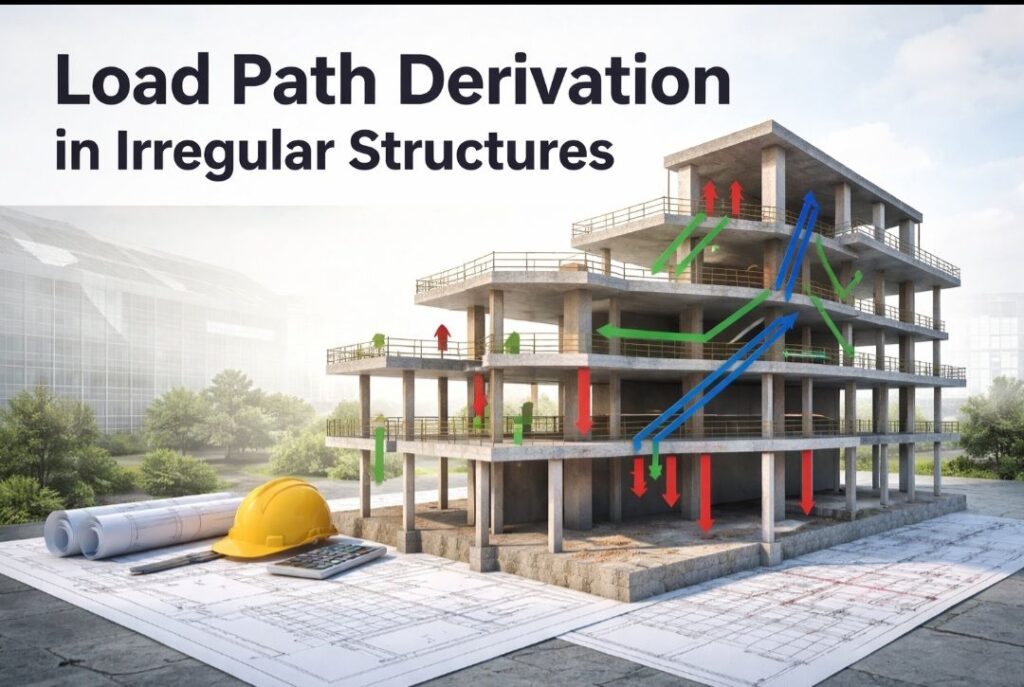
Every structure, regardless of its complexity, must satisfy a fundamental requirement: loads must have a clear and continuous path from the point of application to the ground. In regular, symmetrical buildings, this load path is often intuitive and predictable. Gravity loads travel vertically through slabs, into beams, then into columns, and finally into the foundation.
Lateral loads are resisted through well-defined systems such as frames, shear walls, or cores.
However, in irregular structures, this simplicity disappears. Architectural demands, functional requirements, and site constraints often introduce discontinuities, asymmetry, and abrupt changes in geometry or stiffness. These irregularities disrupt conventional load paths, forcing engineers to carefully derive how forces actually flow through the structure. In such cases, assumptions based on regular behaviour can be dangerously misleading.
Load path derivation in irregular structures is therefore not just an analytical exercise; it is a critical step in ensuring structural safety. Failures in complex buildings are often not due to insufficient strength, but due to misunderstood or incomplete load paths. Understanding how loads deviate, concentrate, and redistribute in irregular systems is essential for robust design.
Load Paths Beyond Idealisation
In basic structural analysis, load paths are often introduced in simplified terms. Loads are assumed to travel along straight, predictable routes through clearly defined elements. While this is useful for conceptual understanding, real structures behave differently, especially when irregularities are present.
A load path is not a single line or direction. It is a network of force flows distributed across multiple elements, influenced by stiffness, geometry, and boundary conditions. In irregular structures, loads do not necessarily follow the shortest or most direct route. Instead, they follow the stiffest available path.
This distinction is critical. Engineers must shift from thinking in terms of geometry to thinking in terms of stiffness and compatibility. The structure will “choose” how loads flow based on relative stiffness of elements, not on how the building appears visually.
Sources of Irregularity in Structures
Irregularities in structures can arise in many forms, and each type influences load paths differently. Plan irregularity occurs when the layout of the structure is asymmetric, such as L-shaped or U-shaped buildings. Vertical irregularity arises when there are sudden changes in stiffness or mass along the height, such as setbacks, transfer floors, or soft storeys.
Discontinuities in structural elements are among the most critical forms of irregularity. For example, when a column is discontinued at a lower level and supported by a transfer beam, the direct load path is interrupted. The load must now be diverted laterally before continuing downward, creating complex stress patterns.
Openings in slabs, irregular placement of shear walls, and eccentric positioning of cores can also alter load paths significantly. Each of these conditions forces loads to redistribute in ways that may not be immediately obvious without detailed analysis.
Load Path Derivation Under Gravity Loads
In regular buildings, gravity loads are transferred vertically with minimal deviation. In irregular structures, however, vertical load paths often include horizontal components due to discontinuities.
Consider a building where upper-level columns do not align with columns below. The loads from these columns must be transferred through beams or slabs acting as transfer elements. These elements experience significant bending and shear as they redirect loads horizontally before passing them down to the supporting columns.
In such scenarios, the engineer must identify not only the primary load-carrying elements but also secondary paths that may become critical under certain conditions. For example, slabs may begin to act as deep beams, redistributing loads across wider क्षेत्रों than initially assumed.
A practical scenario can be seen in buildings with large open ground floors used for parking or commercial spaces. Columns from upper floors may terminate at transfer structures, creating a complex load path that combines bending, shear, and sometimes torsion.
Load Path Under Lateral Loads
Lateral loads introduce an additional layer of complexity, particularly in irregular structures. Wind and seismic forces generate horizontal actions that must be resisted by the structure’s lateral load-resisting system. In regular buildings, this system is typically well-defined. In irregular buildings, however, the distribution of stiffness is often uneven.
When stiffness is not symmetrically distributed, lateral loads do not act through the geometric center of the structure. Instead, they act through the center of stiffness, which may be offset. This creates torsional effects, causing the building to twist as it responds to lateral forces.
The resulting load path is no longer linear. Forces are distributed unevenly across structural elements, with some members experiencing significantly higher demands than others. Engineers must carefully evaluate these effects to ensure that no element is overstressed.
This behaviour is particularly critical in seismic regions, where irregular load paths can lead to concentration of damage and potential collapse. The demonstrated how irregular buildings with poor load path continuity suffered disproportionately compared to more regular structures.
Stiffness and Load Path Formation
Stiffness is the governing factor in load path derivation. In any structural system, loads are attracted to stiffer elements. This principle becomes especially important in irregular structures, where stiffness may vary significantly across the building.
For example, if a building has a very stiff shear wall on one side and flexible frames on the other, a large portion of the lateral load will be carried by the shear wall. This uneven distribution can lead to overstressing of certain elements and underutilization of others.
Similarly, in gravity load transfer, stiffer beams or slabs will attract more load. Engineers must ensure that stiffness distribution is balanced to avoid unintended load concentrations.
Understanding stiffness relationships allows engineers to predict how loads will flow through the structure, even before detailed analysis is performed.
Analytical Approaches to Load Path Derivation
Deriving load paths in irregular structures requires a combination of conceptual understanding and advanced analytical tools. While simplified models can provide initial insights, detailed analysis is often necessary to capture the true behaviour of the structure.
Finite element modelling is commonly used to simulate load distribution in complex systems. These models allow engineers to visualize stress flow, identify critical elements, and evaluate the impact of irregularities.
However, reliance on software alone is not sufficient. Engineers must interpret results critically, ensuring that the model accurately represents the physical behaviour of the structure. Incorrect assumptions or modelling errors can lead to misleading conclusions.
A strong conceptual understanding of load paths is therefore essential to complement analytical methods.
Structural Consequences of Poor Load Path Definition
Failure to properly derive load paths can have serious consequences. When loads are not transferred efficiently, certain elements may become overloaded while others remain underutilized. This imbalance can lead to cracking, excessive deflection, or even structural failure.
In extreme cases, discontinuities in load paths can trigger progressive collapse. If a critical element fails and no alternative load path exists, the structure may not be able to redistribute loads effectively, leading to a chain reaction of failures.
Many structural failures can be traced back to inadequate understanding of load paths rather than insufficient material strength. This highlights the importance of thorough analysis and careful design in irregular structures.
Practical Scenario
Consider a multi-storey building with a large atrium at lower levels. The atrium eliminates several columns, requiring upper floors to transfer loads around the opening. The load path becomes indirect, with forces flowing through beams and slabs that were not originally intended to carry such loads.
Initially, the structure may appear stable. However, over time, cracks develop in transfer beams, and excessive deflection becomes noticeable. These are signs that the load path is not functioning as intended. Without intervention, the structure may experience localized failures that could escalate.
This scenario illustrates how architectural features can introduce complex load paths that require careful engineering consideration.
Design Strategies for Managing Irregular Load Paths
Designing for irregular structures requires a proactive approach to managing load paths. Engineers must ensure continuity in structural elements wherever possible, avoiding abrupt changes that disrupt force flow.
Where discontinuities are unavoidable, elements such as transfer beams, trusses, or deep slabs must be designed to handle the additional demands. Redundancy should be incorporated to provide alternative load paths in case of local failure.
Close collaboration between architects and engineers is also essential. Early integration of structural considerations can help minimize irregularities and simplify load paths.
Conclusion
Load path derivation in irregular structures is one of the most critical aspects of structural engineering. Unlike regular buildings, where load flow is predictable, irregular structures require careful analysis to understand how forces move through the system.
The behaviour of these structures is governed by stiffness, geometry, and continuity. Loads follow the stiffest available path, often leading to unexpected force distributions and potential stress concentrations.
A deep understanding of load paths allows engineers to design structures that are not only strong but also robust and resilient.
Also See: Design for Disproportionate Collapse under Blast and Impact Loading
Sources & Citations
- Taranath, B.S. Structural Analysis and Design of Tall Buildings. CRC Press, 2016.
- • ASCE/SEI 7-16. Minimum Design Loads and Associated Criteria for Buildings and Other Structures.
- • Chopra, A.K. Dynamics of Structures. Pearson, 2017.
- • Starossek, U. Progressive Collapse of Structures. Thomas Telford, 2009.
