Support conditions play a central role in determining how forces are distributed within a structure.
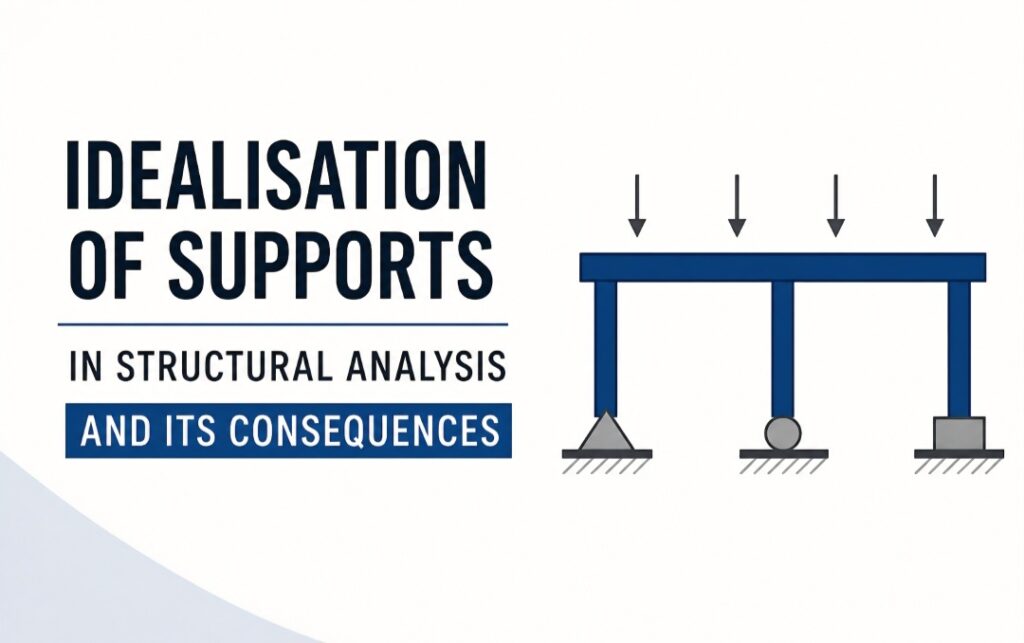
Structural analysis depends heavily on simplification. In order to make complex systems solvable, engineers idealise real structures into manageable models. Among the most critical of these idealisations is the treatment of supports. In analysis, supports are often assumed to behave as perfectly fixed, pinned, or roller connections. These assumptions provide clarity and allow the use of established analytical methods.
However, in reality, supports rarely behave in such idealised ways. Foundations deform, connections possess partial stiffness, and construction tolerances introduce variability. The difference between assumed and actual support behaviour can significantly influence how forces develop within a structure.
Understanding the implications of support idealisation is essential for producing results that reflect real structural behaviour.
Nature of Support Idealisation
In structural models, supports are defined by their ability to restrain movement and rotation. A fixed support is assumed to prevent both translation and rotation. A pinned support allows rotation but restrains translation. A roller support allows movement in one direction while restraining others.
These idealisations simplify boundary conditions and make analysis possible. They create clear distinctions in how structures respond to loading and form the basis for calculating reactions, internal forces, and deflections.
Yet these categories are theoretical constructs. Real supports do not exhibit perfectly rigid or perfectly free behaviour. Instead, they exist along a spectrum of stiffness, where both translation and rotation are resisted to varying degrees.
Structural Behaviour of Supports
In practice, supports are influenced by material properties, connection detailing, and interaction with surrounding elements. A foundation resting on soil will experience settlement and rotation under load. A beam-to-column connection may exhibit partial fixity due to reinforcement detailing or connection geometry.
Even elements assumed to be rigid may undergo deformation under significant loading. Concrete foundations crack, steel connections deform, and soil compresses. These effects alter the boundary conditions of the structure and, consequently, its internal force distribution.
The discrepancy between assumed and actual support behaviour becomes more pronounced in flexible systems, long-span structures, and cases where soil-structure interaction is significant.
Influence on Internal Force Distribution
Support conditions play a central role in determining how forces are distributed within a structure. A beam analysed as simply supported will develop maximum bending moment at midspan, while the same beam assumed to be fixed at supports will develop significant negative moments at the supports.
If the actual support behaviour differs from the assumed condition, the internal force distribution will shift accordingly. Partial fixity, for example, can lead to moments that lie between those predicted by pinned and fixed conditions.
This has direct implications for design. Reinforcement detailing, member sizing, and safety margins are all based on calculated internal forces. If these forces are inaccurate due to incorrect support assumptions, the structure may be either overdesigned or, more critically, underdesigned.
Effect on Structural Stiffness and Deflection
Support idealisation also affects the overall stiffness of a structure. Fixed supports increase stiffness by restraining rotation, leading to reduced deflection. Pinned supports allow greater rotation, resulting in increased deformation.
When actual supports are less rigid than assumed, deflections may be higher than predicted. This can lead to serviceability issues such as excessive sagging, cracking of finishes, or misalignment of structural elements.
In some cases, deflection rather than strength governs design. Accurate representation of support conditions is therefore essential for predicting realistic performance.
Rotational Stiffness and Partial Fixity
Real connections often provide partial rotational restraint. This behaviour is neither fully fixed nor fully pinned but lies somewhere in between. The degree of restraint depends on factors such as connection geometry, material properties, and detailing.
Partial fixity introduces complexity into analysis, as it requires the consideration of rotational stiffness rather than simple boundary conditions. While more accurate, it also demands a deeper understanding of structural behaviour and connection mechanics.
Ignoring partial fixity can lead to simplified but misleading results. Incorporating it, where necessary, leads to more realistic modelling and better alignment between analysis and actual performance.
Time-Dependent Changes in Support Behaviour
Support conditions are not always constant over time. Soil settlement, creep in materials, and degradation of connections can alter how supports behave long after construction is complete.
A support initially assumed to be fixed may gradually lose stiffness due to cracking or foundation movement. This change affects internal force distribution and can lead to redistribution within the structure.
Time-dependent changes highlight the importance of considering not only initial conditions but also how supports may evolve throughout the life of the structure.
Simplification and Engineering Judgement
Despite these complexities, idealisation remains necessary. It is not practical to model every aspect of support behaviour in routine design. The challenge lies in selecting assumptions that are both realistic and conservative.
Engineers must understand the limitations of their models and apply judgement when defining support conditions. In some cases, conservative assumptions may be appropriate. In others, more refined modelling may be required to capture critical behaviour.
The goal is not perfect accuracy, but informed approximation.
Consequences of Incorrect Idealisation
Incorrect support assumptions can lead to significant design errors. Overestimating fixity may result in underestimating midspan moments, while underestimating support stiffness can lead to excessive reinforcement at midspan.
In extreme cases, misrepresentation of support behaviour can compromise structural safety. More commonly, it results in inefficient design, unnecessary material use, or serviceability problems.
Recognising these consequences reinforces the importance of careful modelling and critical evaluation of assumptions.
Conclusion
Support idealisation is a fundamental aspect of structural analysis, however, it represents one of the most significant sources of discrepancy between analytical models and real behaviour. While simplified boundary conditions enable practical design, they must be applied with an understanding of their limitations.
Real supports are neither perfectly fixed nor perfectly free. They exhibit behaviour influenced by stiffness, material properties, and interaction with the environment. These factors affect how forces are distributed and how structures deform.
Also See: Idealisation of Structures: How Engineers Visualise and Break Down Structural Systems
Sources & Citations
- Hibbeler, R.C. Structural Analysis. Pearson Education.
- Kassimali, A. Structural Analysis. Cengage Learning.
- Chen, W.F., & Lui, E.M. Stability Design of Steel Frames. CRC Press.
- EN 1990 & EN 1993 (Eurocode): Basis of Structural Design and Steel Structures.
- Salmon, C.G., Johnson, J.E., & Malhas, F.A. Steel Structures: Design and Behavior. Pearson.
