This article explains how portal frame stability is governed by sway and second-order effects, and how Eurocode 3 (EN 1993-1-1) treats these phenomena through its stability rules.
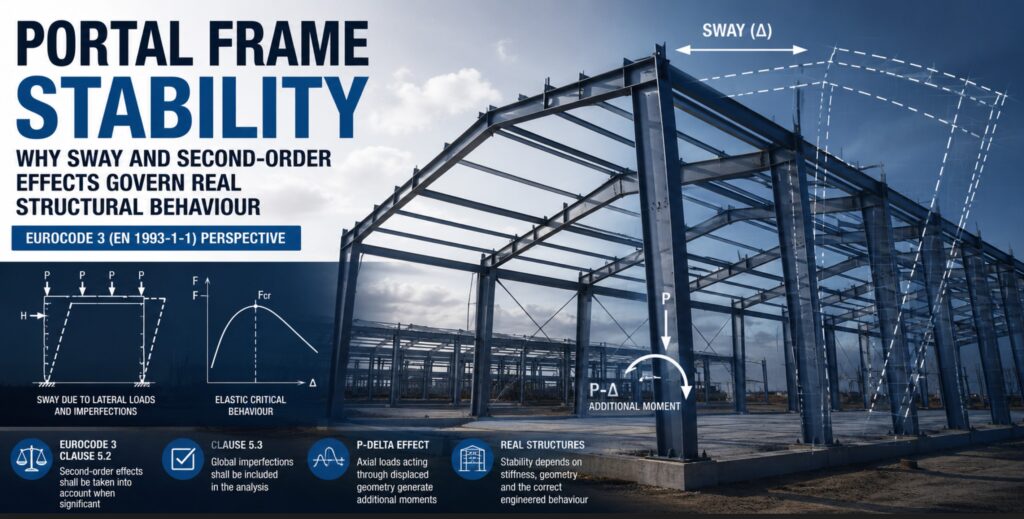
Portal frames often appear straightforward during preliminary design. Engineers idealise them as simple assemblies of beams and columns capable of resisting vertical and horizontal loads through bending action alone. This simplification makes early calculations easy and gives the impression that once member sizes satisfy bending and axial checks, the structure is safe. In practice, this assumption only captures part of the real behaviour.
As load increases, every real frame begins to deform. Columns lean slightly, beams rotate at joints, and the entire geometry shifts from its original position. This movement is not just a geometric observation; it changes the internal force distribution in a way that first-order analysis does not capture. Eurocode recognises this limitation clearly and does not allow engineers to ignore it when the structure becomes sufficiently flexible.
This article explains how portal frame stability is governed by sway and second-order effects, and how Eurocode 3 (EN 1993-1-1) treats these phenomena through its stability rules. Instead of viewing stability as an advanced topic, we will connect it directly to real structural behaviour and the clauses that govern design decisions. The goal is to show that portal frame safety depends less on strength alone and more on how the structure behaves when it moves.
The Real Nature of Portal Frame Behaviour
A portal frame resists vertical loads primarily through bending in the beam and axial forces in the columns. Under ideal conditions, the frame remains perfectly aligned, and all forces are calculated based on this undeformed geometry. This is the basis of first-order analysis, which assumes that deformations are small enough not to influence internal force distribution.
However, Eurocode 3 does not allow this assumption to be used universally. Clause 5.2 of EN 1993-1-1 makes a clear distinction between first-order and second-order analysis. It states that second-order effects must be considered when they significantly influence the response of the structure. In portal frames, this condition is reached much earlier than many engineers expect, particularly in slender or lightly braced systems.
Once the frame deforms, the loads no longer act through their original line of action. Instead, vertical loads act through a displaced geometry, producing additional bending effects. This is the beginning of second-order behaviour, where internal forces depend on both loads and deformation.
How Sway Begins in Real Structures
Sway in a portal frame does not require extreme loading conditions. It begins quietly through imperfections, stiffness imbalance, or asymmetric load distribution. Eurocode explicitly acknowledges this in Clause 5.3, which introduces the concept of geometric imperfections in global analysis. The code assumes that no structure is perfectly vertical or perfectly aligned, even if construction tolerances are tight.
These imperfections introduce small horizontal displacements. Once displacement begins, the stiffness distribution within the frame changes. A slightly more flexible column attracts less axial force but undergoes larger deformation. The stiffer column resists more load but also attracts higher internal forces. This imbalance leads to joint rotations, which further increases lateral movement.
At this stage, sway becomes a structural response rather than a construction error. It is part of how the system redistributes load under real conditions. Wind loads can amplify this effect, but they are not the only trigger. Even gravity loads alone can generate sway in tall or flexible frames.
Eurocode Condition for Second-Order Effects
Eurocode 3 provides a clear threshold for when second-order analysis becomes necessary. Clause 5.2.1(3) and related guidance introduce the stability parameter:
Second-order effects must be considered when the ratio between design load effects and critical buckling resistance becomes significant. In simplified form, this is often expressed as:
when the frame approaches its elastic critical condition.
The elastic critical load represents the point at which a structure becomes unstable under axial loading. In portal frames, this is associated with overall sway buckling of the frame rather than individual member failure.
What is important is not only the value itself, but the ratio between applied load and critical load. As this ratio increases, the structure becomes more sensitive to deformation, and second-order effects grow rapidly. This is why relatively small increases in load or reductions in stiffness can significantly change structural behaviour.
Elastic Critical Behaviour
Eurocode stability philosophy is built around the idea that every frame has a theoretical elastic critical load. This is the load at which the structure would theoretically buckle if material yielding did not occur first.
In portal frames, this concept is particularly important because the system behaves as a single global unit. If stiffness is reduced in one column or joint, the entire frame response changes. This global interaction is what makes portal frames sensitive to second-order effects.
Clause 5.2 of EN 1993-1-1 links this behaviour directly to analysis requirements. It separates structures that can safely use linear analysis from those that require second-order consideration or amplification methods. The key factor is stiffness relative to load level, not just member strength.
Second-Order Effects and the P-Delta Mechanism
Once sway exists, vertical loads begin to act through a displaced geometry. This creates additional moments that were not present in the original first-order condition. This phenomenon is commonly referred to as the P-Delta effect.
Eurocode does not treat P-Delta as a separate concept. Instead, it is embedded within second-order analysis requirements under Clause 5.2.2. The principle is straightforward: internal forces must be calculated on the deformed shape of the structure when deformation significantly affects equilibrium.
In a portal frame, this means that axial loads in the columns produce additional bending moments when the frame sways. The magnitude of this effect depends on both the axial load and the lateral displacement. As displacement increases, the additional moment increases, which in turn increases displacement again. This creates a feedback loop that can significantly amplify internal forces.
This is why second-order effects are not a minor correction. They represent a fundamental change in how the structure carries load.
Why Portal Frames Are Highly Sensitive
Portal frames are particularly vulnerable to second-order effects because their lateral stability depends on bending stiffness rather than triangulation. Unlike braced systems, there is no geometric mechanism to prevent lateral movement. The entire resistance comes from flexural rigidity of beams and columns.
Eurocode recognises this indirectly through its stability framework. When stiffness is low relative to axial load, the frame moves closer to its critical condition, and second-order effects become dominant.
Several practical conditions increase this sensitivity. Tall columns increase slenderness, large roof loads increase axial force, and flexible joints reduce rotational restraint. When these conditions combine, the frame becomes increasingly responsive to small disturbances.
This is why portal frames that appear similar in geometry can behave very differently in practice. One may remain stable under service loads, while another exhibits noticeable sway and amplified internal forces.
Imperfections as a Design Requirement
One of the most important aspects of Eurocode stability philosophy is the mandatory inclusion of imperfections. Clause 5.3 introduces global and local imperfections as part of structural analysis. These imperfections are not optional and are not considered construction errors. They are part of the design model itself.
Eurocode introduces notional horizontal forces to represent these imperfections. These forces ensure that even in the absence of wind or lateral loading, the structure still experiences a minimum level of lateral demand. This forces the designer to account for sway effects regardless of external conditions.
For portal frames, this is particularly significant. It means that even a perfectly symmetrical load case will still produce lateral effects in design. This prevents unsafe reliance on idealised symmetry, which does not exist in real construction.
Practical Behaviour in Real Structures
In actual buildings, the effects of second-order behaviour often appear before any structural failure occurs. Frames may exhibit visible lateral movement during erection or under roof loading. Cladding systems may show misalignment, and openings may require adjustment due to frame displacement.
These issues are often mistaken for construction defects, but they are frequently the result of underestimated flexibility in the structural system. Once construction is complete, correcting stiffness-related issues becomes extremely difficult without significant reinforcement.
This is why Eurocode stability checks are not theoretical exercises. They directly influence how a building behaves during construction and throughout its service life.
Engineering Interpretation of Stability
Stability in portal frames is not determined solely by strength checks. It is governed by the relationship between load and stiffness. Eurocode captures this relationship through its requirement to consider second-order effects when necessary.
From a design perspective, increasing stiffness is often more effective than increasing strength. Larger sections, improved joint rigidity, or additional bracing elements can significantly reduce sway and therefore reduce second-order amplification.
The key engineering insight is that a stable structure is not one that simply resists load, but one that limits deformation under load.
Conclusion
Portal frame stability depends on behaviour rather than just capacity. As load increases, deformation begins to influence internal forces, and second-order effects become significant. Eurocode 3 addresses this explicitly through Clauses 5.2 and 5.3, which require engineers to consider both geometric imperfections and stability-related amplification when necessary.
Sway develops naturally in flexible systems, and once it begins, it interacts with axial loads to produce additional moments through the P-Delta effect. This interaction can significantly increase internal forces beyond those predicted by first-order analysis.
Understanding this behaviour allows engineers to design frames that are not only strong but stable in real conditions. In portal frame design, safety is ultimately governed by how the structure behaves when it moves, not just how it behaves on paper.
Also See: Structural Analysis & Design of Steel Portal Frames
Sources & Citations
- EN 1993-1-1:2005 + A1:2014 Eurocode 3: Design of steel structures – Part 1-1: General rules and rules for buildings. European Committee for Standardization (CEN), Brussels.
- EN 1992-1-1:2004 + A1:2014 Eurocode 2: Design of concrete structures – Part 1-1: General rules and rules for buildings. European Committee for Standardization (CEN), Brussels.
- Trahair, N. S., & Bradford, M. A. (1998) The Behaviour and Design of Steel Structures to BS 5950.Chapman & Hall.
- Hancock, G. J. (2007) Design of Cold-Formed Steel Structures. Elsevier.
