While strength protects against structural failure, stability prevents loss of equilibrium, and serviceability ensures satisfactory performance during normal use.
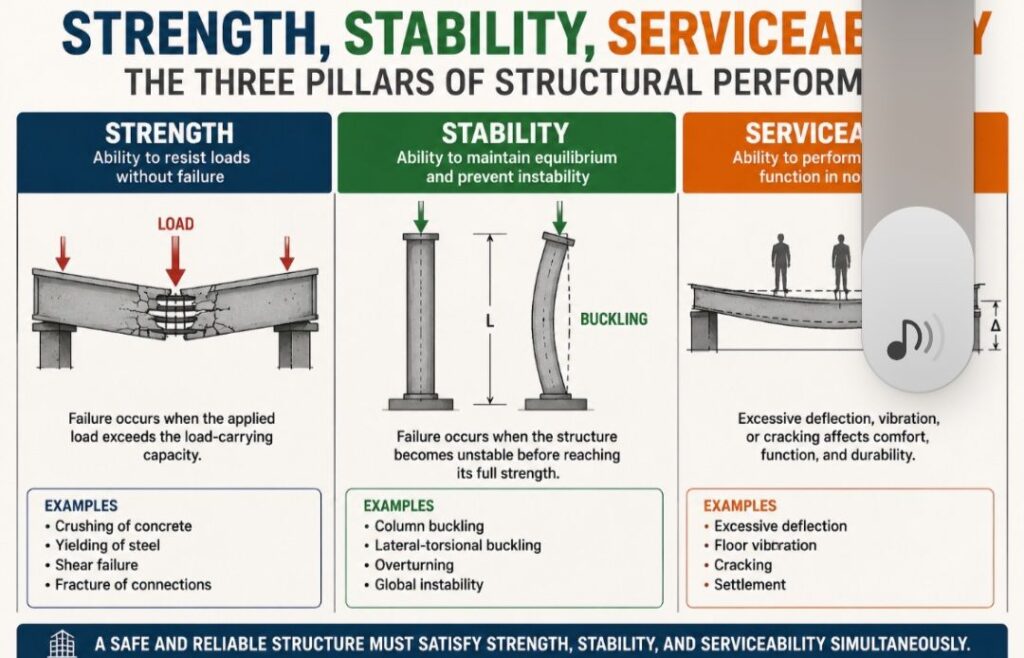
Structural engineering is fundamentally concerned with ensuring that structures perform safely and effectively throughout their intended lifespan. To achieve this objective, engineers must satisfy three critical design requirements: strength, stability, and serviceability.
Although these terms are frequently used together, they represent distinct aspects of structural performance. A structure may possess adequate strength but still fail due to instability. Likewise, a structure may remain safe from collapse yet perform poorly because serviceability requirements have not been met.
Understanding the differences between strength, stability, and serviceability is therefore essential for both structural design and assessment.
Understanding Structural Strength
Strength refers to the ability of a structural element or system to resist applied loads without experiencing failure.
When engineers design a beam, column, slab, or foundation, they must ensure that the structure can safely resist the forces imposed upon it. These forces may include dead loads, live loads, wind loads, seismic actions, and other environmental effects.
For reinforced concrete structures, strength is governed by the capacity of both concrete and reinforcement to resist bending, shear, compression, and tension. For steel structures, strength depends on the ability of steel members and connections to resist applied forces without yielding or fracturing.
A strength failure occurs when the applied load exceeds the load-carrying capacity of the structure.
Examples of strength failures include:
- Crushing of concrete columns.
- Yielding of steel beams.
- Shear failure of reinforced concrete members.
- Fracture of structural connections.
Strength-related failures are often sudden and can result in partial or complete collapse if adequate safety measures are not provided.
For this reason, structural design codes require engineers to verify that every member possesses sufficient strength under the most severe design load combinations.
Understanding Structural Stability
While strength concerns the ability to resist loads, stability concerns the ability to maintain equilibrium under those loads.
A structure may possess considerable strength yet become unstable if its geometry or support conditions allow excessive displacement or buckling.
One of the most common examples of instability is column buckling.
A slender column subjected to compression may fail long before the material reaches its compressive strength because the member becomes unstable and deflects laterally.
The phenomenon can be represented by Euler’s critical buckling equation:
[ P_{cr} = \frac{\pi^2 EI}{(KL)^2} ]
This relationship shows that member geometry can govern failure even when material strength remains largely unused.
Examples of stability failures include:
- Buckling of slender columns.
- Lateral-torsional buckling of beams.
- Overturning of retaining walls.
- Global instability of tall structures.
- Progressive sway of inadequately braced frames.
Stability is particularly important in modern structures where longer spans, slender members, and taller buildings are increasingly common.
A structure that lacks stability may fail despite having sufficient material strength.
Understanding Serviceability
Serviceability refers to the ability of a structure to perform its intended function without causing discomfort, damage, or operational problems during normal use.
Unlike strength and stability, serviceability is not primarily concerned with collapse.
Instead, it addresses how a structure behaves under everyday loading conditions.
A building may remain completely safe from structural failure while still exhibiting excessive deflection, vibration, cracking, or settlement that affects usability and occupant comfort.
Common serviceability concerns include:
- Excessive beam deflection.
- Floor vibrations.
- Cracking of concrete elements.
- Excessive settlement.
- Water leakage resulting from structural movement.
- Misalignment of doors, windows, and partitions.
For example, a floor slab may possess adequate strength to support all anticipated loads but still experience excessive vibration when people walk across it. Although collapse is unlikely, occupants may perceive the floor as unsafe or uncomfortable.
Similarly, excessive beam deflection may damage finishes and partitions even when structural safety remains uncompromised.
Serviceability requirements therefore ensure that structures remain functional, durable, and comfortable throughout their service life.
Strength Alone Is Not Enough
Many people mistakenly assume that a strong structure is automatically a good structure.
In reality, structural design involves much more than preventing collapse.
Consider a reinforced concrete beam that has sufficient strength to resist all applied loads. If the beam deflects excessively under service loads, cracks may develop in finishes, ceilings may become distorted, and occupants may lose confidence in the structure.
Likewise, a highly reinforced slender column may possess substantial compressive strength but still fail through buckling if stability considerations are ignored.
These examples demonstrate why structural engineers must evaluate multiple performance criteria simultaneously.
Modern Design Codes and These Requirements
Modern structural design standards recognize the importance of strength, stability, and serviceability.
Under the Eurocode framework, engineers generally perform:
- Ultimate Limit State (ULS) checks to verify strength and overall safety.
- Stability checks to prevent buckling, overturning, and loss of equilibrium.
- Serviceability Limit State (SLS) checks to control deflection, vibration, cracking, and other performance issues.
A successful design satisfies all three requirements.
Meeting only one or two is insufficient.
The Relationship Between Strength, Stability, and Serviceability
Although strength, stability, and serviceability are distinct concepts, they are closely interconnected.
Strength ensures that a structure does not fail under load.
Stability ensures that the structure maintains equilibrium and resists instability mechanisms.
Serviceability ensures that the structure remains functional and comfortable throughout its intended lifespan.
Together, these three requirements form the foundation of modern structural engineering practice.
A structure can only be considered successful when it is strong enough to resist loads, stable enough to maintain its configuration, and serviceable enough to perform its intended function without causing unacceptable problems for its users.
Conclusion
The distinction between strength, stability, and serviceability is one of the most important concepts in structural engineering. While strength protects against structural failure, stability prevents loss of equilibrium, and serviceability ensures satisfactory performance during normal use.
Engineering failures often occur when one of these requirements is overlooked. Consequently, structural engineers must evaluate all three throughout the design process to produce structures that are not only safe but also durable, functional, and efficient.
Ultimately, successful structural design is not simply about making structures stronger. It is about achieving the appropriate balance between strength, stability, and serviceability to ensure reliable performance throughout the life of the structure.
Also See: Vibration Serviceability in Long span Floors
Sources & Citations
- EN 1990:2002+A1:2005 – Eurocode: Basis of Structural Design.
- EN 1992-1-1:2004+A1:2014 – Eurocode 2: Design of Concrete Structures – General Rules and Rules for Buildings.
- EN 1993-1-1:2005+A1:2014 – Eurocode 3: Design of Steel Structures – General Rules and Rules for Buildings.
- Macdonald, A. J. (2001). Structure and Architecture. Architectural Press.
- Salmon, C. G., Johnson, J. E., & Malhas, F. A. (2009). Steel Structures: Design and Behavior. Pearson Education
