A properly designed retaining wall should never rely solely on structural strength. Drainage is an essential part of the structural system.
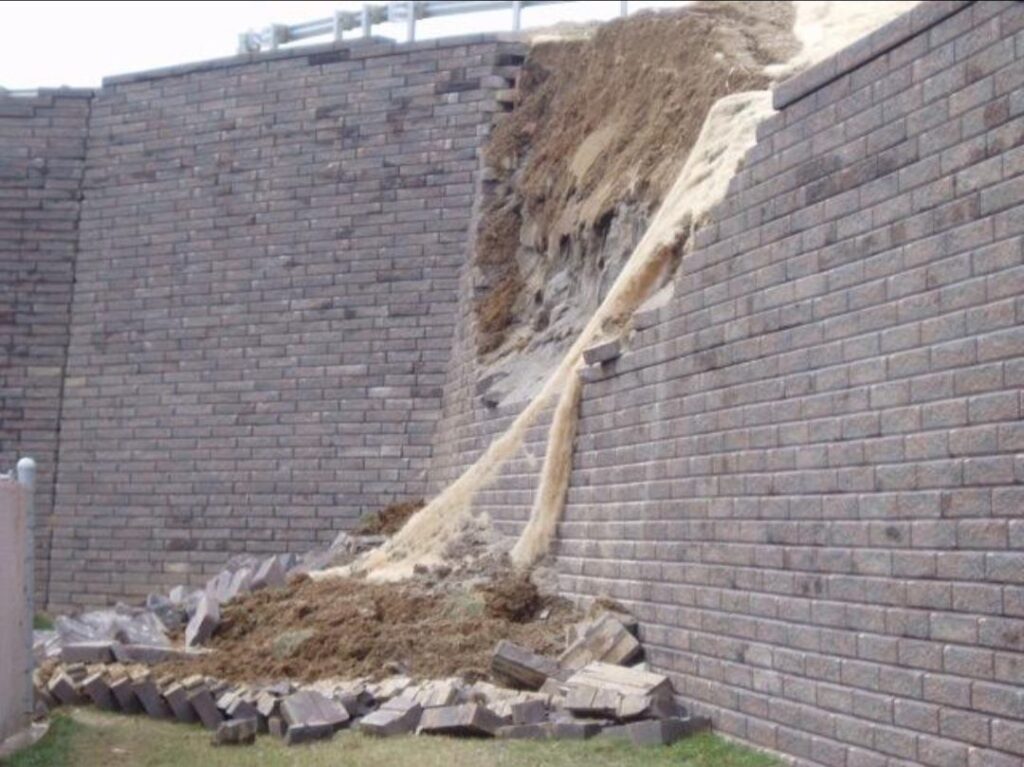
A retaining wall may appear stable throughout the dry season and then suddenly begin to crack, tilt, or collapse once the rains arrive. In many cases, the wall itself is not the real problem. The failure often begins behind the wall, where water slowly changes the forces acting on the structure until the wall can no longer resist them.
Retaining walls are designed to resist lateral earth pressure. Under dry conditions, the soil behind the wall exerts a predictable force that engineers can estimate with reasonable accuracy. During the rainy season, however, water infiltrates the backfill soil and dramatically alters its behaviour. The wall that seemed adequate in dry weather may suddenly become overstressed because the actual loads have increased far beyond what was assumed during design.
In many developing urban areas, retaining walls are constructed without proper drainage systems, without geotechnical investigation, or with inadequate reinforcement detailing. Some are even built as masonry gravity walls where reinforced concrete systems should have been used. These weaknesses often remain hidden until prolonged rainfall exposes them.
The Role of Hydrostatic Pressure
The most dangerous effect of rainfall on retaining walls is usually hydrostatic pressure.
When water accumulates behind a wall and cannot escape, it exerts pressure in addition to the soil pressure already acting on the structure. Unlike soil pressure, which depends largely on soil density and internal friction, hydrostatic pressure increases linearly with water depth and acts continuously across the wall surface.
The pressure exerted by water can be represented by:
P = ƴw.h
Where:
- P is the water pressure,
- Ywis the unit weight of water,
- h is the depth below the water surface.
This means that even a moderate accumulation of trapped water can produce substantial lateral loading. Because water pressure acts uniformly and continuously, it can rapidly push a wall beyond its design capacity.
Many retaining wall failures during rainy periods are therefore not purely “soil failures” but drainage failures.
Poor Drainage Is One of the Biggest Causes
A properly designed retaining wall should never rely solely on structural strength. Drainage is an essential part of the structural system.
Engineers typically provide:
- Weep holes,
- Drainage pipes,
- Granular backfill,
- Geotextile filters,
- Subsurface drainage layers.
Without these provisions, water becomes trapped behind the wall. As saturation increases, the effective stress within the soil decreases while pore water pressure rises. The soil becomes heavier and weaker at the same time.
In poorly drained clayey soils, this condition becomes even worse because clay retains water and drains slowly. The wall may remain under elevated pressure long after rainfall has stopped.
Many failed retaining walls reveal no major concrete crushing or reinforcement fracture. Instead, they show signs of gradual rotation, sliding, or overturning caused by persistent water buildup.
Increase in Soil Weight During Saturation
Rainwater does not only add water pressure. It also increases the weight of the retained soil.
Dry soil becomes saturated soil, and saturated soil has a much higher unit weight. This directly increases lateral earth pressure acting on the wall.
For active earth pressure, engineers commonly use:
Where:
- is the active earth force,
- is the active earth pressure coefficient,
- is the unit weight of soil,
- is wall height.
As rainfall saturates the backfill, the value of increases significantly. This means the total lateral force rises even before hydrostatic pressure is considered.
If the original design underestimated soil conditions or ignored groundwater effects, the wall may become critically overstressed during prolonged rainfall.
Sliding Failure of Retaining Walls
Some retaining walls fail by sliding forward at the base.
Sliding occurs when the horizontal driving force becomes greater than the resisting friction between the foundation and the soil beneath it. Rainwater contributes to this problem in multiple ways:
- Increased lateral pressure,
- Reduced soil shear strength,
- Softening of founding soils,
- Erosion beneath the footing.
The resisting force against sliding is commonly expressed as:
Where:
- is frictional resistance,
- is the coefficient of friction,
- is the vertical load.
When the foundation soil becomes saturated, the friction coefficient may reduce substantially. At the same time, increased lateral loading pushes harder against the wall. This combination creates ideal conditions for sliding failure.
In severe cases, erosion caused by uncontrolled runoff can undermine portions of the foundation entirely.
Overturning Failure
Another common rainy-season failure mechanism is overturning.
As water pressure and soil pressure increase, the overturning moment acting about the toe of the wall also increases. If the resisting moment generated by the wall’s self-weight becomes insufficient, the wall rotates outward.
Tall slender walls are particularly vulnerable if:
- Base widths are inadequate,
- Reinforcement is insufficient,
- Drainage is poor,
- Backfill slopes toward the wall,
- Surcharge loads are ignored.
Retaining wall overturning often begins gradually. Small rotations may first appear as:
- Cracks near the stem,
- Separation at joints,
- Leaning alignment,
- Bulging sections.
Without intervention, complete collapse may follow during subsequent storms.
Poor Backfill Material
The quality of backfill strongly affects retaining wall performance.
Good retaining wall backfill should ideally:
- Drain easily,
- Possess good shear strength,
- Contain limited clay content,
- Compact properly.
Unfortunately, many site projects use excavated material indiscriminately as backfill. Clay-rich soils trap water and develop high pore pressure during rainfall. Organic soils may also decompose and settle over time.
Improper compaction compounds the problem further. Loose backfill settles unevenly and may create localized pressure concentrations against the wall.
Inadequate Structural Design
Some retaining walls fail simply because they were underdesigned from the beginning.
Common design deficiencies include:
- Ignoring groundwater effects,
- Inadequate reinforcement,
- Insufficient footing dimensions,
- Poor shear design,
- Neglecting surcharge loads,
- Lack of stability checks.
Under Eurocode principles, retaining wall design requires verification against:
- Sliding,
- Overturning,
- Bearing failure,
- Structural failure,
- Serviceability conditions.
Geotechnical design considerations under Eurocodes are mainly covered under , while reinforced concrete detailing falls under .
Failure to integrate both geotechnical and structural behaviour is one reason many retaining walls experience distress during extreme weather.
The Effect of Poor Construction Practices
Even a good design can fail if construction quality is poor.
Common site-related issues include:
- Honeycombed concrete,
- Incorrect reinforcement placement,
- Poor concrete curing,
- Blocked drainage pipes,
- Inadequate compaction,
- Weak foundation preparation.
In some cases, drainage pipes are installed but later clogged by fine soil particles because no filter layer was provided. Once drainage becomes ineffective, hydrostatic pressure begins to build again.
Construction sequencing also matters. If backfilling occurs before adequate concrete strength develops, excessive early loading may weaken the wall permanently.
Climate Change and Increasing Rainfall Intensity
Rainfall events are becoming more intense in many regions. Drainage systems that may once have been adequate are increasingly overwhelmed by higher runoff volumes.
Urbanization also contributes significantly. Concrete surfaces reduce natural infiltration and concentrate stormwater flows. Retaining walls near roads, hillside developments, and drainage channels therefore experience higher hydraulic loading than originally anticipated.
Modern retaining wall design increasingly requires engineers to consider:
- Extreme rainfall scenarios,
- Surface runoff management,
- Long-term drainage maintenance,
- Groundwater fluctuations,
- Erosion control systems.
Preventing Retaining Wall Failure
Retaining wall failures during rainy seasons are often preventable when engineering principles are properly followed.
A safe retaining wall system should include:
- Proper geotechnical investigation,
- Adequate drainage design,
- Suitable backfill selection,
- Structural stability checks,
- Quality construction supervision,
- Regular maintenance.
Drainage inspection is especially critical before rainy periods begin. Blocked weep holes, damaged drain pipes, or eroded foundation areas should never be ignored.
Ultimately, retaining walls are not merely concrete barriers resisting soil. They are drainage-sensitive structural systems interacting continuously with soil mechanics, groundwater behaviour, and environmental loading. Once water is neglected in design or construction, failure becomes only a matter of time.
Also See: Retaining Walls Construction Methods
Sources and Citations
- Eurocode 7: Geotechnical Design
- Eurocode 2: Design of Concrete
- Structures. Das, B. M. Principles of Foundation Engineering
- Bowles, J. E. Foundation Analysis and Design.
