Understanding the mechanics behind soft-storey collapse is therefore essential because the problem is fundamentally behavioural rather than simply dimensional.
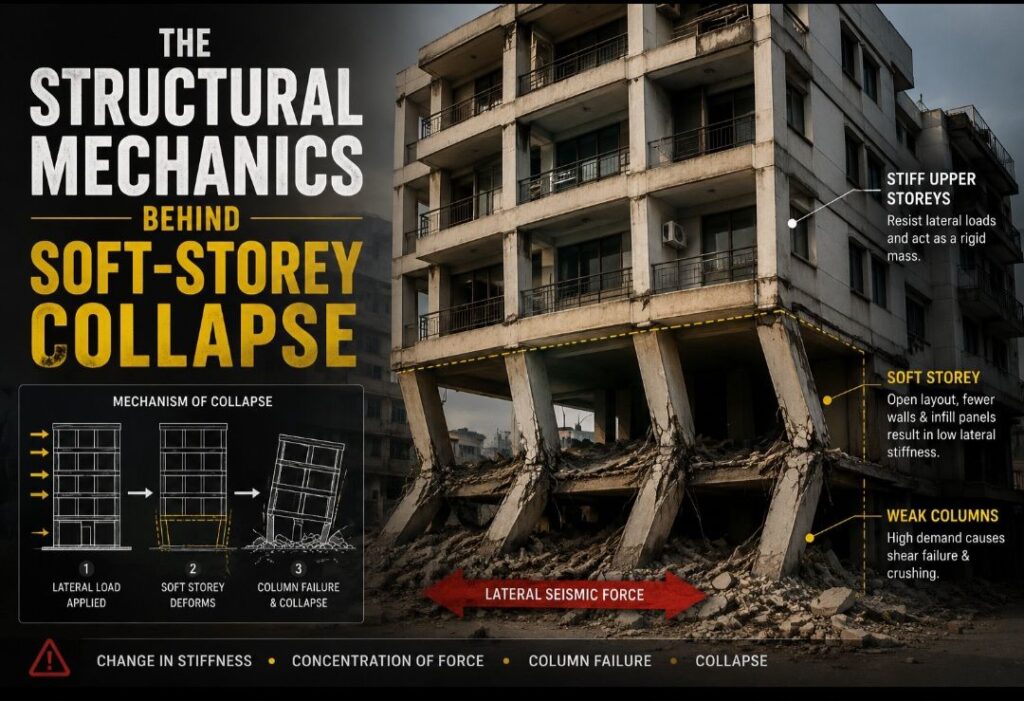
Buildings are expected to transfer loads safely from the upper levels of the structure down to the foundation. Under ordinary gravity loading, this load transfer process is often stable and predictable because vertical structural elements such as columns and walls provide continuous support throughout the height of the building.
However, structures subjected to lateral loading behave very differently.
When wind or seismic forces act on a building, the structure begins to respond as an integrated lateral force-resisting system. The entire building sways, internal forces redistribute dynamically, and deformation compatibility between floors becomes critically important. Under these conditions, structural irregularities that may appear insignificant under gravity loading can become extremely dangerous.
One of the most critical of these irregularities is the soft storey.
Soft-storey collapse is one of the most destructive and commonly observed forms of structural failure during earthquakes and severe lateral loading events. It occurs when one level of a building possesses substantially lower stiffness or strength than the floors above it, causing deformation and damage to concentrate disproportionately within that level.
Instead of lateral forces being distributed uniformly throughout the structure, the soft storey becomes the primary zone of deformation. Columns experience excessive drift demands, second-order effects intensify, stiffness deteriorates rapidly, and local failure mechanisms begin to develop.
Once this process initiates, collapse progression can become extremely rapid.
Understanding the mechanics behind soft-storey collapse is therefore essential because the problem is fundamentally behavioural rather than simply dimensional. It is not merely the presence of an open floor that creates danger, but the way stiffness irregularity alters structural response under lateral loading.
What Is a Soft Storey?
A soft storey is a level within a building that possesses significantly lower lateral stiffness compared to adjacent storeys.
This reduction in stiffness commonly occurs when one floor contains fewer walls, fewer bracing elements, or more open space than the upper floors. Ground floors used for parking, commercial spaces, entrance lobbies, or large open halls are particularly susceptible to this condition.
In many buildings, upper floors contain masonry infill walls, partitions, and closely spaced structural elements that contribute substantial lateral stiffness. If the ground floor lacks these elements, a sudden discontinuity in stiffness develops within the structural system.
Under gravity loading, the building may appear entirely adequate because vertical load paths remain intact. Under lateral loading, however, the behaviour changes dramatically.
The soft storey becomes the weakest lateral deformation zone within the structure.
Stiffness and Structural Response
To understand soft-storey collapse, it is first necessary to understand the role of stiffness in structural systems.
Stiffness represents the resistance of a structure to deformation under applied load. In lateral systems, stiffness governs how horizontal forces distribute throughout the building.
When a structure possesses relatively uniform stiffness along its height, lateral deformation tends to distribute more evenly between storeys. No single level experiences excessive displacement concentration.
However, when one storey is substantially softer than the others, deformation localises within that level because the structure naturally deforms most where resistance is lowest.
This behaviour is similar to a chain containing one weak link. Under loading, the weakest region undergoes the largest deformation while stiffer regions remain comparatively stable.
As a result, the soft storey attracts disproportionately large drift demand.
Concentration of Interstorey Drift
Interstorey drift refers to the relative horizontal displacement between adjacent floors during lateral loading.
In a building with a soft storey, drift becomes heavily concentrated within the flexible level because upper floors move almost as a rigid block while the soft level undergoes excessive deformation.
This concentration of drift creates severe demands on columns, beam-column joints, and connections within the soft storey.
The problem becomes especially dangerous because structural damage increases stiffness degradation. As cracking develops and yielding begins, stiffness reduces further, causing even greater deformation concentration within the same level.
This creates a progressive feedback mechanism where increasing damage produces increasing deformation.
The soft storey therefore becomes progressively weaker as loading continues.
Column Behaviour in Soft Storeys
Columns within soft storeys experience some of the most critical demands in the entire structure.
Under lateral displacement, these columns must resist large bending moments while simultaneously carrying substantial axial gravity loads from the upper floors.
As drift increases, bending stresses intensify rapidly. The columns experience curvature reversal, cracking, reinforcement yielding, and increasing instability effects.
Unlike upper floors where walls and partitions may share lateral resistance, soft-storey columns often carry the majority of the lateral demand alone.
This concentration of force can push columns into highly nonlinear behaviour very quickly.
Once yielding begins, the stiffness of the columns reduces significantly, causing lateral displacement demands to increase even further.
Second-Order Effects and Instability
One of the most dangerous aspects of soft-storey behaviour is the amplification of second-order effects.
As lateral displacement increases, gravity loads acting through displaced columns generate additional overturning moments. These additional moments are known as P-Delta effects.
In stable structures, second-order effects may remain relatively small. In soft-storey systems, however, large drift concentrations can amplify these effects dramatically.
The displaced structure effectively creates additional destabilising forces that increase column demand further.
This creates another feedback loop:
- larger displacement produces larger secondary moments,
- which produce larger deformation,
- which further increases instability.
As this mechanism progresses, the structure may approach a condition of lateral instability.
At this stage, collapse can occur suddenly.
Influence of Masonry Infill Walls
Many soft-storey failures are strongly influenced by masonry infill walls.
Although infill walls are often treated as non-structural elements during design, they contribute substantial stiffness to buildings under lateral loading. Upper floors containing infill walls therefore become significantly stiffer than open ground floors without walls.
This creates a sharp stiffness discontinuity between levels.
During seismic loading, upper storeys with infill walls move relatively little while the open storey absorbs most of the lateral deformation.
The resulting concentration of drift can overwhelm the ground-floor columns rapidly.
This explains why buildings with open parking levels beneath residential floors are especially vulnerable to soft-storey collapse.
Dynamic Behaviour During Earthquakes
Soft-storey collapse becomes particularly severe during earthquakes because seismic loading is dynamic and cyclic.
Unlike static lateral loads, earthquake forces reverse direction repeatedly and introduce inertia effects throughout the structure. Floors accelerate back and forth, generating large cyclic demands within the lateral system.
Soft storeys attract a disproportionate share of this dynamic deformation because of their reduced stiffness.
Repeated cyclic loading accelerates cracking, stiffness degradation, and reinforcement yielding within the affected level.
As the structure loses stiffness, its vibration characteristics also change. Natural periods lengthen, dynamic response evolves, and instability effects intensify further.
The structural system may therefore deteriorate progressively during the earthquake itself.
Failure Mechanisms in Soft Storeys
Soft-storey collapse often begins with excessive drift and column cracking within the flexible level.
As deformation increases, plastic hinges form at column ends. Reinforcement yields, concrete confinement becomes critical, and cyclic degradation weakens the load-carrying capacity of the columns.
If shear demand becomes excessive, brittle column shear failure may occur before adequate ductile deformation develops.
This is especially dangerous because shear failure is rapid and sudden.
Once several columns lose capacity, gravity load redistribution becomes unstable. Adjacent columns become overloaded, triggering progressive collapse mechanisms throughout the storey.
Upper floors may then descend onto the weakened level, producing partial or total structural collapse.
Role of Structural Regularity
Buildings with regular stiffness distribution generally perform much better under lateral loading because deformation distributes more uniformly throughout the structure.
Structural regularity helps prevent excessive concentration of force and drift within isolated regions.
Soft-storey conditions violate this principle by introducing abrupt stiffness changes that disrupt normal force distribution.
This highlights an important principle in structural engineering: uniformity in stiffness is often just as important as strength itself.
A strong structure with severe stiffness irregularity may perform worse than a weaker but more uniform system.
Prevention of Soft-Storey Collapse
Preventing soft-storey collapse requires controlling stiffness irregularity and ensuring adequate lateral resistance throughout the height of the building.
This may involve:
- adding shear walls,
- introducing bracing systems,
- increasing column stiffness,
- improving confinement reinforcement,
- or redistributing lateral resisting elements more uniformly.
Capacity design principles are also important. Columns within soft storeys must possess sufficient ductility and shear resistance to sustain large deformation demands without brittle failure.
The goal is not merely to increase strength, but to ensure stable and controlled structural behaviour under lateral loading.
Conclusion
Soft-storey collapse represents one of the clearest examples of how stiffness irregularity can govern structural behaviour under lateral loading.
The problem is fundamentally mechanical in nature. When one level becomes significantly more flexible than the surrounding structure, deformation concentrates within that region, triggering excessive drift, second-order effects, stiffness degradation, and progressive instability.
Columns within the soft storey experience extreme demands because they must resist both gravity loads and amplified lateral deformation simultaneously.
As damage accumulates, the structure becomes increasingly unstable, often leading to rapid collapse progression.
Understanding soft-storey mechanics therefore requires more than recognising architectural irregularity. It requires understanding how stiffness governs force distribution, how deformation localises within weak regions, and how instability develops progressively within structural systems.
In modern structural engineering, preventing collapse is not simply a matter of designing strong members. It is a matter of ensuring stable structural behaviour throughout the entire load-resisting system.
Also See: Across- Wind Load on Rectangular Tall Buildings
Sources & Citations
- Chopra, A.K. Dynamics of Structures. Pearson Education.
- Paulay, T., & Priestley, M.J.N. Seismic Design of Reinforced Concrete nd Masonry Buildings.
- FEMA 451. NEHRP Recommended Provisions for Seismic Regulations for New Buildings.
- EN 1998 (Eurocode 8): Design of Structures for Earthquake Resistance.
- Park, R., & Paulay, T. Reinforced Concrete Structures.
