A beam is generally considered deep when its span-to-depth ratio becomes sufficiently small such that strain distribution across the depth is no longer linear.
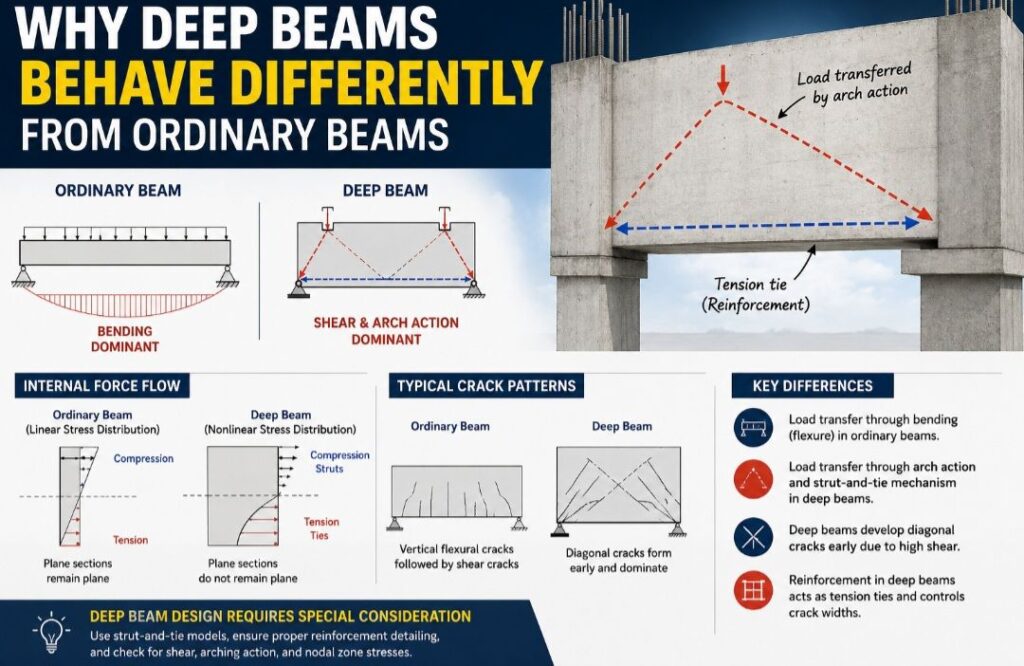
Beam theory forms one of the foundational concepts in structural engineering. From early structural analysis to modern reinforced concrete design, engineers are taught to analyse beams primarily through flexural behaviour. Loads are transferred through bending, tensile stresses develop at one face, compressive stresses develop at the opposite face, and shear stresses are distributed across the depth of the member. For ordinary slender beams, these assumptions generally produce reliable results.
However, not all beams behave in this conventional manner.
When the depth of a beam becomes large relative to its span, the assumptions governing ordinary beam theory begin to break down. Internal stresses no longer distribute linearly, strain behaviour changes significantly, and load transfer mechanisms become dominated by direct force paths rather than classical flexural action. These members are known as deep beams.
Deep beams represent one of the most important examples of disturbed structural behaviour in reinforced concrete design. Their response differs fundamentally from ordinary beams because geometry alters how forces flow through the member. Rather than behaving primarily through bending, deep beams develop arching action, nonlinear stress fields, and concentrated compression struts that dramatically influence structural performance.
Understanding why deep beams behave differently is essential because applying ordinary beam assumptions to deep beam behaviour can lead to serious design errors.
What Defines a Deep Beam
A beam is generally considered deep when its span-to-depth ratio becomes sufficiently small such that strain distribution across the depth is no longer linear.
In conventional beam theory, it is assumed that plane sections remain plane after bending. This assumption allows engineers to derive linear strain and stress distributions through the depth of the member. However, deep beams violate this assumption because shear deformation becomes significant relative to flexural deformation.
Most design codes define deep beams using span-to-depth limits. In reinforced concrete structures, members with clear spans less than approximately four times their overall depth are often classified as deep beams. However, the distinction is not merely geometric. The defining characteristic is behavioural rather than dimensional.
Deep beams behave differently because load transfer occurs through direct compression paths between loads and supports.
Breakdown of Classical Beam Theory
Ordinary beam theory is based on several simplifying assumptions. One of the most important is that sections perpendicular to the neutral axis before loading remain plane after deformation.
This assumption works reasonably well for slender beams because flexural deformation dominates structural response. Internal stresses distribute gradually, and strain variation through the depth remains approximately linear.
In deep beams, however, the load path becomes much shorter and steeper. Forces transfer rapidly between load application points and supports, producing highly nonlinear stress distributions.
The strain profile through the depth no longer remains linear. Shear deformation becomes substantial, and local stress concentrations develop within the member.
As a result, ordinary flexural theory cannot accurately capture the internal behaviour of deep beams.
Dominance of Shear Behaviour
One of the most significant differences between deep beams and ordinary beams is the increased dominance of shear.
In slender beams, flexure typically governs design because bending moments become large relative to shear forces. Cracks usually initiate vertically in flexural tension zones before gradually evolving into diagonal shear cracks.
In deep beams, the situation changes dramatically. Because spans are shorter relative to depth, shear forces become extremely significant. Diagonal stresses develop rapidly, and load transfer begins to occur through inclined compression fields within the concrete.
This causes deep beams to develop diagonal cracking patterns much earlier than ordinary beams. Failure mechanisms become strongly influenced by shear rather than pure flexure.
The concentration of shear stresses also increases the risk of brittle failure if reinforcement detailing is inadequate.
Arching Action in Deep Beams
Perhaps the most important behavioural characteristic of deep beams is arching action.
In ordinary beams, loads are transferred gradually through flexural stresses distributed along the member length. In deep beams, however, loads tend to travel directly toward supports through diagonal compression struts.
This creates a natural arch mechanism within the beam.
The concrete between the load point and support behaves like a compression arch, while reinforcement acts as the tension tie resisting horizontal thrust forces generated by the arching action.
As a result, internal force flow within deep beams differs fundamentally from ordinary beam behaviour. Instead of smooth stress variation dominated by bending, deep beams develop concentrated compression trajectories and tension tie forces.
The load path becomes highly nonlinear and localised.
Disturbed Regions and Nonlinear Stress Flow
Deep beams are often classified as disturbed regions, sometimes referred to as D-regions in structural design.
In ordinary structural regions, stress distribution remains relatively smooth and predictable, allowing classical beam theory to provide reasonable approximations.
Disturbed regions, by contrast, contain abrupt changes in geometry, support conditions, or load application that disrupt normal stress flow.
Deep beams fall into this category because loads and reactions occur so close together that stresses cannot redistribute gradually.
Instead, internal forces flow through concentrated compression fields, tension zones, and nodal regions where stresses become highly complex.
This explains why stress trajectories within deep beams differ significantly from those in slender beams.
Crack Patterns in Deep Beams
The cracking behaviour of deep beams also differs substantially from ordinary beams.
In slender beams, flexural cracks usually initiate vertically near regions of maximum bending moment. As loading increases, diagonal shear cracks may eventually form near supports.
Deep beams often exhibit diagonal cracking at relatively early stages of loading because shear stresses dominate structural response.
These cracks typically develop along the principal tensile stress trajectories within the beam. Instead of isolated vertical flexural cracks, deep beams frequently develop extensive diagonal cracking patterns extending between load points and supports.
This cracking behaviour reflects the internal force flow associated with arching action.
The formation of diagonal cracks significantly influences stiffness, force redistribution, and ultimate failure behaviour.
Reinforcement in Deep Beams
Reinforcement detailing becomes especially critical in deep beams because of the complex stress fields involved.
In ordinary beams, longitudinal reinforcement primarily resists flexural tension while stirrups resist shear forces.
In deep beams, reinforcement must participate in maintaining the integrity of the internal load transfer mechanism. Horizontal reinforcement helps resist tension tie forces associated with arching action, while vertical reinforcement controls diagonal cracking and improves ductility.
Because stresses are highly concentrated near load and support regions, anchorage detailing becomes extremely important. Poor anchorage can lead to premature bond failure and collapse of the internal force transfer mechanism.
Reinforcement in deep beams therefore serves a more integrated structural role than in conventional flexural members.
Strut-and-Tie Behaviour
The behaviour of deep beams is commonly analysed using strut-and-tie models because classical beam theory becomes inadequate.
Strut-and-tie modelling idealises internal force flow using compression struts within concrete and tension ties formed by reinforcement.
This method reflects the actual load transfer mechanism observed within deep beams. Forces travel through diagonal compression paths while reinforcement resists tensile forces necessary to maintain equilibrium.
Nodes develop at regions where struts and ties intersect, often corresponding to highly stressed zones within the structure.
Strut-and-tie models therefore provide a more realistic representation of deep beam behaviour than ordinary flexural analysis.
The approach is particularly valuable because it recognises that deep beams behave more like structural force-transfer systems than traditional bending members.
Failure Modes of Deep Beams
Deep beams can fail through several mechanisms depending on geometry, reinforcement, and material behaviour.
Diagonal compression failure may occur when compression struts crush under excessive stress. Diagonal tension failure may develop when tensile stresses exceed the cracking resistance of concrete and reinforcement is insufficient to control crack propagation.
Anchorage failure can occur if reinforcement cannot adequately develop required forces within highly stressed regions.
Because deep beams are heavily influenced by shear and stress concentration, failure may occur suddenly and in a brittle manner if detailing is poor.
This contrasts with slender flexural beams, which often exhibit more gradual yielding behaviour before collapse.
Influence of Load and Support Locations
Load and support placement strongly influence deep beam behaviour because force transfer occurs directly between these regions.
Small changes in load position can significantly alter stress trajectories within the beam. Concentrated loads near supports intensify compression fields and increase stress concentration within nodal zones.
Similarly, support geometry affects how forces spread through the member.
This sensitivity explains why deep beam design requires careful attention to load application regions, bearing zones, and reinforcement anchorage details.
Applications of Deep Beams
Deep beams commonly occur in transfer girders, pile caps, wall beams, bunker structures, offshore structures, and heavily loaded foundation systems.
Transfer structures in high-rise buildings often behave as deep beams because they support large concentrated loads over relatively short spans.
Pile caps also exhibit deep beam behaviour due to direct force transfer between columns and piles.
In these applications, understanding actual force flow becomes essential for safe and efficient design.
Conclusion
Deep beams behave differently from ordinary beams because their geometry fundamentally alters how forces move through the structure. As span-to-depth ratios decrease, classical flexural assumptions become increasingly invalid and internal behaviour becomes dominated by shear, arching action, and nonlinear stress flow.
Instead of transferring loads gradually through bending, deep beams develop direct compression struts between loads and supports. This produces disturbed stress regions, extensive diagonal cracking, and highly concentrated internal forces. The resulting behaviour requires different analytical approaches, different detailing strategies, and a deeper understanding of structural mechanics than ordinary beam design.
Also See: Structural Analysis and Design of Transition Structures
Sources & Citations
- Schlaich, J., Schäfer, K., & Jennewein, M. Toward a Consistent Design of Structural Concrete.
- MacGregor, J.G., & Wight, J.K. Reinforced Concrete: Mechanics and Design.
- Nilson, A.H., Darwin, D., & Dolan, C.W. Design of Concrete Structures.
- EN 1992-1-1 (Eurocode 2): Design of Concrete Structures.
- ACI Committee 318. Building Code Requirements for Structural Concrete.
