Under load reversal, stress pattern changes. A region previously subjected to compression may suddenly experience tension.
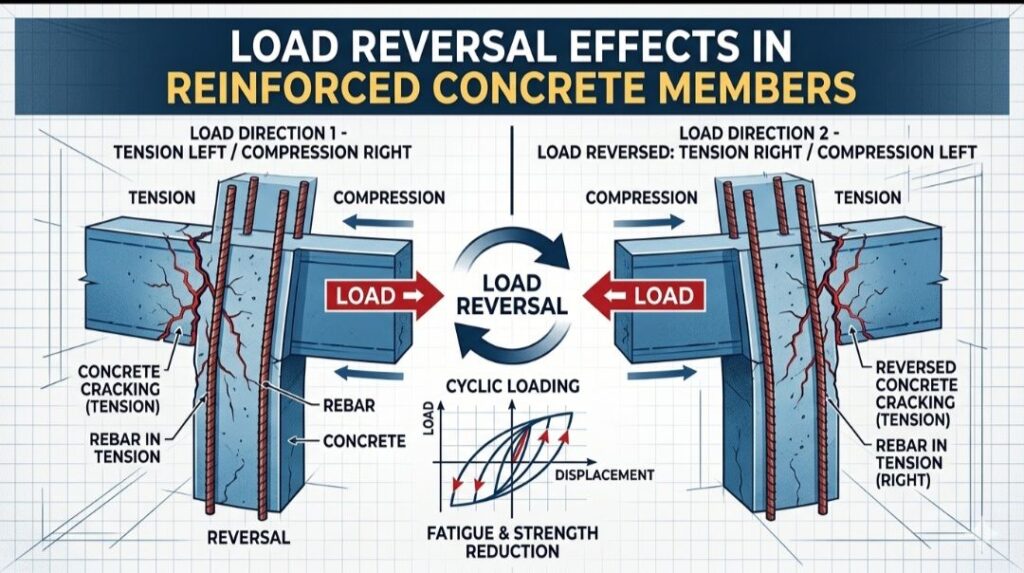
Most reinforced concrete members are designed with an assumed direction of loading in mind. Beams are expected to sag under gravity loads, slabs are analysed based on downward loading, and reinforcement is detailed according to predicted tension zones. In reality, however, structures do not always experience forces in a single consistent direction. Changes in loading conditions, environmental effects, wind action, seismic response, differential settlement, vibration, and continuity within structural systems can all cause internal forces to reverse.
This phenomenon is known as load reversal.
Load reversal occurs when a structural member experiences a change in the direction of bending moment, shear, or stress relative to its original condition. Regions previously in compression may become zones of tension, while reinforcement designed as secondary steel may suddenly become critical to structural performance.
Although often associated with seismic loading, load reversal is not limited to earthquakes. It can occur in bridges subjected to moving traffic, cantilever systems exposed to uplift forces, continuous beams under changing load patterns, and structures influenced by dynamic or lateral loading.
Understanding load reversal is essential because reinforced concrete behaves differently when stress patterns change. Cracking patterns evolve, stiffness reduces, bond conditions alter, and force redistribution becomes more complex. The structural response under reversed loading can differ significantly from behaviour under monotonic loading.
Nature of Load Reversal
In conventional gravity-loaded systems, the direction of internal forces is relatively predictable. Simply supported beams experience positive bending moments, causing tension at the bottom fibres and compression at the top. Reinforcement is therefore concentrated in expected tension zones.
Under load reversal, this stress pattern changes. A region previously subjected to compression may suddenly experience tension. Reinforcement that was lightly stressed under normal loading may become primary reinforcement during reversed loading conditions.
This transition is particularly important in reinforced concrete because concrete performs poorly in tension. Once tensile stresses exceed the cracking strength of concrete, cracks form and stiffness decreases significantly.
Repeated reversal of stresses can therefore produce extensive cracking, cyclic degradation, and progressive reduction in structural stiffness.
Causes of Load Reversal
Load reversal can develop through several mechanisms depending on the structural system and loading environment.
Lateral Loading
Wind and seismic forces are among the most common causes of load reversal in buildings. Unlike gravity loads, lateral forces can act in multiple directions, causing bending moments within members to alternate.
During seismic excitation, for example, beams and columns within moment-resisting frames may experience repeated cycles of positive and negative bending. Reinforcement on opposite faces of the member alternately becomes tension reinforcement as the direction of structural sway changes.
This cyclic stress reversal creates demanding conditions that differ fundamentally from ordinary static loading.
Moving Loads
Bridges and industrial structures often experience load reversal due to moving loads. As vehicles or equipment travel across a structure, internal force patterns continuously change.
A section of a continuous bridge girder may experience positive bending under one loading position and negative bending under another. This repeated stress fluctuation affects fatigue behaviour, cracking patterns, and reinforcement demand.
Wind Uplift and Cantilever Action
Cantilever systems are particularly vulnerable to reversal effects because uplift forces can reverse expected stress patterns. Roof structures exposed to strong wind suction may develop moments opposite to those caused by gravity loading.
Similarly, retaining walls and foundations may experience changing lateral pressures that alter internal force directions.
Differential Settlement and Structural Redistribution
Support movement can also generate load reversal. Differential settlement may introduce unexpected moments into beams, slabs, and frames, reversing original force assumptions.
In indeterminate structures, redistribution of internal forces after cracking or local damage can further contribute to stress reversal within members.
Behaviour of Reinforced Concrete Under Reversed Loading
Reinforced concrete behaves differently under reversed loading compared to monotonic loading because cracking and bond conditions continuously evolve during stress cycling.
When concrete cracks under tension, stiffness reduces significantly. If loading reverses, previously cracked zones may close while new cracks develop on the opposite face of the member. This repeated opening and closing of cracks alters the stiffness characteristics of the member over time.
The reinforcement also experiences alternating stress cycles, affecting bond interaction between steel and concrete. Under repeated reversal, bond deterioration may occur, reducing force transfer efficiency and increasing slip between materials.
This behaviour becomes especially critical during severe cyclic loading such as earthquakes, where members experience multiple cycles of large deformation.
Stiffness Degradation
One of the most important consequences of load reversal is stiffness degradation.
As cracking develops on both faces of a reinforced concrete member, the effective stiffness progressively reduces. The structure becomes more flexible, resulting in larger deflections and increased displacement response under subsequent loading.
This reduction in stiffness alters load distribution throughout the structure. Members that lose stiffness may attract less force, while stiffer regions carry greater loads.
In seismic systems, stiffness degradation significantly affects dynamic response because natural frequencies and vibration characteristics change during loading.
The structure therefore behaves differently as damage accumulates.
Hysteretic Behaviour
Under cyclic load reversal, reinforced concrete exhibits hysteretic behaviour. Instead of following a single linear load-deformation relationship, the response forms loops representing energy dissipation during repeated loading cycles.
These hysteresis loops reflect cracking, yielding of reinforcement, bond slip, and inelastic deformation within the member.
Energy dissipation is beneficial in seismic design because it allows structures to absorb earthquake energy without immediate collapse. However, excessive cyclic deformation can also lead to progressive damage accumulation and strength deterioration.
The shape and stability of hysteresis loops therefore provide important insight into structural performance under reversed loading.
Influence on Reinforcement Detailing
Load reversal has major implications for reinforcement detailing.
In members subjected to possible stress reversal, reinforcement must often be provided on multiple faces to resist alternating tension zones. Continuous beams, seismic frames, and cantilever systems typically require substantial top and bottom reinforcement because tension may develop on either side depending on loading conditions.
Anchorage detailing also becomes more critical under reversed loading. Reinforcement must maintain adequate bond capacity during cyclic stress changes, requiring proper development length, confinement, and transverse reinforcement.
Poor detailing can lead to premature bond failure, reinforcement slip, and brittle behaviour under cyclic loading.
Load Reversal in Seismic Design
Seismic design represents one of the most demanding applications involving load reversal.
Earthquake forces subject structures to rapidly changing lateral motion, causing repeated cycles of stress reversal throughout the structural system. Beams, columns, joints, and walls experience alternating tension and compression as the structure sways back and forth.
Under these conditions, structures must possess not only strength but also ductility. Members must be capable of sustaining repeated inelastic deformation without sudden failure.
This is why seismic detailing requirements are often far more stringent than those for ordinary gravity-loaded structures. Confinement reinforcement, closely spaced stirrups, strong-column weak-beam philosophy, and ductile detailing provisions all aim to improve behaviour under cyclic load reversal.
Structural Consequences of Poor Reversal Resistance
Structures not properly detailed for load reversal may experience severe performance problems under cyclic loading conditions.
Cracking may become extensive, stiffness may reduce rapidly, and reinforcement anchorage may deteriorate. Brittle shear failures become more likely as cyclic degradation weakens concrete resistance.
In severe cases, progressive loss of stiffness and strength can lead to instability or collapse.
Even under moderate loading conditions, repeated reversal can increase long-term damage and maintenance requirements.
Understanding these risks is therefore essential when designing structures subjected to dynamic, lateral, or variable loading conditions.
Conclusion
Load reversal represents one of the most important yet frequently underestimated aspects of reinforced concrete behaviour. Unlike monotonic loading, reversed loading introduces alternating stress patterns that significantly affect cracking, stiffness, bond behaviour, and force redistribution.
The response of reinforced concrete under load reversal is governed not only by strength, but also by cyclic degradation, energy dissipation, and ductility. Members subjected to reversal effects require careful detailing to ensure adequate performance under changing loading conditions.
Also See: Design for Disproportionate Collapse Under Blast and Impact Loading
Sources & Citations
- Chopra, A.K. Dynamics of Structures. Pearson Education.
- Paulay, T., & Priestley, M.J.N. Seismic Design of Reinforced Concrete and Masonry Buildings.
- Nilson, A.H., Darwin, D., & Dolan, C.W. Design of Concrete Structures.
- Park, R., & Paulay, T. Reinforced Concrete Structures.
- EN 1998 (Eurocode 8): Design of Structures for Earthquake Resistance.
