Boundary conditions are among the most influential assumptions in structural analysis because they determine how a structure is restrained and how forces are transferred through it.
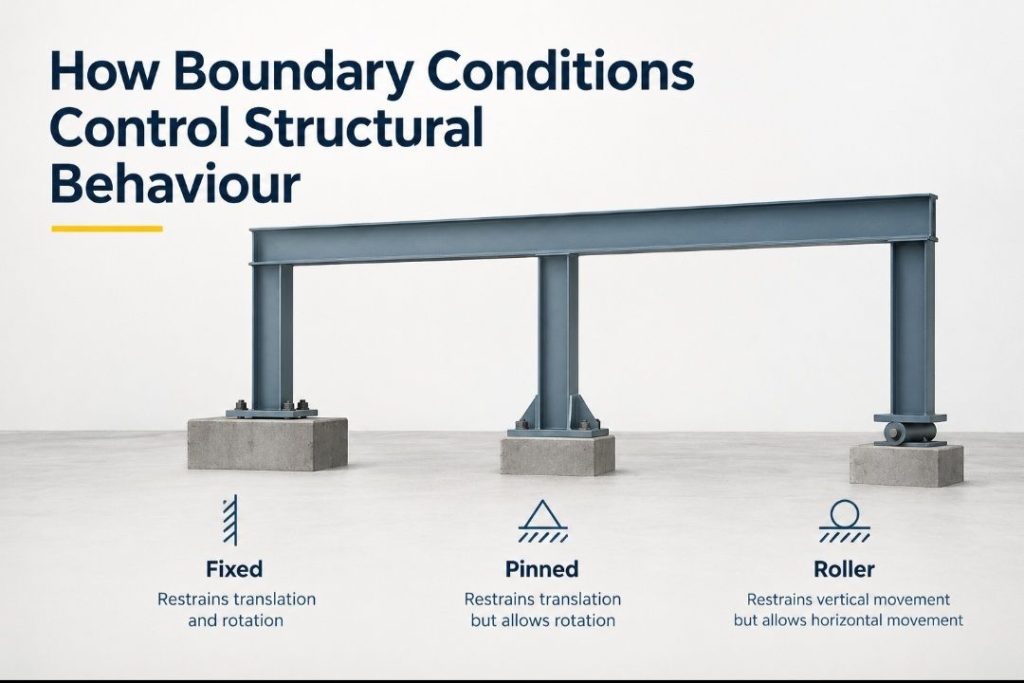
Structural analysis is built around a simple idea: a mathematical model is used to represent how a real structure carries and transfers load. The accuracy of that representation depends not only on member sizes and material properties, but also on how the structure is connected to its supports and surrounding elements. These assumptions are commonly represented through boundary conditions.
A boundary condition defines how a structural member or system is restrained and what movements are permitted at a particular location. A support may prevent translation while allowing rotation, restrict movement in several directions, or provide resistance through a more flexible connection. These choices directly influence the forces, reactions and deformations produced by an analysis.
This is why changing a boundary condition can produce a significant change in structural behaviour without changing the geometry or loading of the structure. An engineer who understands the physical behaviour behind the assumed restraints can therefore interpret analysis results more reliably and avoid creating a model that is mathematically correct but poorly representative of the actual structure.
What Is a Boundary Condition?
A boundary condition describes what can and cannot happen at a particular point, line or surface within a structural system.
For a simple beam, a pinned support may prevent horizontal and vertical translation while allowing rotation. A fixed support provides additional rotational restraint. A roller support may permit horizontal movement while resisting vertical movement.
These idealised conditions make structural analysis manageable, but real structures rarely behave exactly like textbook supports. A reinforced concrete beam-column connection has finite stiffness. A steel connection may provide some rotational resistance without behaving as a perfectly fixed joint. A foundation may settle or rotate rather than behaving like an immovable support.
The engineer therefore needs to decide which idealisation provides a reasonable representation of the actual structural behaviour.
Boundary Conditions Determine How Loads Are Transferred
Loads do not simply act on individual structural members. They travel through a connected system until they reach the foundations and the ground.
The assumed restraints influence the route taken by those loads.
Consider a beam supported at both ends. If both supports are modelled as pinned, the beam can rotate at the supports and the resulting bending moment distribution will differ from a beam with fixed ends. Introducing rotational restraint changes the shape of the bending moment diagram and can reduce positive moment in the span while generating negative moment near the supports.
The same principle applies to larger structural systems. Restraining a joint can attract additional force, while releasing that restraint can shift forces into other members.
A boundary condition is therefore not merely a setting within analysis software. It is part of the assumed load path.
Fixed and Pinned Supports Are Idealisations
The distinction between pinned and fixed supports is useful for understanding structural behaviour, but real connections usually fall somewhere between the two extremes.
A reinforced concrete beam cast monolithically with a column may provide significant rotational continuity. A steel beam connected to a column through a flexible connection may provide only limited rotational restraint.
If a connection is modelled as fully fixed when it behaves much more flexibly, the analysis may predict greater moment transfer than the actual connection can develop. Conversely, modelling a genuinely stiff connection as pinned may remove continuity that exists in the real structure.
The important question is therefore not simply whether a support is labelled “fixed” or “pinned.” The question is whether the assumed restraint reasonably represents the physical connection.
Foundation Conditions Matter
Boundary conditions become particularly important at the interface between a structure and its foundation.
A common analytical assumption is to model column bases as fully fixed or pinned. This can be appropriate for certain foundation and connection arrangements, but it should not automatically be applied to every building.
The actual behaviour depends on factors such as foundation type, soil stiffness, footing dimensions, reinforcement, base connection details and the interaction between the foundation and the supporting ground.
A foundation can experience translation, rotation and settlement. These movements can influence the forces within the superstructure.
For a flexible foundation system, assuming completely immovable supports may produce a different structural response from one that accounts for foundation flexibility.
Soil-Structure Interaction Can Change Structural Response
The ground is not an infinitely rigid support.
When a building applies load to the foundation, the supporting soil deforms. The magnitude and distribution of that deformation depend on the characteristics of the soil and the foundation system.
This can produce differential movement between supports. If one part of a structure settles more than another, additional forces can develop within beams, columns, walls and slabs.
For simple structures, these effects may be small enough for conventional support assumptions to remain reasonable. For more sensitive structures, particularly those with significant foundation flexibility or irregular loading, the interaction between the foundation and superstructure may need greater attention.
The boundary condition at the base is therefore connected directly to geotechnical behaviour.
Releases Can Change the Structural System
Member releases are another form of boundary condition used in structural modelling.
A release tells the analytical model that a particular force or moment is not transferred through a connection. For example, releasing the rotational degree of freedom at the end of a beam can represent a connection intended to behave as pinned.
However, an incorrect release can fundamentally change the behaviour of the model.
Releasing a connection that should provide continuity can eliminate an important load path. Failing to release a genuinely flexible connection can create artificial continuity and attract forces that the real connection cannot reliably transfer.
This is one reason releases should be based on actual structural details rather than used simply to make an analytical model produce more convenient results.
Boundary Conditions Influence Structural Stiffness
Boundary conditions also affect the stiffness of a structural system.
A structure with greater restraint generally has fewer degrees of freedom and may respond differently under lateral or vertical loading. Changing the restraint at one location can alter the stiffness distribution throughout the system.
This becomes particularly important in frames subjected to lateral loads.
For example, the assumed stiffness of beam-column connections can influence frame drift, member forces and the distribution of lateral loads. A model with fully rigid connections may therefore behave differently from one with semi-rigid connections.
The difference is not necessarily an indication that one model is mathematically wrong. It may indicate that the models represent different physical assumptions.
Boundary Conditions Affect Stability
Support conditions can also determine whether a structural system is stable.
A structure needs sufficient restraint to prevent unwanted rigid-body movement and to provide the stability required for the intended load cases.
An analytical model with inadequate restraints may exhibit mechanisms, excessive displacements or instability. Adding restraints can eliminate these movements, but the engineer must still establish whether those restraints actually exist in the physical structure.
Artificially restraining a model can hide a genuine stability problem.
For example, a partially completed steel frame may depend on temporary bracing before its permanent stability system is complete. If the model assumes restraints that have not yet been installed, the analysis may fail to represent the actual construction-stage condition.
Boundary Conditions Should Reflect Construction Stages
The completed structure is not the only condition that may require analysis.
During construction, floors may be incomplete, permanent bracing may not yet be installed and temporary supports may carry loads that will eventually be transferred through permanent members.
The boundary conditions therefore change during the construction sequence.
A steel frame during erection may have fewer restraints than the completed building. A reinforced concrete slab may initially rely on formwork and props before transferring loads to the permanent structure. A basement may rely on temporary excavation supports before the permanent slabs and walls become effective.
Where construction-stage stability is critical, these conditions should be recognised in the structural assessment.
Do Not Let Software Choose the Structural Behaviour
Modern structural analysis software makes it easy to assign supports, releases and restraints. The ease of applying these conditions can create a dangerous habit: selecting a convenient boundary condition without first deciding what the real structure is expected to do.
The software can calculate the response of the model it has been given. It cannot determine whether that model correctly represents the physical structure.
This distinction is important.
A model may converge successfully, produce clean diagrams and satisfy numerical checks while still containing an unrealistic support condition. Numerical stability does not automatically mean structural realism.
The engineer must therefore establish the physical behaviour first and then translate that behaviour into the analytical model.
How to Check Boundary Conditions
A useful check is to work backwards from the physical structure.
Ask what each connection can actually resist. Can it transfer bending moment? Can it resist horizontal movement? Can it rotate freely? Does the foundation have meaningful flexibility? Are there elements providing restraint that have been omitted from the model?
The resulting reactions should also make physical sense.
If a model produces an unexpected large reaction or unusual force concentration, the boundary conditions should be reviewed alongside the loading, stiffness and geometry. Unexpected results do not automatically mean the software is wrong.
They may indicate that the assumed structural system needs to be reconsidered.
Conclusion
Boundary conditions are among the most influential assumptions in structural analysis because they determine how a structure is restrained and how forces are transferred through it. Changing a support condition, connection release or foundation assumption can change reactions, bending moments, shear forces, deformation and stability without changing the basic geometry of the structure.
The challenge is that real structures rarely behave like perfectly pinned or perfectly fixed textbook systems. Connections have stiffness, foundations deform and construction stages introduce temporary conditions that can alter the available restraints.
A reliable structural model therefore begins with an understanding of the physical structure. Boundary conditions should represent the intended behaviour of the actual system rather than simply being selected to obtain a stable or convenient analysis model. The quality of the final design depends not only on the calculations performed, but also on whether the assumptions behind those calculations reflect the structure being built.
Also See: How Structural Models Can Give Different Results for the Same Building
Sources & Citations
- EN 1990, Eurocode: Basis of Structural Design, European Committee for Standardization.
- EN 1991-1-1, Eurocode 1: Actions on Structures – General Actions, European Committee for Standardization.
- EN 1992-1-1, Eurocode 2: Design of Concrete Structures, European Committee for Standardization.
- EN 1993-1-1, Eurocode 3: Design of Steel Structures, European Committee for Standardization.
- EN 1997-1, Eurocode 7: Geotechnical Design – General Rules, European Committee for Standardization.
