Every structural load eventually reaches the ground, and every ground movement influences the structure. This simple reality makes collaboration between structural and geotechnical engineers essential to successful project delivery.
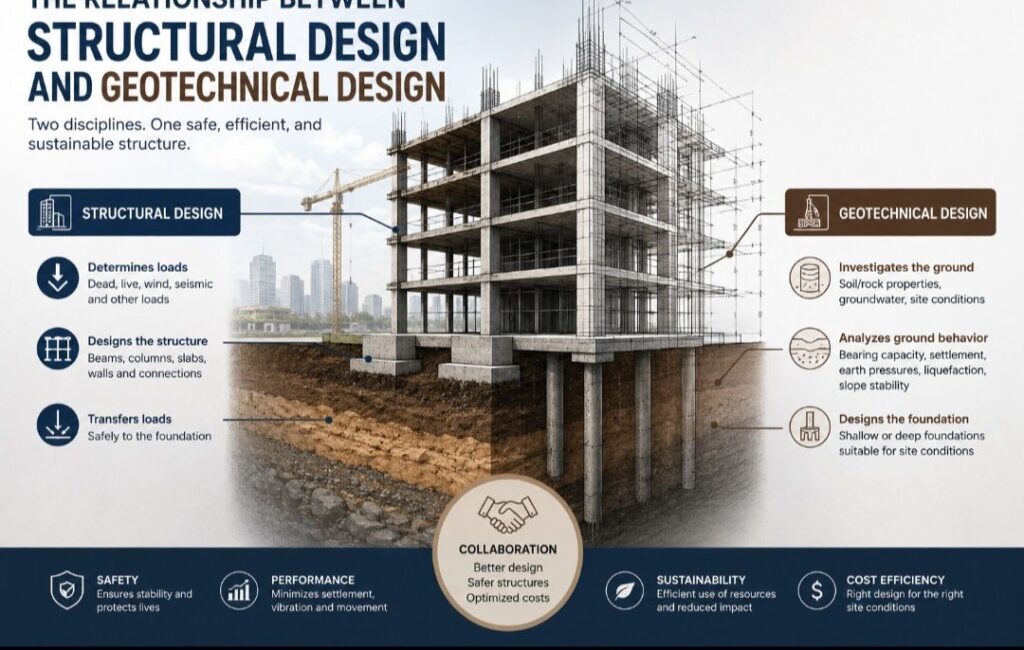
Structural engineering and geotechnical engineering are often viewed as separate disciplines within the construction industry. Structural engineers focus on designing beams, columns, slabs, walls, and framing systems, while geotechnical engineers investigate soil conditions and design foundations. Although this division of responsibility is practical, it can create the impression that the two disciplines operate independently. In reality, they are closely connected, and the success of any structure depends on the effectiveness of both.
Every structure ultimately relies on the ground for support. Regardless of how sophisticated a building may be, every load generated within the structure eventually travels through the foundation and into the supporting soil. This means that the behaviour of the structure cannot be separated from the behaviour of the ground beneath it. A well-designed superstructure can experience significant distress if the supporting soil performs poorly, just as a well-investigated site can be compromised by unrealistic structural demands.
Many structural problems that emerge during the life of a building are not caused solely by deficiencies in structural design or geotechnical design. Instead, they often arise from a failure to properly understand the interaction between the two. Excessive settlement, differential movement, foundation distress, cracking, and serviceability issues frequently occur at the interface between structural and geotechnical engineering. Understanding this relationship is therefore essential for delivering safe, durable, and economical structures.
The Ground Is Part of the Structural System
When engineers discuss load paths, they usually describe how loads travel through slabs, beams, columns, and foundations. However, the load path does not end at the foundation level. Foundations do not create support; they simply transfer loads into the ground. The soil or rock beneath the foundation provides the actual support for the structure.
This fact is sometimes overlooked because the ground is not traditionally considered a structural element. Yet from an engineering perspective, it performs a structural function. The supporting soil resists loads, deforms under stress, and influences the behaviour of the entire structure. If the ground compresses more than expected, the structure must accommodate that movement. If the ground behaves differently across a site, the structure must respond to the resulting differential settlement.
Unlike concrete and steel, soil is a naturally occurring material with highly variable properties. Its behaviour depends on factors such as density, moisture content, stress history, groundwater conditions, and geological formation. Even within a relatively small site, soil properties can vary significantly. This variability introduces uncertainties that directly affect structural performance.
For this reason, engineers should think of the structure and the ground as a single interacting system rather than two separate components. The performance of one cannot be fully understood without considering the performance of the other.
How Structural Decisions Influence Geotechnical Design
Structural engineers make decisions every day that directly affect foundation design and geotechnical performance. Building height, column spacing, structural layout, material selection, and load distribution all influence how forces are transferred to the ground.
Consider two buildings with identical floor areas. One may use closely spaced columns that distribute loads relatively evenly, while the other may rely on large spans and heavily loaded transfer structures. Although both buildings occupy the same footprint, the loads imposed on the ground may be dramatically different. These differences influence foundation size, depth, type, and cost.
The choice of structural system also affects foundation requirements. Heavy reinforced concrete structures typically impose larger vertical loads than lighter steel structures. Similarly, buildings located in regions with significant wind or seismic activity may generate substantial lateral forces that must ultimately be resisted by the foundation system.
Structural engineers sometimes focus primarily on the behaviour of the superstructure without fully considering the implications for foundation design. However, a seemingly minor change to the structural layout can have major consequences below ground level. Increasing a column load may require a larger footing, deeper piles, or a completely different foundation solution.
This relationship demonstrates why structural and geotechnical engineers should collaborate from the earliest stages of design. Decisions made above ground frequently determine what becomes necessary below ground.
How Geotechnical Decisions Influence Structural Performance
The influence also works in the opposite direction. Geotechnical decisions have a direct impact on how a structure behaves throughout its life.
One of the most important geotechnical considerations is settlement. All foundations experience some degree of settlement under load. The critical question is not whether settlement will occur, but how much will occur and how it will be distributed across the structure.
Uniform settlement rarely creates major structural problems because the entire building moves together. Differential settlement is far more significant. When different parts of a structure settle by different amounts, additional stresses develop within structural elements. These stresses can lead to cracking, distortion, and serviceability problems.
Many building defects commonly attributed to structural deficiencies are actually caused by foundation movement. Cracked masonry walls, uneven floors, misaligned doors and windows, and damaged finishes often originate from differential settlement rather than inadequate structural strength.
Soil stiffness plays a particularly important role in this process. A soil deposit may possess sufficient bearing capacity to support a structure safely, yet still experience settlements large enough to affect structural performance. This highlights an important distinction between strength and serviceability. A foundation can be safe from a bearing capacity perspective while still causing unacceptable structural behaviour.
Geotechnical engineers must therefore consider not only whether the ground can support the applied loads but also how the resulting movements will affect the structure above.
Beyond Bearing Capacity
Foundation design is often associated with bearing capacity calculations. While bearing capacity remains an essential consideration, it represents only one aspect of foundation performance.
A common misconception is that once bearing capacity requirements have been satisfied, the foundation design is complete. In reality, settlement frequently governs foundation performance long before bearing capacity becomes critical. Engineers must therefore evaluate both ultimate and serviceability limit states.
This distinction becomes especially important for structures that are sensitive to movement. Hospitals, industrial facilities, high-rise buildings, and structures containing precision equipment may require extremely strict settlement limits. In such cases, acceptable performance depends as much on deformation control as on load-carrying capacity.
The structural engineer relies on the geotechnical engineer to provide realistic estimates of foundation movement. At the same time, the geotechnical engineer relies on the structural engineer to define the structure’s tolerance to settlement. Neither discipline can address the problem independently.
Effective design emerges only when both perspectives are considered simultaneously.
Importance of Soil-Structure Interaction
Perhaps the most important concept linking structural and geotechnical engineering is soil-structure interaction. This term describes the continuous relationship between a structure and the ground supporting it.
Traditional structural analysis often assumes that foundations behave as fixed supports. While this assumption simplifies calculations, actual conditions are rarely so straightforward. Foundations deform, soils compress, and structures respond to those movements. The resulting behaviour influences both the structure and the ground.
A stiff structure may redistribute loads in a manner that reduces differential settlement. Conversely, a flexible structure may respond differently to the same ground conditions. Likewise, the stiffness of the soil affects how loads are distributed among foundations and structural elements.
This interaction means that neither the structure nor the soil can be analysed completely in isolation. Changes in one influence the behaviour of the other. As projects become more complex, engineers increasingly rely on advanced analysis techniques to capture these interactions more accurately.
Nevertheless, sophisticated software cannot replace engineering judgement. Understanding the principles of soil-structure interaction remains essential for interpreting analytical results and making sound design decisions.
Why Collaboration Matters
Many construction problems can be traced to poor communication between structural and geotechnical engineers rather than errors within either discipline. Assumptions made by one team may not be fully understood by the other, leading to inconsistencies that only become apparent during construction or operation.
For example, a geotechnical report may provide foundation recommendations based on preliminary loading information, while later structural revisions significantly increase those loads. Similarly, structural designers may assume foundation movements are negligible without fully reviewing geotechnical predictions.
Such disconnects can result in costly redesigns, construction delays, and long-term performance issues. In contrast, projects that encourage early collaboration often achieve more efficient and reliable outcomes. Engineers can identify potential problems sooner, optimise foundation solutions, and ensure that structural and geotechnical assumptions remain consistent throughout the design process.
The relationship between the two disciplines should therefore be viewed as a partnership rather than a sequence of separate tasks.
Conclusion
Structural design and geotechnical design are fundamentally interconnected. Every structural load eventually reaches the ground, and every ground movement influences the structure. This simple reality makes collaboration between structural and geotechnical engineers essential to successful project delivery.
The Structural Engineer’s Guide to Reading Geotechnical Reports
Sources & Citations
- Bowles, J.E. (1996). Foundation Analysis and Design. McGraw-Hill.
- Das, B.M. and Sobhan, K. (2018). Principles of Geotechnical Engineering. Cengage Learning.
- Tomlinson, M. and Woodward, J. (2014). Pile Design and Construction Practice. CRC Press.
- European Committee for Standardization. EN 1997-1: Eurocode 7 – Geotechnical Design – General Rules.
- European Committee for Standardization. EN 1992-1-1: Eurocode 2 – Design of Concrete Structures.
- Poulos, H.G. and Davis, E.H. (1980). Pile Foundation Analysis and Design. Wiley.
- Institution of Civil Engineers (2017). ICE Manual of Geotechnical Engineering.
- Coduto, D.P., Yeung, M.R., and Kitch, W.A. (2015). Foundation Design: Principles and Practices.
- Burland, J.B. (2008). “The Interaction Between Structures and Ground.” Geotechnical Engineering Journal.
- Institution of Structural Engineers (2023). Manual for the Structural Assessment of Existing Buildings.
