Selecting the most appropriate rehabilitation method requires a thorough understanding of the bridge’s structural condition and operational requirements. Engineers must first identify the causes of deterioration before determining the most effective solution.
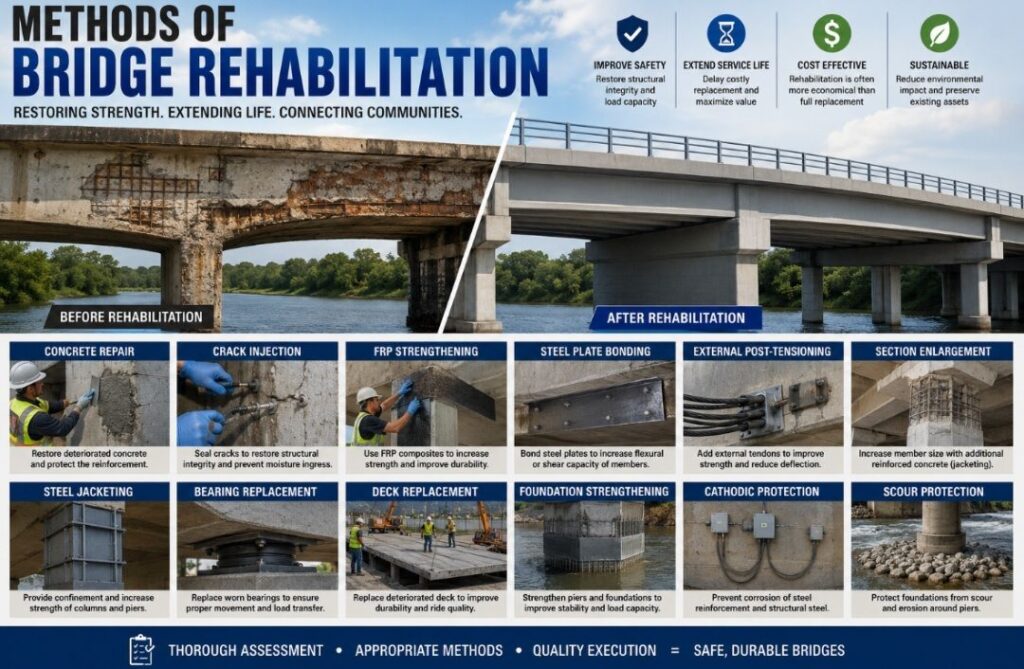
Bridges are among the most important components of transportation infrastructure, providing safe and efficient movement of people and goods while connecting communities and supporting economic development. Designed to withstand years of continuous service, they are subjected to repeated traffic loading, environmental exposure, temperature variations, and, in some cases, extreme events such as flooding, earthquakes, and accidental impacts. Although bridges are designed with durability in mind, no structure is immune to deterioration over time.
As bridges age, their structural components gradually lose their original condition due to material degradation, increasing traffic demands, and changing environmental conditions. If these issues are not addressed promptly, they can reduce the bridge’s load-carrying capacity, affect serviceability, and compromise public safety. Replacing an entire bridge is often expensive and disruptive, making rehabilitation a more practical and economical solution in many situations.
Bridge rehabilitation involves restoring or enhancing the structural performance of an existing bridge to extend its service life and ensure that it continues to meet current operational requirements. Depending on the bridge’s condition, rehabilitation may involve repairing damaged elements, strengthening structural components, replacing deteriorated parts, or upgrading the bridge to accommodate increased traffic loads. Selecting the appropriate rehabilitation method requires a thorough understanding of the bridge’s condition, the causes of deterioration, and the intended performance objectives.
What Is Bridge Rehabilitation?
Bridge rehabilitation is the process of restoring, strengthening, or upgrading an existing bridge to improve its structural integrity, durability, functionality, and service life. Unlike routine maintenance, which focuses on preserving the bridge through regular cleaning and minor repairs, rehabilitation addresses more significant structural deficiencies that have developed over time.
It is also different from complete bridge replacement. Rather than demolishing the entire structure, rehabilitation seeks to preserve as much of the existing bridge as possible while restoring its ability to perform safely and efficiently. This approach often reduces construction costs, shortens project duration, minimises traffic disruption, and decreases environmental impacts.
Successful bridge rehabilitation begins with a comprehensive structural assessment. Engineers evaluate the bridge’s current condition through inspections, material testing, load assessments, and structural analysis to determine the extent of deterioration and identify the most appropriate rehabilitation strategy.
Why Bridges Require Rehabilitation
Bridge deterioration occurs for many reasons, often as a result of several interacting factors rather than a single cause.
One of the most common causes is corrosion of steel reinforcement and structural steel members. Moisture, chlorides from marine environments or de-icing salts, and aggressive chemicals gradually attack steel, reducing its cross-sectional area and weakening the structure.
Concrete bridges are also affected by carbonation, freeze-thaw cycles, alkali-silica reaction, and repeated traffic loading, all of which contribute to cracking and material deterioration. Over time, these defects allow water and harmful substances to penetrate deeper into the structure, accelerating deterioration.
Fatigue is another significant concern, particularly in steel bridges subjected to millions of repeated loading cycles throughout their service life. Small fatigue cracks may gradually propagate until they threaten the structural integrity of critical components.
Bridge foundations are equally vulnerable. Scour caused by flowing water can remove soil supporting bridge piers and abutments, reducing foundation stability and increasing the risk of structural failure.
Increasing traffic volumes and heavier vehicles also place greater demands on bridges that may have been designed decades ago using lower design loads. In many cases, rehabilitation becomes necessary to increase structural capacity and comply with modern design standards.
Concrete Repair and Replacement
Concrete repair is one of the most frequently used bridge rehabilitation methods because deterioration often begins in exposed concrete components such as decks, piers, beams, and abutments.
Damaged concrete is first removed until sound material is reached. The exposed reinforcement is cleaned, treated where necessary, and repaired or replaced if corrosion has significantly reduced its capacity. Suitable repair materials are then placed to restore the original geometry and structural performance.
Modern repair mortars are specifically formulated to provide high bond strength, durability, and compatibility with existing concrete. When properly executed, concrete repair restores both the appearance and structural integrity of deteriorated bridge elements while preventing further deterioration.
Crack Injection and Sealing
Cracks are common in concrete bridges and require careful evaluation before rehabilitation measures are selected. While some cracks result from normal shrinkage and thermal effects, others may indicate structural distress or ongoing deterioration.
Where cracks compromise durability or structural performance, epoxy injection is frequently used to restore continuity within the concrete. Low-viscosity epoxy resin is injected under pressure into the crack, bonding the fractured concrete and improving structural behaviour.
For non-structural cracks where preventing moisture ingress is the primary objective, flexible sealants may be used instead of structural epoxy. Proper crack treatment helps prevent corrosion of reinforcement and extends the service life of the bridge.
Steel Plate Bonding
Steel plate bonding is a strengthening technique used to increase the flexural or shear capacity of existing reinforced concrete bridge members.
In this method, steel plates are bonded or mechanically anchored to the surface of beams, slabs, or girders. The added steel shares the applied loads with the existing structural member, increasing its load-carrying capacity without requiring complete replacement.
Although this technique has been successfully used for many years, careful attention must be given to corrosion protection and the quality of bonding to ensure long-term performance.
Fibre-Reinforced Polymer (FRP) Strengthening
Fibre-Reinforced Polymer (FRP) strengthening has become one of the most widely adopted bridge rehabilitation methods because of its high strength-to-weight ratio and excellent resistance to corrosion.
FRP sheets or laminates are bonded externally to structural members using specialised adhesives. Once installed, the composite material works together with the existing concrete or steel to increase flexural strength, shear capacity, or confinement.
Unlike steel plates, FRP systems add very little weight to the structure and can often be installed with minimal disruption to traffic. Their durability and ease of installation make them particularly attractive for bridge rehabilitation projects where rapid construction is required.
External Post-Tensioning
External post-tensioning is used when existing bridge girders require additional load-carrying capacity or improved serviceability.
High-strength tendons are installed outside the concrete member and stressed after installation. The applied prestressing force introduces beneficial compressive stresses that reduce tensile stresses caused by service loads, improving both strength and crack control.
This method is especially effective for strengthening long-span bridges where replacing major structural components would be difficult or uneconomical.
Section Enlargement (Concrete Jacketing)
Concrete jacketing is a widely used rehabilitation method for increasing the strength, stiffness, and durability of existing bridge components. The technique involves enlarging the cross-section of structural members such as columns, piers, beams, or abutments by placing additional reinforced concrete around the existing element.
Before the new concrete is placed, the existing surface is roughened to improve bond, and supplementary reinforcement is installed to ensure composite action between the old and new sections. Once completed, the enlarged member has greater load-carrying capacity and improved resistance to bending, shear, and axial forces.
Concrete jacketing is particularly effective for rehabilitating bridges that require increased structural capacity to accommodate higher traffic loads or comply with updated design standards.
Steel Jacketing
Steel jacketing is commonly used to strengthen bridge columns and piers that have experienced deterioration or require additional confinement. Steel plates or fabricated steel shells are installed around the existing structural member and securely connected to form a protective jacket.
The steel jacket enhances both strength and ductility while improving the member’s ability to resist seismic loading, impact, and repeated traffic-induced stresses. It also provides additional confinement to concrete, delaying cracking and improving overall structural performance.
Proper corrosion protection is essential to ensure the long-term durability of steel jackets, particularly in aggressive environments.
Bearing Replacement
Bridge bearings play a critical role by transferring loads from the bridge deck to the supporting substructure while allowing controlled movements caused by temperature changes, shrinkage, creep, and traffic loading.
Over time, bearings may deteriorate due to ageing, corrosion, excessive deformation, or mechanical wear. Damaged bearings can restrict intended movements, resulting in increased stresses within the bridge structure.
Replacing deteriorated bearings restores the bridge’s ability to accommodate movement safely and improves its overall structural behaviour. Bearing replacement is often carried out using hydraulic jacks to temporarily lift the bridge deck while the existing bearings are removed and new units installed.
Deck Replacement
Bridge decks are among the most heavily loaded components of any bridge and are often the first structural elements to exhibit significant deterioration.
Where deterioration is extensive, replacing the bridge deck may be more economical than repeated repairs. Modern deck replacement techniques often utilise precast concrete panels or accelerated bridge construction methods to minimise traffic disruption and shorten construction time.
Replacing only the deck while retaining the existing superstructure can significantly extend the bridge’s service life at a considerably lower cost than complete bridge replacement.
Pier and Foundation Strengthening
The performance of a bridge depends heavily on the integrity of its foundations. Scour, settlement, erosion, and increased loading can reduce foundation stability and compromise structural safety.
Foundation rehabilitation may involve underpinning, installation of additional piles, enlargement of pile caps, pressure grouting, or construction of reinforced concrete collars around existing foundations. Where scour is a concern, engineers may install riprap, gabions, sheet piles, or other scour protection measures to prevent further erosion around bridge piers.
Strengthening bridge foundations ensures that increased loads can be safely transferred to the supporting ground while improving the bridge’s long-term stability.
Factors Influencing the Choice of Rehabilitation Method
Selecting the most appropriate rehabilitation method requires a thorough understanding of the bridge’s structural condition and operational requirements. Engineers must first identify the causes of deterioration before determining the most effective solution.
Other important considerations include the bridge’s remaining service life, expected traffic loading, environmental exposure, construction cost, material availability, ease of construction, maintenance requirements, and the level of traffic disruption that can be tolerated during rehabilitation.
In many cases, combining multiple rehabilitation techniques provides the most effective and economical solution, restoring both structural capacity and durability while extending the bridge’s operational life.
Challenges in Bridge Rehabilitation
Bridge rehabilitation presents several technical and logistical challenges. Much of the work must be carried out while the bridge remains in service, requiring careful traffic management and strict safety measures to minimise disruption.
Existing bridges may also contain hidden defects that are not discovered until construction begins, necessitating modifications to the rehabilitation strategy. Engineers must ensure compatibility between new and existing materials to prevent differential movement, cracking, or accelerated deterioration.
Environmental considerations further complicate rehabilitation projects, particularly when work is carried out over rivers, coastal environments, or environmentally sensitive areas. Successful rehabilitation therefore requires careful planning, detailed structural assessment, and close coordination between designers, contractors, and bridge owners.
Conclusion
Bridge rehabilitation is an essential aspect of modern infrastructure management, enabling ageing bridges to remain safe, functional, and capable of meeting today’s transportation demands. Rather than replacing an entire structure, rehabilitation focuses on restoring structural performance through targeted repair, strengthening, and upgrading of deteriorated components.
A wide range of rehabilitation methods—including concrete repair, crack injection, FRP strengthening, external post-tensioning, jacketing, bearing replacement, deck replacement, and foundation strengthening—are available to address different forms of deterioration. The choice of method depends on the bridge’s condition, structural requirements, environmental exposure, available budget, and desired service life.
Also See: Differential Temperature Effects in Long Span Bridges
Sources & Citations
- EN 1992-2:2005 – Eurocode 2: Design of Concrete Structures – Concrete Bridges.
- EN 1504 (Parts 1–10) – Products and Systems for the Protection and Repair of Concrete Structures.
- AASHTO. LRFD Bridge Design Specifications.
- fib. fib Model Code for Concrete Structures.
- Chen, W. F., & Duan, L. (2014). Bridge Engineering Handbook: Rehabilitation and Maintenance.
