Long-span floors are inherently more sensitive to vibration because increasing span length generally reduces structural stiffness. As spans become larger, deflections increase and natural frequencies decrease.
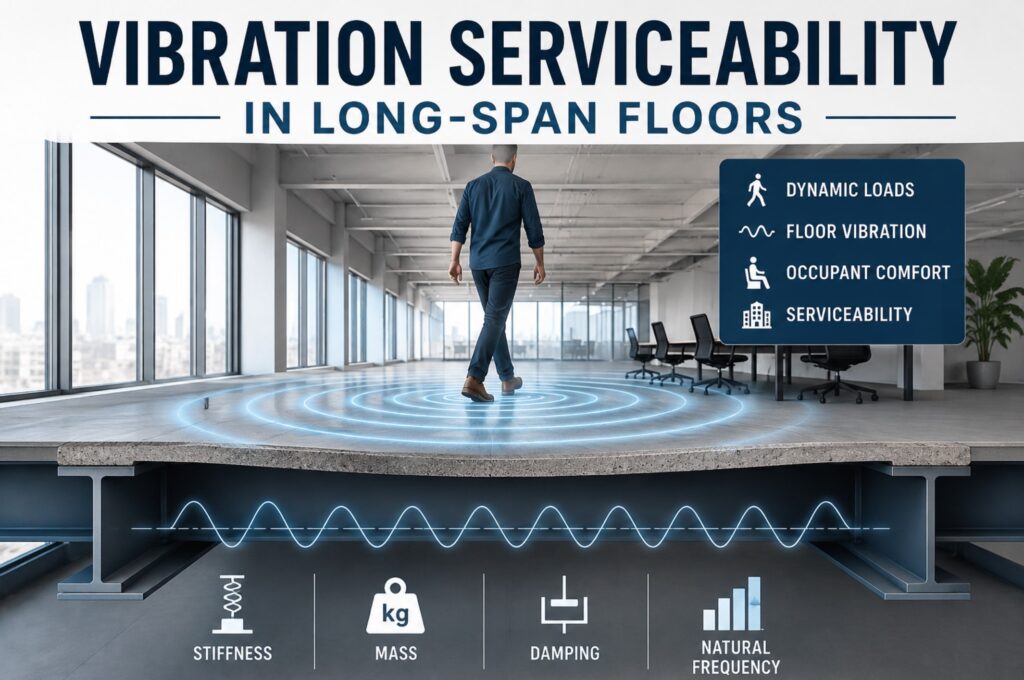
Modern structural engineering increasingly favours long-span floor systems because of the flexibility and openness they provide within buildings. Offices, commercial complexes, auditoriums, airports, and residential developments now commonly utilise wider structural grids with fewer internal supports. Advances in materials and analysis methods have made these systems more achievable than ever before, allowing engineers to design lighter and more efficient structures while maintaining adequate strength.
However, this shift toward slender and lightweight floor systems has introduced a growing serviceability challenge that is often more difficult to manage than strength itself. A floor may satisfy all ultimate limit state requirements and still perform poorly if vibration becomes excessive during normal occupancy. In many modern buildings, occupants complain about movement, bouncing, or noticeable oscillation even when the structure is considered safe according to conventional strength-based design.
This highlights an important reality in structural engineering: strength alone does not define performance. Structures must also provide comfort, stability, and confidence during use. Vibration serviceability therefore represents a critical aspect of modern floor design, particularly in long-span systems where flexibility and reduced stiffness make dynamic effects more pronounced.
Unlike catastrophic structural failures, vibration problems are often subtle. They develop during everyday use and are closely linked to human perception. Nevertheless, their consequences can be significant, affecting usability, occupant confidence, equipment performance, and overall building functionality.
Nature of Floor Vibrations
Floor vibration occurs when a structural system responds dynamically to time-dependent forces. These forces may arise from walking, running, rhythmic movement, machinery operation, crowd activity, or repetitive impact loading. Unlike static loads, which remain relatively constant, dynamic loads vary continuously with time and introduce motion into the structure.
When a person walks across a floor, each footstep generates a force impulse. This impulse transfers energy into the structural system, causing it to vibrate. The floor then oscillates around its equilibrium position as inertia and stiffness interact.
The behaviour of the floor during vibration depends primarily on three factors: mass, stiffness, and damping. Mass contributes inertia, stiffness provides resistance to deformation, and damping dissipates energy over time. Together, these properties govern how the floor responds to dynamic excitation.
The key issue in vibration serviceability is not necessarily structural safety but the magnitude and persistence of motion experienced by occupants. A floor may remain far below its strength capacity while still producing vibrations significant enough to create discomfort or concern.
Why Long-Span Floors Are More Vulnerable
Long-span floors are inherently more sensitive to vibration because increasing span length generally reduces structural stiffness. As spans become larger, deflections increase and natural frequencies decrease. Lower frequencies are more likely to align with the frequency range associated with human activity, making resonance effects more probable.
Modern construction trends often intensify this problem. Engineers seek material efficiency by reducing beam depth, minimising member sizes, and using lighter structural systems. While these approaches improve economy and architectural flexibility, they also reduce mass and stiffness, increasing dynamic sensitivity.
In older buildings, heavier construction materials and shorter spans often resulted in naturally damped systems with relatively high stiffness. Many modern structures, by contrast, are more flexible and responsive under dynamic loading.
This does not mean that long-span systems are inherently unsafe. Rather, it means their dynamic behaviour becomes a governing design consideration. Serviceability rather than strength frequently controls the design process.
Natural Frequency and Structural Response
Every structural system possesses natural frequencies at which it prefers to vibrate. These frequencies are determined primarily by the relationship between mass and stiffness. Stiffer structures generally possess higher natural frequencies, while heavier or more flexible structures exhibit lower frequencies.
When external dynamic loading occurs at a frequency close to the natural frequency of the floor, resonance may develop. Under resonance conditions, energy is added to the structure in phase with its motion, causing vibration amplitudes to increase significantly.
Human walking frequencies typically range between 1.5 Hz and 3 Hz. Rhythmic activities such as dancing or coordinated crowd movement may generate even more concentrated excitation frequencies. If the floor’s natural frequency falls within or near these ranges, the likelihood of problematic vibration increases substantially.
This explains why some long-span floors feel lively or bouncy during normal occupancy despite appearing structurally adequate from a strength perspective.
The relationship between frequency and human perception is especially important because occupants are often highly sensitive to low-frequency motion. Even relatively small accelerations may become noticeable if the vibration occurs within a perceptible frequency range.
Resonance and Amplification
Resonance represents one of the most critical phenomena in vibration serviceability. Under resonant conditions, the repeated application of dynamic force continuously reinforces structural motion. Instead of dissipating quickly, vibration builds progressively with each cycle of excitation.
The resulting amplification can be significant. A floor subjected to relatively small repetitive forces may experience large vibration amplitudes if resonance occurs.
This behaviour highlights the fundamental difference between static and dynamic response. In static analysis, response depends primarily on load magnitude. In dynamic systems, timing and frequency become equally important.
Resonance problems are particularly severe in lightweight floor systems with low damping capacity. Because less energy is dissipated during each cycle, oscillations persist longer and reach higher amplitudes.
Engineers must therefore evaluate not only structural strength but also how dynamic loading interacts with the vibration characteristics of the floor system.
Human Perception and Comfort
One of the defining characteristics of vibration serviceability is its dependence on human perception. Unlike ultimate failure, which can often be quantified directly through material strength and capacity, vibration acceptability depends heavily on occupant response.
Humans are highly sensitive to motion, especially in environments where stability is expected. Slight vibration in a pedestrian bridge may be acceptable because movement is anticipated. The same level of motion in an office or residential building may create discomfort or concern.
Perception depends on several interacting factors, including acceleration magnitude, frequency, duration, repetition, and occupancy type. Continuous low-level vibration may become more disturbing than short-duration motion of greater magnitude.
Psychological factors also influence perception. Occupants who notice visible floor movement often associate it with structural weakness, even when no danger exists. This can reduce confidence in the structure and negatively affect user experience.
Because of these factors, vibration serviceability criteria are generally based on comfort thresholds rather than structural safety limits.
Influence of Structural Stiffness
Structural stiffness is one of the most effective means of controlling floor vibration. Increasing stiffness raises the natural frequency of the floor and reduces deflection under dynamic loading.
This may be achieved through deeper beams, increased slab thickness, shorter spans, or additional supports. Structural continuity can also improve stiffness by enhancing load sharing between members.
However, increasing stiffness often conflicts with architectural and economic objectives. Deeper beams reduce usable space, additional supports limit layout flexibility, and heavier systems increase material costs.
Modern structural design therefore involves balancing efficiency against vibration performance. Optimising solely for strength and economy may produce floors that satisfy code requirements while remaining uncomfortable during occupancy.
Mass and Damping
Mass influences vibration response by increasing inertia. Heavier floor systems generally experience lower acceleration under dynamic excitation because greater force is required to produce motion.
This explains why traditional concrete structures often feel more stable than lightweight steel or composite floors under similar loading conditions.
Damping controls how rapidly vibration dissipates after excitation occurs. It represents the mechanisms through which energy is lost within the structural system.
In real buildings, damping arises from several sources, including internal material friction, connection behaviour, partitions, ceilings, finishes, and even furniture. Occupancy itself can influence damping characteristics.
Structures with higher damping experience reduced vibration amplitudes and faster decay of motion. Conversely, lightly damped systems sustain oscillation for longer periods, increasing discomfort.
Because damping is influenced by many non-structural factors, accurately predicting vibration behaviour during design remains challenging.
Analytical Approaches in Vibration Assessment
Evaluating vibration serviceability requires dynamic analysis techniques that extend beyond conventional static methods. Engineers often estimate natural frequencies, mode shapes, and acceleration response under expected dynamic loading conditions.
Simplified analytical approaches may use empirical equations or code-based criteria to estimate acceptable performance. More advanced methods involve finite element modelling and time-history analysis to capture complex dynamic behaviour more accurately.
The level of analysis required depends on the sensitivity of the structure and the expected nature of dynamic loading. Long-span floors in offices, laboratories, and assembly areas often require more detailed evaluation than conventional residential systems.
Despite advances in computational methods, vibration prediction still involves uncertainty because actual occupancy conditions and damping characteristics may differ from assumptions made during design.
Mitigation Measures
When vibration problems are identified, several strategies may be used to improve performance. Increasing stiffness remains the most direct solution, although it is not always practical after construction.
Additional mass may reduce acceleration response, while supplemental damping systems can help dissipate energy more effectively. Tuned mass dampers, vibration isolators, and stiffening elements are sometimes introduced in sensitive structures.
Architectural layout can also influence vibration behaviour. Redistribution of occupancy, modification of walking paths, or relocation of sensitive equipment may reduce dynamic excitation.
The effectiveness of mitigation measures depends on understanding the underlying vibration mechanism rather than simply increasing structural capacity.
Conclusion
Vibration serviceability has become an increasingly important aspect of structural design as modern buildings continue to adopt longer spans, lighter systems, and more efficient structural configurations. In many cases, occupant comfort rather than structural strength governs floor performance.
Unlike traditional static problems, vibration behaviour involves motion, frequency, damping, and human perception. Long-span floors are especially sensitive because reduced stiffness and lower natural frequencies increase susceptibility to dynamic excitation and resonance. Thus, understanding these behaviours requires engineers to move beyond strength-based thinking and consider how structures respond dynamically during everyday use. A floor that satisfies all strength requirements may still perform poorly if vibration becomes excessive.
Also See: Vibration Control in Tall Buildings Using Damping Systems
Sources & Citations
- Murray, T.M., Allen, D.E., & Ungar, E.E. Floor Vibrations Due to Human Activity.
- Chopra, A.K. Dynamics of Structures. Pearson Education.
- Smith, A.L., Hicks, S.J., & Devine, P.J. Design of Floors for Vibration: A New Approach.
- ISO 10137. Bases for Design of Structures – Serviceability of Buildings Against Vibration.
- Bachmann, H. Vibration Problems in Structures: Practical Guidelines.
