Cellular beams provide an efficient solution for long-span structures by combining increased structural depth with reduced steel weight and regular openings for building services.
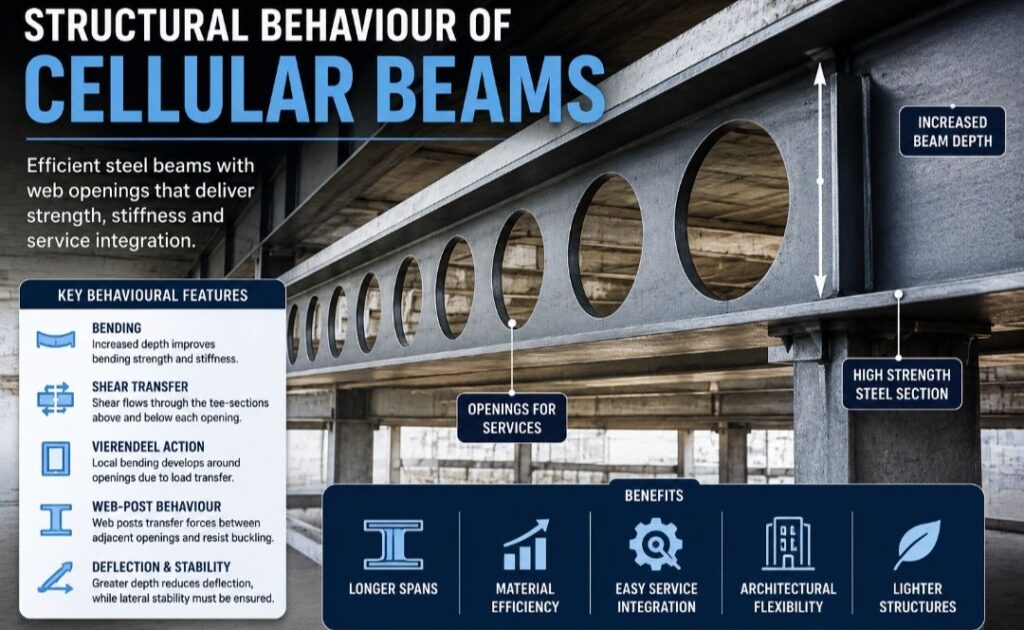
Cellular beams are steel beams formed by creating a series of circular openings along the web of an I-section. The openings reduce the self-weight of the beam while allowing the overall section depth to increase. This combination makes cellular beams particularly useful where engineers need long spans, greater structural depth, and clear space for building services.
Although a cellular beam resembles a conventional steel beam, its structural behaviour differs significantly because the web openings interrupt the normal flow of shear stresses. The remaining steel above and below each opening forms T-sections that work together to resist bending and shear.
Understanding this behaviour is important when assessing the strength, stiffness, and stability of cellular beams.
What Is a Cellular Beam?
A cellular beam consists of an I-section that has been cut longitudinally through its web and then reassembled to create a deeper section with regularly spaced circular openings.
The resulting beam has a greater overall depth than the original section without a proportional increase in steel weight. The circular openings also create space for mechanical and electrical services, which can reduce the required floor-to-floor height in buildings.
Cellular beams commonly appear in long-span floor systems, commercial buildings, industrial structures, and other applications where designers need large column-free spaces.
Their efficiency comes from increasing the beam depth while keeping much of the original steel material. However, the openings introduce local structural effects that engineers must consider during design.
Behaviour Under Bending
Bending remains one of the primary actions in a cellular beam. Under vertical loading, the beam develops compression in one flange and tension in the other, while the forces transfer through the web and the material surrounding each opening.
Increasing the overall beam depth increases its bending resistance and stiffness. This makes cellular beams particularly effective for long spans where deflection can control the design.
However, the web openings interrupt the continuous distribution of stresses. The sections above and below each opening therefore carry significant local forces, and their behaviour can differ from that of a solid-web I-section.
The designer must ensure that the material around each opening can resist the combined effects of bending, shear, and local stresses.
Behaviour Under Shear
Shear behaviour presents one of the most important differences between cellular and conventional steel beams.
In a solid-web beam, the web provides a continuous path for shear forces between the flanges. In a cellular beam, the openings interrupt this path. The shear force therefore passes through the material above and below the opening, creating localised shear effects.
The sections surrounding the openings can experience both vertical shear and horizontal shear. These actions can produce high stresses near the top and bottom of the opening, particularly close to supports where shear forces are greatest.
For this reason, engineers generally avoid placing large openings in regions where the beam experiences very high shear unless the design specifically accounts for the resulting stresses.
Vierendeel Action
One of the distinctive features of cellular beams is Vierendeel action.
When bending and shear forces act around a circular opening, the upper and lower T-sections must transfer forces across the opening. This produces local bending moments in the sections surrounding the opening.
The behaviour resembles a small Vierendeel frame, where the material above and below the opening acts as chords and the regions beside the opening transfer forces between them.
Vierendeel action becomes particularly important when the opening is large relative to the beam depth. Engineers therefore consider the size and spacing of openings carefully during preliminary design.
Web Post Behaviour
The material between two adjacent openings forms a web post. These web posts play an important role in transferring forces along the beam.
The web post can experience compression, tension, and shear. Closely spaced openings reduce the width of the web posts and can increase the stresses within them.
A narrow web post may also become susceptible to buckling under compression. This makes the ratio between opening diameter, opening spacing, and web-post width an important design consideration.
Engineers therefore select opening geometry to provide adequate structural resistance while still achieving the architectural and service-routing benefits of the cellular beam.
Deflection and Stiffness
Deflection often plays an important role in cellular beam design because these members typically serve long-span applications.
Increasing the beam depth significantly improves its second moment of area and therefore its bending stiffness. However, the presence of web openings reduces stiffness compared with an equivalent solid-web beam of the same overall depth.
The designer must therefore assess both strength and serviceability. A beam may have adequate ultimate resistance but still experience excessive deflection under service loads.
This becomes particularly important where the beam supports brittle finishes, partitions, ceilings, or sensitive building services.
Lateral-Torsional Buckling
Like conventional steel beams, cellular beams can experience lateral-torsional buckling when the compression flange lacks adequate lateral restraint.
The increased depth of a cellular beam can improve its overall bending efficiency, but the altered section geometry also affects its stability characteristics. The designer must consider the unrestrained length, section properties, loading arrangement, and available lateral restraint.
Floor slabs can provide significant restraint to composite cellular beams, but engineers should not assume that restraint exists without verifying the connection and construction details.
Openings and Structural Efficiency
The geometry of the openings strongly influences the performance of a cellular beam.
Larger openings provide more space for services but remove more web material and increase local stresses around the opening. Smaller openings preserve more web material but provide less space for ducts, pipes, and other services.
The spacing between openings also affects structural behaviour. Closely spaced openings produce narrow web posts, while larger spacing increases the amount of solid web available to transfer forces.
The designer must therefore balance structural efficiency, service integration, fabrication requirements, and architectural requirements when selecting the opening arrangement.
Design Considerations
Good cellular beam design therefore requires more than checking the overall bending capacity. Engineers must understand how forces flow around each opening and ensure that the remaining steel can safely transfer those forces throughout the beam.7
Several factors require attention when designing cellular beams.
The designer should first establish the required span, loading, beam depth, and serviceability limits. These parameters help determine an appropriate parent section and overall cellular beam geometry.
The opening diameter and spacing should then be selected based on both structural and service requirements. Engineers should check bending resistance, shear resistance, Vierendeel effects, web-post stability, local buckling, and lateral-torsional buckling.
Connections also require careful consideration. Concentrated forces introduced through supports or connections can create high local stresses, particularly where an opening lies close to the support.
Construction stages may also influence behaviour. Composite cellular beams can experience different loading conditions before and after the concrete slab develops composite action, so engineers should consider the relevant stages of construction in the analysis.
Conclusion
Cellular beams provide an efficient solution for long-span structures by combining increased structural depth with reduced steel weight and regular openings for building services.
Their behaviour differs from that of conventional solid-web beams because the openings interrupt the web and introduce additional local effects. Bending, shear, Vierendeel action, web-post behaviour, deflection, and lateral-torsional buckling all influence the performance of the member.
Also See: Designing Composite Beams with Web Openings – A Practical Guide
Sources & Citations
EN 1993-1-1 – Eurocode 3: Design of Steel Structures – General Rules and Rules for Buildings.
EN 1993-1-5 – Eurocode 3: Plated Structural Elements.
EN 1993-1-8 – Eurocode 3: Design of Joints.
SCI P355 – Design of Composite Beams with Large Web Openings.
SCI Publication 068 – Design of Long Span Steel Structures.
