An opening changes the behaviour of a reinforced concrete beam by interrupting its normal force path. The remaining concrete and reinforcement must redirect the internal forces around the void, which can increase local shear, bending and stress concentrations.
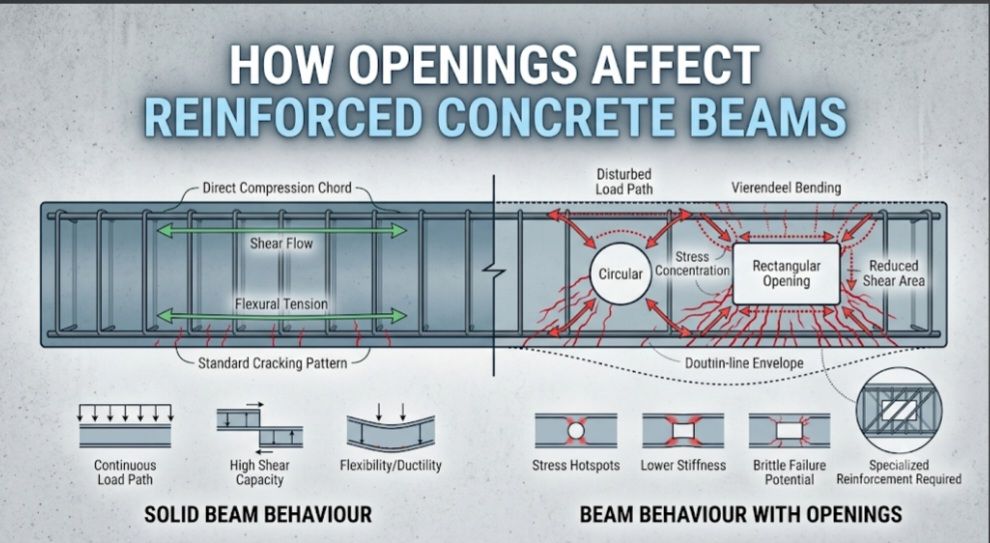
Reinforced concrete beams are designed to transfer loads through a continuous structural system from the applied loads to the supports. When an opening is introduced into the beam, this normal load path is interrupted. The internal forces must instead travel around the opening through the remaining concrete and reinforcement.
This means that a beam opening is not simply a portion of concrete that has been removed. Depending on its size and location, it can affect shear resistance, bending behaviour, stiffness and reinforcement demands. A small opening in a relatively low-shear region may have a limited effect, while a larger opening close to a support can significantly change the behaviour of the beam.
The structural significance of an opening therefore depends not only on its dimensions, but also on how it changes the internal force flow through the member.
How an Opening Changes Force Flow
In a solid beam, shear forces are transferred through the web while bending produces compression and tension across the section. An opening removes part of this web and forces the internal forces to divert around the void.
The concrete above and below the opening, together with the regions at its sides, must therefore carry forces that would otherwise have travelled through the removed section.
This creates local concentrations of stress and changes the distribution of shear and bending forces. The larger the opening, the more significant this redistribution becomes.
This is why an opening should be considered as part of the structural system rather than as an isolated hole in an otherwise unchanged beam.
The Effect on Shear
Shear is often one of the most important considerations when introducing an opening.
A reinforced concrete beam normally relies on the concrete web, aggregate interlock, longitudinal reinforcement and shear reinforcement to resist shear. Removing part of the web reduces the available concrete through which these mechanisms can operate.
The effect becomes particularly important near supports, where shear forces are generally high.
An opening that removes a substantial portion of the web in this region can significantly reduce the available shear-resisting mechanism. The remaining concrete around the opening must carry the forces through narrower paths, increasing local stresses.
For this reason, the same opening can have very different consequences depending on where it is located along the beam.
Opening Location Matters
The position of an opening is often just as important as its size.
An opening close to a support is generally more critical from a shear perspective because the beam typically experiences higher shear forces in this region. An opening near midspan may experience lower shear but can still have an important effect on flexural behaviour.
For example, removing concrete or cutting reinforcement in the tension zone near midspan can reduce the beam’s flexural resistance. Similarly, a large opening extending into the compression zone can affect the compression force path.
The location of an opening should therefore be assessed against the actual bending moment and shear force at that position rather than by applying a simple rule based only on its dimensions.
Vierendeel Action Around Large Openings
Large rectangular openings introduce another important behaviour known as Vierendeel action.
When forces approach an opening, they cannot pass directly through the void. They must travel around it through the remaining portions of the beam. The concrete above and below the opening and the regions at its sides consequently develop additional local bending and shear forces.
The side regions effectively act as connecting members between the upper and lower portions of the beam.
As the opening becomes larger, these local forces become more significant. This can result in cracking around the opening, particularly near the corners where changes in geometry produce concentrated stresses.
For substantial openings, this behaviour needs to be considered explicitly rather than assuming that the beam continues to behave exactly like a solid section.
Reinforcement Detailing Around Openings
Reinforcement is critical to maintaining a suitable load path around an opening.
Longitudinal reinforcement that would normally pass through the opening cannot simply be cut without replacing its structural function. Additional reinforcement may be required above, below and alongside the opening to transfer the forces around the void.
The exact arrangement depends on the size and location of the opening, the loading and the existing reinforcement.
Particular attention should also be given to the corners. Reinforcement must be properly anchored and detailed so that it can transfer the forces generated around the opening. Simply adding a few bars around the opening does not guarantee that the original structural capacity has been restored.
Poor detailing can result in excessive cracking, local failure or reinforcement congestion that makes proper construction difficult.
When Does an Opening Become Structurally Significant?
There is no universal opening size that can be considered insignificant for every reinforced concrete beam.
Its effect depends on:
- the beam depth and width;
- opening height and width;
- location along the span;
- shear force and bending moment at the opening;
- existing longitudinal reinforcement;
- shear reinforcement;
- concrete strength;
- support conditions; and
- proximity to other openings.
A relatively small opening can become structurally important if it is positioned close to a support or interrupts critical reinforcement. Conversely, a larger opening may have a more manageable effect if it is carefully positioned and properly detailed.
The assessment should therefore be based on the forces and load path at the actual opening location.
Multiple Openings
Several small openings can also create a significant structural problem when they are placed too close together.
The concrete between adjacent openings may become too narrow to effectively transfer the forces between them. The openings can then interact and behave more like one large discontinuity.
This is particularly relevant where several mechanical or electrical services need to pass through a beam.
The spacing between openings and the amount of concrete remaining between them should therefore be considered as part of the overall structural assessment.
Cutting Openings in Existing Beams
Creating an opening in an existing reinforced concrete beam requires even greater care.
Unlike a beam designed with an opening from the beginning, an existing beam is already carrying its design loads. Cutting concrete or reinforcement changes the established load path while the structure is in service.
The existing reinforcement should be identified before any cutting takes place, preferably using reinforcement scanning and available structural drawings. The proposed opening should then be assessed for its effect on the existing bending and shear resistance.
Where necessary, temporary propping and strengthening may be required before the opening is formed.
Cutting a beam simply because a pipe or duct needs to pass through it is not an acceptable structural procedure.
Designing Around the Opening
Where possible, openings should be considered during the original structural design.
This allows the engineer to select suitable locations, coordinate the opening with the reinforcement and provide the necessary strengthening without creating difficult construction conditions.
For larger openings, conventional beam calculations may not fully describe the disturbed force flow. Strut-and-tie modelling can be useful for visualising how compression and tension forces travel around significant discontinuities and for developing an appropriate reinforcement arrangement.
The objective is not merely to add reinforcement around the opening, but to establish a clear and reliable load path through the modified beam.
Conclusion
An opening changes the behaviour of a reinforced concrete beam by interrupting its normal force path. The remaining concrete and reinforcement must redirect the internal forces around the void, which can increase local shear, bending and stress concentrations.
The effect depends on the size, shape and location of the opening, as well as the forces acting at that section. Openings near supports require particular attention because of the high shear forces commonly present in those regions, while large openings near midspan can significantly affect flexural behaviour.
Also See: Common Structural Problems Caused by Poor Construction Sequencing
References
- Eurocode 2: EN 1992-1-1, Design of Concrete Structures – General Rules and Rules for Buildings.
- ACI 318, Building Code Requirements for Structural Concrete.
- fib, Model Code for Concrete Structures 2010.
- Kong, F. K. and Sharp, G. R., Structural Behaviour of Reinforced Concrete Deep Beams with Web Openings.
- CIRIA, Design of Structural Openings in Reinforced Concrete Members.
