Exoskeleton structures are increasingly used in modern high-rise buildings where both performance and aesthetics are important. They are particularly suitable for buildings that require large open interior spaces and distinctive architectural forms.
The evolution of tall building design has always been driven by the need to achieve greater heights while maintaining structural efficiency and architectural flexibility. As buildings become taller, lateral loads from wind and seismic forces begin to dominate structural design. Traditional systems that rely heavily on internal columns and cores often become less efficient at extreme heights, requiring larger structural members that can reduce usable space and increase material consumption.
In response to these challenges, engineers have developed innovative structural systems that move primary load-resisting elements to the exterior of the building. One of the most advanced and visually striking of these systems is the exoskeleton structure. In this approach, the structural framework is located on the outside of the building, forming a rigid external shell that carries both gravity and lateral loads. This concept transforms the building façade into an active structural component rather than a passive enclosure.
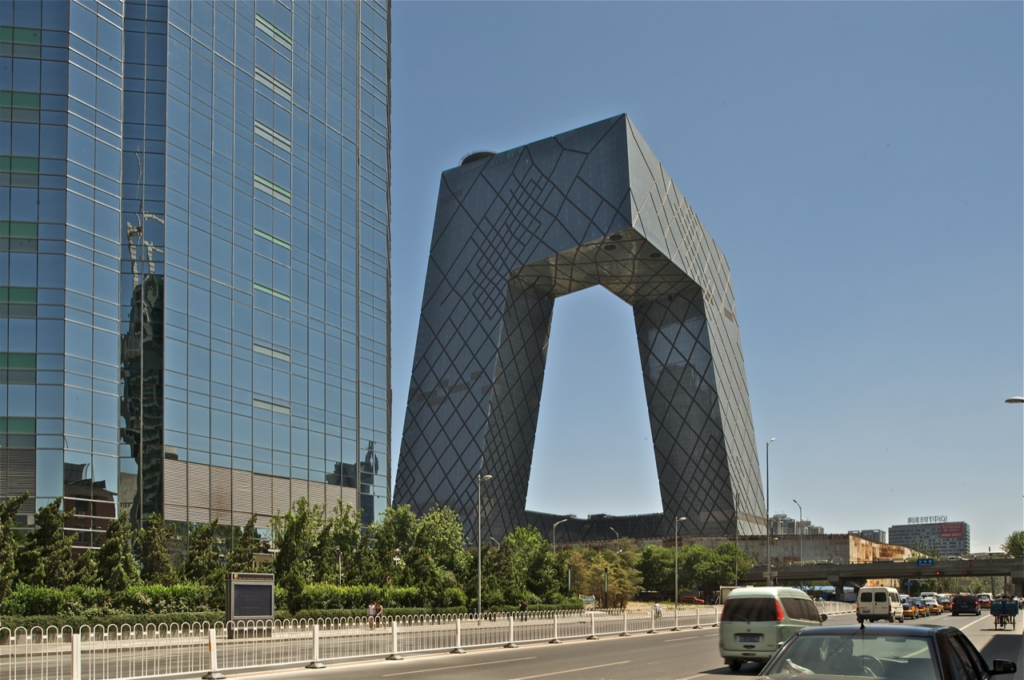
Exoskeleton structures have gained prominence in modern architecture due to their ability to combine structural performance with strong visual identity. Buildings such as the CCTV Headquarters and the Al Bahar Towers demonstrate how external structural systems can redefine both the engineering and aesthetics of high-rise construction. These examples highlight the growing importance of exoskeleton systems in contemporary structural engineering.
Structural Concept of Exoskeleton Systems
An exoskeleton structural system is defined by the placement of major structural elements along the building perimeter. Unlike conventional buildings where columns, beams, and shear walls are primarily located within the interior, exoskeleton structures transfer these elements to the façade. The result is a structural shell that surrounds the building and resists loads through its external framework.
This external framework may consist of diagonal members, vertical columns, horizontal rings, or a combination of these elements. In many cases, the configuration resembles a diagrid or braced tube, but with a stronger emphasis on the exterior as the primary load-resisting system. The exoskeleton is designed to carry both vertical loads from floors and lateral loads from wind and seismic actions.
Because the structural system is located at the outermost boundary of the building, it benefits from a large lever arm relative to the building’s center. This significantly enhances its ability to resist overturning moments caused by lateral loads. As a result, exoskeleton structures can achieve high levels of stiffness and stability with efficient use of materials.
Structural Behaviour Under Lateral Loads
The behaviour of exoskeleton structures under lateral loading is fundamentally based on the interaction between axial forces and global structural action. When wind forces act on the building, the external framework resists these forces through a combination of axial tension and compression in its members.
Diagonal members play a particularly important role in this system. They form triangulated configurations that allow forces to be transferred efficiently throughout the structure. Unlike conventional moment-resisting frames, where bending dominates, exoskeleton systems rely heavily on axial force mechanisms. This leads to improved structural efficiency because materials are utilized more effectively in tension and compression.
The external placement of structural elements also increases the overall stiffness of the building. By positioning load-resisting members at the perimeter, the structure maximizes its resistance to lateral displacement. This helps reduce drift and improves occupant comfort, which is a critical consideration in tall buildings.
Interaction with Interior Structural Elements
Although the exoskeleton carries a significant portion of the structural load, it does not operate in isolation. Interior elements such as floor slabs, secondary beams, and sometimes a central core work together with the exoskeleton to form a complete structural system.
Floor slabs act as diaphragms that transfer loads between the interior and exterior systems. They distribute lateral forces to the exoskeleton and ensure that the building behaves as a unified structure. In some designs, a central core is still present to provide additional stiffness and support vertical circulation systems such as elevators and staircases.
The interaction between the exoskeleton and interior elements must be carefully designed to ensure compatibility in stiffness and deformation. If one system is significantly stiffer than the other, it may attract a disproportionate share of the load, leading to inefficiencies or potential structural issues.
Structural Efficiency and Material Optimization
One of the primary advantages of exoskeleton structures is their ability to achieve high structural efficiency. By relocating structural elements to the building perimeter, the system reduces the need for interior columns. This not only improves load distribution but also creates large, open interior spaces that can be used more flexibly.
The reliance on axial forces rather than bending further enhances material efficiency. Structural members can be designed to carry loads primarily in tension or compression, allowing for smaller cross-sections compared to members subjected to significant bending moments.
In many cases, exoskeleton systems can reduce overall material usage compared to traditional structural systems. This reduction not only lowers construction costs but also contributes to sustainability by minimizing the environmental impact associated with material production.
Architectural Expression and Design Freedom
Exoskeleton structures offer unique opportunities for architectural expression. Because the structural framework is located on the exterior, it becomes a visible and defining feature of the building. This allows architects to create distinctive designs that integrate structure and aesthetics.
The external framework can be configured in various patterns, including diagonal grids, vertical ribs, or complex geometric forms. These patterns often become iconic elements of the building’s identity. For example, the exposed structural form of the CCTV Headquarters contributes significantly to its architectural impact.
At the same time, the reduction of interior columns provides greater flexibility in floor planning. Open floor layouts are particularly valuable in commercial buildings, where adaptability and efficient use of space are important considerations.
Construction Considerations
Constructing an exoskeleton structure requires careful planning and execution. The external framework often involves complex geometry and requires precise fabrication of structural members. Steel is commonly used for exoskeleton systems due to its strength and ability to accommodate intricate shapes.
Erection of the exoskeleton must be carefully coordinated with the construction of interior elements. Temporary supports may be required until the structural system is fully connected and capable of carrying loads. The sequencing of construction activities plays a critical role in ensuring stability throughout the process.
Connections between members are also critical. Because the exoskeleton carries significant loads, the joints must be designed to transfer forces efficiently while accommodating potential deformations. Advanced fabrication techniques and quality control measures are essential to ensure structural integrity.
Challenges and Limitations
Despite their advantages, exoskeleton structures present several challenges. One of the main challenges is the complexity of design and analysis. The interaction between multiple structural elements and the reliance on axial force mechanisms require advanced computational modelling and careful engineering judgement.
Another challenge is the integration of building services and façade systems. Since the structural framework occupies the building exterior, it can complicate the placement of cladding, windows, and mechanical systems. Engineers and architects must work closely to ensure that these elements are properly integrated.
Maintenance can also be more demanding because structural elements are exposed to environmental conditions. Protective coatings and regular inspection are necessary to ensure long-term durability.
Applications in Modern High-Rise Buildings
Exoskeleton structures are increasingly used in modern high-rise buildings where both performance and aesthetics are important. They are particularly suitable for buildings that require large open interior spaces and distinctive architectural forms.
The CCTV Headquarters is one of the most well-known examples of an exoskeleton structure, where the external framework defines both the structural system and the architectural form. Similarly, the Al Bahar Towers demonstrate how external systems can be integrated with advanced façade technologies.
These examples illustrate the versatility of exoskeleton systems and their ability to meet the demands of modern urban development.
Conclusion
Exoskeleton structures represent a significant advancement in the design of tall buildings. By moving the primary structural system to the building exterior, engineers can achieve greater efficiency, improved stiffness, and enhanced architectural expression. The ability to resist loads through axial forces and to maximize the structural lever arm makes this system particularly effective for high-rise construction.
While the design and construction of exoskeleton systems can be complex, the benefits they offer in terms of performance and flexibility make them an attractive option for modern buildings. As architectural ambitions continue to grow and cities demand more innovative structures, exoskeleton systems will play an increasingly important role in shaping the future of tall building engineering.
Also See: Core Wall Systems in High-rise Buildings
Sources & Citations
- Moon, K.S. Optimal Grid Geometry of Diagrid Structures for Tall Buildings. Architectural Science Review, 2009.
- Taranath, B.S. Structural Analysis and Design of Tall Buildings. CRC Press, 2016.
- Ali, M.M., & Moon, K.S. Structural Developments in Tall Buildings. Architectural Science Review, 2007.
- Smith, B.S., & Coull, A. Tall Building Structures: Analysis and Design. Wiley, 1991.
