Źzźżżź. Core-wall systems are used extensively in modern high-rise buildings due to their effectiveness and practicality. They form the backbone of many structural systems, providing
The design of high-rise buildings presents unique structural challenges that distinguish them from low- and medium-rise structures. As buildings increase in height, lateral loads from wind and seismic activity begin to dominate structural design. These forces generate overturning moments and horizontal displacements that must be carefully controlled to ensure both safety and occupant comfort.
Engineers therefore rely on structural systems that provide sufficient stiffness and strength to resist these effects efficiently.
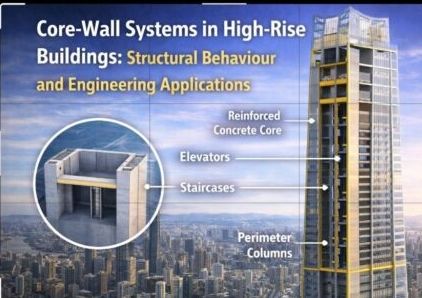
One of the most widely used structural systems in modern high-rise construction is the core-wall system. This system utilizes a central reinforced concrete core, typically housing elevators, staircases, and service shafts, to act as the primary lateral load-resisting element of the building. By concentrating stiffness and strength within this central core, engineers can create a stable structure capable of resisting significant lateral forces.
Core-wall systems are found in many prominent buildings around the world due to their simplicity and effectiveness. Structures such as the and the rely heavily on reinforced concrete cores as part of their overall structural systems. These examples highlight the importance of core-wall systems in modern tall building design.
Structural Concept of Core-Wall Systems
At the heart of a core-wall system is a vertical reinforced concrete element that extends continuously from the foundation to the top of the building. This core typically consists of interconnected shear walls arranged to form a closed or partially closed section. The configuration may be rectangular, square, circular, or irregular depending on architectural requirements.
The primary function of the core is to resist lateral loads through bending and shear. When wind or seismic forces act on the building, the core behaves like a vertical cantilever fixed at its base. The walls of the core develop compressive and tensile stresses as they resist the overturning moment generated by lateral loads.
Because cores are mostly centrally located, it also provides torsional resistance. When lateral loads act eccentrically, causing the building to twist, the core’s closed geometry helps resist this torsion. This makes the system particularly effective in maintaining overall stability.
In addition to its structural role, the core serves important functional purposes. It houses elevators, stairwells, and mechanical services, making it a practical and efficient use of space within the building.
Structural Behaviour Under Lateral Loads
The behaviour of a core-wall system under lateral loading is similar to that of a cantilever beam. When wind forces act on the building, the core experiences bending, with one side undergoing compression and the opposite side experiencing tension. The magnitude of these stresses increases with building height, making the design of the core critical in tall structures.
Shear forces are also developed within the core walls, particularly near the base of the building where forces are greatest. These shear forces must be resisted through adequate wall thickness, reinforcement, and proper detailing.
With increasing building height, however, the limitations of a core-only system become more apparent. The core must become increasingly stiff to control lateral deflection, which may require thicker walls and more reinforcement. This can lead to inefficiencies and may conflict with architectural requirements.
Thus, in very tall buildings, core-wall systems are often combined with other structural systems such as outriggers or perimeter frames to enhance performance. This hybrid approach allows the structure to achieve greater heights while maintaining efficiency.
Torsional Behaviour and Stability
Torsion is an important consideration in the design of high-rise buildings, particularly when the distribution of mass and stiffness is not symmetrical. If the center of mass does not align with the center of stiffness, lateral loads can cause the building to twist.
Core-wall systems help
resist torsion due to their geometric configuration. A closed core section provides significant torsional stiffness, allowing it to resist twisting effectively. However, if the core is irregular or offset from the building’s center, torsional effects can become more pronounced.
Engineers must carefully analyze torsional behaviour during design to ensure that the structure performs adequately under all loading conditions. This often involves advanced computational modelling to capture the complex interaction between lateral loads and structural response.
Interaction with Gravity Load System
While the core-wall system primarily resists lateral loads, it also plays a role in supporting gravity loads. Floors are typically connected to the core through beams or slabs, allowing vertical loads to be transferred into the core and then down to the foundation.
However, in most buildings, gravity loads are shared between the core and perimeter columns. This distribution of loads helps reduce the demand on any single structural element and improves overall efficiency.
The interaction between the core and the gravity load system is an important aspect of structural design. Engineers must ensure that loads are distributed appropriately and that differential movement between structural elements does not lead to unintended stresses.
Design Considerations
Designing a core-wall system requires careful consideration of several factors. One of the most important is the thickness of the core walls. Thicker walls provide greater stiffness and strength but increase material usage and reduce usable floor space. Engineers must balance these competing requirements to achieve an optimal design.
Reinforcement detailing is also critical. The core must be capable of resisting both bending and shear forces, which requires appropriate placement of vertical and horizontal reinforcement. Proper detailing ensures that the core can perform effectively under extreme loading conditions.
Openings within the core, such as those for doors and mechanical systems, can weaken the structure and must be carefully designed to avoid compromising structural integrity. Engineers often use coupling beams between wall segments to maintain continuity and improve performance.
Construction Considerations
The construction of core-wall systems requires precise execution to ensure structural performance. Reinforced concrete cores are typically constructed using climbing formwork systems, which allow the structure to be built efficiently as the building rises.
Quality control is essential, particularly in the placement of reinforcement and the pouring of concrete. Any defects in the core can have significant implications for the overall stability of the building.
Construction sequencing must also be carefully planned. The core is often constructed ahead of the surrounding floor structure, providing a stable framework that supports subsequent construction activities.
Applications in High-Rise Buildings
Core-wall systems are used extensively in modern high-rise buildings due to their effectiveness and practicality. They form the backbone of many structural systems, providing the primary resistance to lateral loads.
In supertall buildings, the core is often combined with additional systems such as outriggers, belt trusses, or diagrids to enhance performance.
The , for example, uses a reinforced concrete core as part of a more complex structural system that includes buttressed cores and perimeter elements. Similarly, the incorporates a central core that works in conjunction with other structural elements to resist wind loads.
These examples demonstrate how core-wall systems can be adapted and integrated into advanced structural designs to achieve exceptional building heights.
Limitations of Core-Wall Systems
While core-wall systems are highly effective, they are not without limitations. As buildings become taller, the stiffness provided by the core alone may not be sufficient to control lateral deflections. This often necessitates the use of supplementary systems such as outriggers.
Another limitation is the potential impact on architectural design. Large core walls can reduce usable floor space and restrict layout flexibility. Engineers and architects must work closely together to optimize the design and minimize these impacts.
Despite these challenges, core-wall systems remain one of the most reliable and widely used structural solutions for high-rise buildings.
Conclusion
Core-wall systems play a fundamental role in the structural design of high-rise buildings. By providing a central element capable of resisting lateral loads, they ensure stability and safety in structures subjected to significant wind and seismic forces. Their simplicity, efficiency, and integration with building functions make them a preferred choice in modern construction.
Although their limitlations become more apparent in very tall buildings, the combination of core-wall systems with other structural strategies allows engineers to overcome these challenges and achieve increasingly ambitious designs.
Also See; Designing a Shear Wall to Eurocode
Sources & Citations
- Taranath, B.S. Structural Analysis and Design of Tall Buildings. CRC Press, 2016.
- Smith, B.S., & Coull, A. Tall Building Structures: Analysis and Design. Wiley, 1991.
- Ali, M.M., & Moon, K.S. Structural Developments in Tall Buildings: Current Trends and Future Prospects. Architectural Science Review, 2007.
- Council on Tall Buildings and Urban Habitat (CTBUH). Outrigger Design for High-Rise Buildings.
