Temporary works may only exist for a short period, but their influence on a permanent structure can extend far beyond the construction stage.
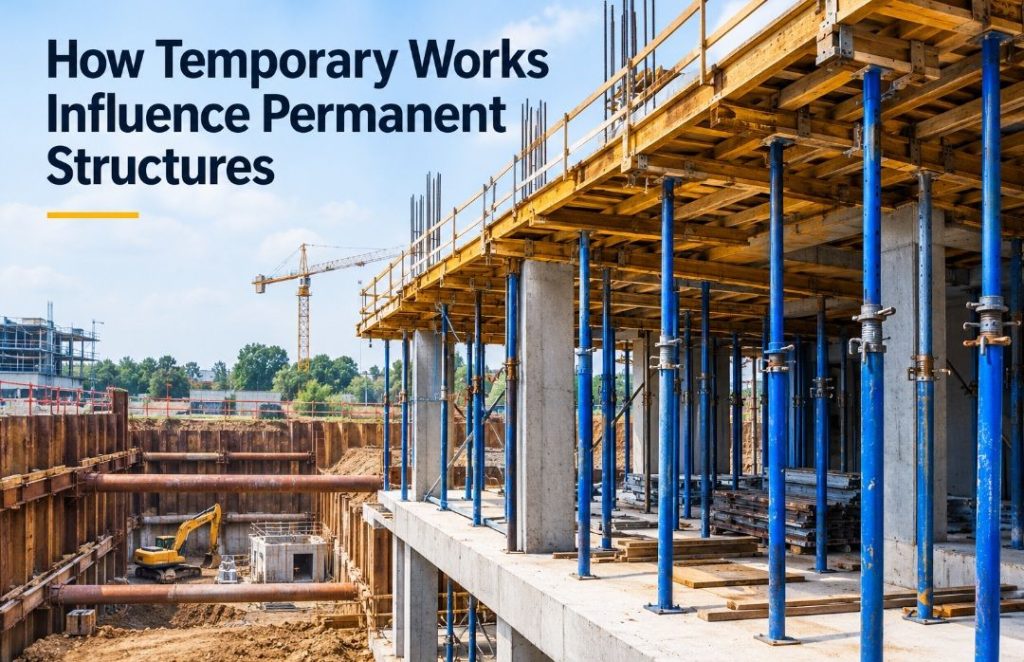
Temporary works are often treated as construction-stage arrangements that disappear once the permanent structure is completed. Props, temporary bracing, excavation supports, scaffolding, working platforms and other temporary systems may not form part of the finished building, but they can significantly influence how the permanent structure behaves while it is being constructed.
A permanent structure does not necessarily experience its final design load configuration from the beginning. Loads are introduced progressively as floors, walls, finishes and other components are constructed. Temporary supports can change how these loads are transferred between members, sometimes creating load paths that are different from those assumed for the completed structure.
This makes temporary works an important part of structural engineering. Poorly planned temporary support can introduce excessive forces, unexpected deflections or instability, while premature removal can transfer loads to permanent members before they are ready to carry them. Understanding this interaction helps ensure that the structure remains stable throughout construction and performs as intended after completion.
Temporary Works Create Different Load Paths
The completed structure may have a clear load path from slabs through beams and columns to the foundations. During construction, however, temporary supports can interrupt or modify that path.
For example, a beam may be supported by props while concrete gains strength. The props temporarily carry part of the load that would eventually be transferred through the beam and its supports. When the props are removed, that load is redistributed into the permanent structure.
The resulting load transfer depends on when the support is removed, the stiffness of the permanent members and the amount of load already present. Removing a temporary support is therefore not simply a matter of taking away a piece of construction equipment. It can represent a significant change in the structural system.
Propping Can Affect Load Distribution
Temporary propping is commonly used during slab and beam construction, particularly where fresh concrete, formwork and construction loads need additional support.
The location and stiffness of the props influence how forces are distributed. A relatively stiff prop can attract a substantial portion of the load, while a less stiff support may contribute considerably less. This means that two apparently similar propping arrangements can produce different structural responses.
The issue becomes more important when several floors are constructed above one another. Loads from an upper floor can be transferred through props and formwork to lower floors. If the lower floors were not designed or assessed for these construction-stage loads, excessive stress or deflection can occur.
This is why back-propping and reshoring arrangements require proper consideration rather than being based solely on site convenience.
Temporary Bracing Can Influence Structural Stability
Temporary bracing is particularly important during the erection of steel structures and incomplete reinforced concrete frames.
A completed building may obtain lateral stability from the interaction of frames, slabs, shear walls and other permanent elements. During construction, some of these elements may not yet be present or may not have reached their required strength.
A steel frame, for example, may be stable once all permanent bracing and floor diaphragms are installed but unstable during an intermediate erection stage. Temporary bracing can provide the missing restraint until the permanent stability system is completed.
Removing such bracing too early can expose the partially completed structure to wind or construction loads for which it was not yet stable.
Temporary Supports Can Influence Deflection
Temporary supports do not only affect strength and stability. They can also influence the final deformation of a structure.
Consider a beam that is supported by props while additional floors or loads are being constructed. If the props are removed after significant loading has already occurred, the beam may suddenly take a larger portion of the accumulated load. This can result in additional deflection.
In some situations, the sequence of loading and unloading can therefore affect the final deformation of the permanent structure.
This is particularly relevant for long-span beams, transfer structures and slabs where serviceability requirements can be more critical. A structure that satisfies its strength requirements may still experience unacceptable deflection if construction-stage support and loading are poorly controlled.
Excavation Support Can Affect Permanent Structures
Temporary works are not limited to supports above ground. Excavation support systems can also influence permanent structures.
Deep excavations may require sheet piles, soldier piles, retaining systems, struts or anchors to maintain stability while foundations and basement structures are constructed. These temporary systems control ground movement and help protect surrounding structures.
If an excavation experiences excessive movement, the resulting ground deformation can affect adjacent foundations, roads and existing buildings.
The relationship between the temporary excavation support and the permanent basement structure therefore needs to be considered carefully. Once the permanent walls and slabs become capable of resisting the required earth and water pressures, temporary supports may be removed progressively. The sequence needs to ensure that the permanent system can safely take over the required loads.
Temporary Works Can Introduce Unintended Loads
Temporary structures and construction equipment can introduce loads that are not present in the completed building.
Material storage, construction equipment, concrete placing operations and concentrated loads from temporary supports can create significant local forces. These loads may occur on slabs that were originally designed primarily for normal occupancy conditions.
For example, storing reinforcement bundles or blocks in one location can create concentrated loading that differs substantially from the uniformly distributed loads assumed in design.
Temporary works should therefore be assessed together with the construction activities they support. The support system itself may be adequate while the permanent structure underneath it is not.
Removal of Temporary Supports Is a Structural Operation
One of the most important aspects of temporary works is their removal.
The removal of a prop, brace or temporary support changes the structural system. If the permanent structure has not developed sufficient strength or stiffness, the resulting load transfer can cause excessive deformation or overstress.
Concrete strength is particularly important where temporary supports are being removed from newly cast members. The required strength is not determined simply by the number of days that have passed since casting. It depends on the design requirements, concrete development and the construction sequence.
Where the removal of supports has a significant structural effect, the sequence should be established as part of the temporary works planning rather than left entirely to site judgement.
Temporary Works Must Be Designed for Construction Conditions
A common mistake is to focus heavily on the permanent structure while treating temporary works as a contractor’s routine responsibility.
Although contractors are responsible for implementing many temporary works, their structural implications should not be overlooked. The temporary arrangement needs to account for the loads, geometry, stability conditions and sequence that will actually occur on site.
This becomes particularly important when construction deviates from the original design sequence. A change in the order of casting, premature removal of supports, alteration of bracing or changes to the planned erection sequence can change the structural behaviour.
The temporary condition should therefore be treated as a structural condition in its own right.
Coordination Between Design and Construction
Good coordination between the structural designer, contractor and site supervision team is essential where temporary works affect the permanent structure.
The design team needs to understand significant construction-stage conditions, while the construction team needs to understand any limitations associated with the permanent structure. Where temporary support arrangements have a direct influence on load transfer, they should be properly documented and communicated.
Site teams should also verify that the actual arrangement corresponds with the intended sequence. A small change in the position of a prop or brace can sometimes have a larger structural effect than expected.
Conclusion
Temporary works may only exist for a short period, but their influence on a permanent structure can extend far beyond the construction stage. Props can alter load distribution, temporary bracing can provide essential stability, excavation support can control ground movement, and the removal of temporary supports can trigger significant load redistribution.
The key issue is that a building does not behave only as its final design model during construction. It passes through a series of structural configurations before reaching completion. Each configuration has its own load paths, stability requirements and potential failure mechanisms.
Also See: How Construction Sequence Affects Structural Design
Sources & Citations
- EN 1990, Eurocode: Basis of Structural Design, European Committee for Standardization.
- EN 1991-1-6, Eurocode 1: Actions on Structures – Actions During Execution, European Committee for Standardization.
- EN 1992-1-1, Eurocode 2: Design of Concrete Structures, European Committee for Standardization.
- EN 1993-1-1, Eurocode 3: Design of Steel Structures, European Committee for Standardization.
- BS 5975, Temporary Works Procedures and the Permissible Stress Design of Falsework, BSI.
