Many major bridges around the world now rely on the Segmental bridge construction method. This is because it offers advantages in terms of structural efficiency, construction speed, and adaptability to difficult site conditions.
The construction of long-span bridges has always presented significant engineering challenges. Traditional bridge construction methods often require extensive scaffolding, false-work, and access from the ground or water below. In many locations, such as deep valleys, busy highways, or large rivers, providing such temporary support structures can be difficult, expensive, or even impossible. Structural engineers therefore developed alternative construction techniques that allow bridges to be built efficiently while minimizing disruption to the environment and surrounding infrastructure.
One of the most important developments in modern bridge engineering is segmental bridge construction. This method involves building a bridge from smaller structural units known as segments, which are assembled sequentially to form the complete bridge structure. Each segment is carefully designed to connect with adjacent segments, allowing the bridge to grow progressively until the full span is achieved. The technique has become widely used for long-span concrete bridges because it allows engineers to construct large structures with high precision and reduced dependence on temporary support systems.
Segmental construction has played a crucial role in the development of modern transportation infrastructure. Many major bridges around the world now rely on this method because it offers advantages in terms of structural efficiency, construction speed, and adaptability to difficult site conditions. Projects such as the Confederation Bridge and the Millau Viaduct illustrate how segmental construction techniques can be applied to build large and complex bridge structures.
Concept of Segmental Bridge Construction
Segmental bridge construction is based on the idea of dividing the bridge superstructure into smaller prefabricated or cast-in-place sections that are assembled sequentially. Each segment typically represents a portion of the bridge deck and its supporting structural components, such as a box girder or beam.
Instead of constructing the entire bridge in one continuous operation, engineers produce these segments individually and then connect them using post-tensioning tendons, reinforcement, and carefully designed joints. Once assembled, the segments act together as a continuous structural system capable of carrying traffic loads, wind forces, and other environmental loads.
This approach offers several advantages. By producing segments individually, engineers can achieve high levels of quality control and dimensional accuracy. The smaller components are also easier to transport and install compared to large monolithic structural elements. As a result, segmental construction allows bridges to be built efficiently even in locations where traditional construction methods would be impractical.
Structural Behaviour of Segmental Bridges
Although segmental bridges are assembled from multiple pieces, they are designed to behave as continuous structural systems once construction is complete. The individual segments are connected using prestressing tendons that run longitudinally through the structure. These tendons apply compressive forces that hold the segments together and allow them to act as a single structural unit.
Under traffic loading, the bridge behaves similarly to a continuous beam or girder. Bending moments develop along the length of the structure, with compression occurring in one region and tension in another. The prestressing forces help counteract tensile stresses, improving the overall durability and structural performance of the bridge.
The most common structural form used in segmental bridges is the box girder. A box girder consists of a hollow structural section that provides excellent torsional stiffness and efficient resistance to bending. The closed shape of the box girder also allows internal space for prestressing tendons and inspection access, making it particularly suitable for long-span bridge construction.
Types of Segmental Construction Methods
Segmental bridges can be constructed using several different methods depending on the project conditions and structural requirements. One widely used approach is balanced cantilever construction. In this method, segments are added symmetrically on both sides of a bridge pier, forming a cantilever that gradually extends outward. Each new segment is supported by the previously completed portion of the bridge, allowing the structure to grow without the need for temporary supports below.
Another approach is span-by-span construction. In this method, segments are assembled across an entire span between two piers before moving to the next span. Specialized launching equipment or erection girders are often used to position the segments accurately during installation.
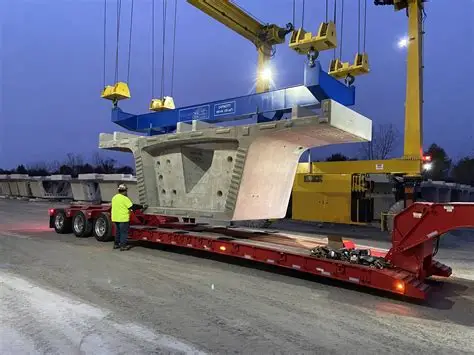
A third method involves precast segments that are fabricated in a controlled manufacturing facility and transported to the construction site. These segments are then lifted into place and connected using prestressing tendons. Precasting allows for faster construction and improved quality control compared to cast-in-place methods.
Each of these techniques has specific advantages depending on site conditions, span length, and project requirements. Engineers carefully evaluate these factors when selecting the most appropriate construction method.
Advantages of Segmental Bridge Construction
Segmental bridge construction offers several significant advantages compared to traditional bridge construction techniques. One of the most important benefits is the ability to build bridges without extensive falsework or scaffolding. This is particularly valuable when constructing bridges over rivers, highways, or environmentally sensitive areas where temporary supports would be difficult to install.
Another advantage is improved construction efficiency. Since many segments can be fabricated simultaneously while other parts of the bridge are being assembled, the overall construction schedule can be significantly reduced. The use of standardized segments also simplifies the construction process and improves productivity.
Segmental construction also allows engineers to achieve high levels of precision and quality control. Precast segments are typically produced in controlled factory environments where materials, curing conditions, and dimensional accuracy can be carefully monitored. This helps ensure that the final bridge structure meets strict performance and durability requirements.
Engineering Challenges
Despite its many advantages, segmental bridge construction also presents several engineering challenges. This must be carefully addressed during design and construction. One of the most critical considerations is the design of the joints between segments. These joints must be capable of transferring large shear forces and bending moments while maintaining structural continuity.
The alignment of segments during erection is another important issue. Because Segmental bridges are assembled piece by piece, even small positioning errors can accumulate and affect the final geometry of the structure. Engineers therefore rely on precise surveying techniques and specialized erection equipment to maintain accurate alignment throughout the construction process.
Prestressing operations also require careful control. The prestressing tendons must be installed and tensioned according to strict procedures. This is to ensure that the correct forces are applied to the structure. Improper prestressing could lead to structural weaknesses or long-term performance problems.
Applications in Modern Bridge Engineering
Segmental bridge construction has become one of the most widely used techniques for building modern concrete bridges. The method is particularly well suited for long-span highway bridges, urban viaducts, and bridges crossing difficult terrain.
Many notable bridges around the world have been constructed using segmental techniques. The Confederation Bridge is one of the longest bridges constructed. This is primarily from precast concrete segments, demonstrating the ability of this method to create large and durable transportation structures.
Similarly, the Millau Viaduct incorporates advanced construction methods that rely on segmented structural components to achieve its remarkable span and height. These projects illustrate how segmental construction has transformed the way engineers approach large bridge projects.
Conclusion
Segmental bridge construction represents a major advancement in modern bridge engineering. By dividing the bridge structure into smaller segments that are assembled sequentially, engineers can construct long-span bridges with greater efficiency, precision, and adaptability to challenging site conditions.
The structural behaviour of segmental bridges allows them to function as continuous systems capable of carrying significant loads while maintaining durability and stability. Through the use of prestressing, advanced erection techniques, and careful design of structural joints, engineers have successfully applied this method to some of the most impressive bridge projects in the world.
Also See: Differential Temperature Effects in Long Span Bridges
Sources & Citations
- Podolny, W., & Muller, J. Construction and Design of Prestressed Concrete Segmental Bridges. Wiley, 1982.
- Hewson, N. Prestressed Concrete Bridges: Design and Construction. Thomas Telford Publishing, 2003.
- Barker, R.M., & Puckett, J.A. Design of Highway Bridges: An LRFD Approach. Wiley, 2013.
- fib Bulletin 55. Precast Segmental Bridges. International Federation for Structural Concrete, 2010.
