The consequences of a column failure depend on several key factors, including structural redundancy, material behaviour, and connection detailing.
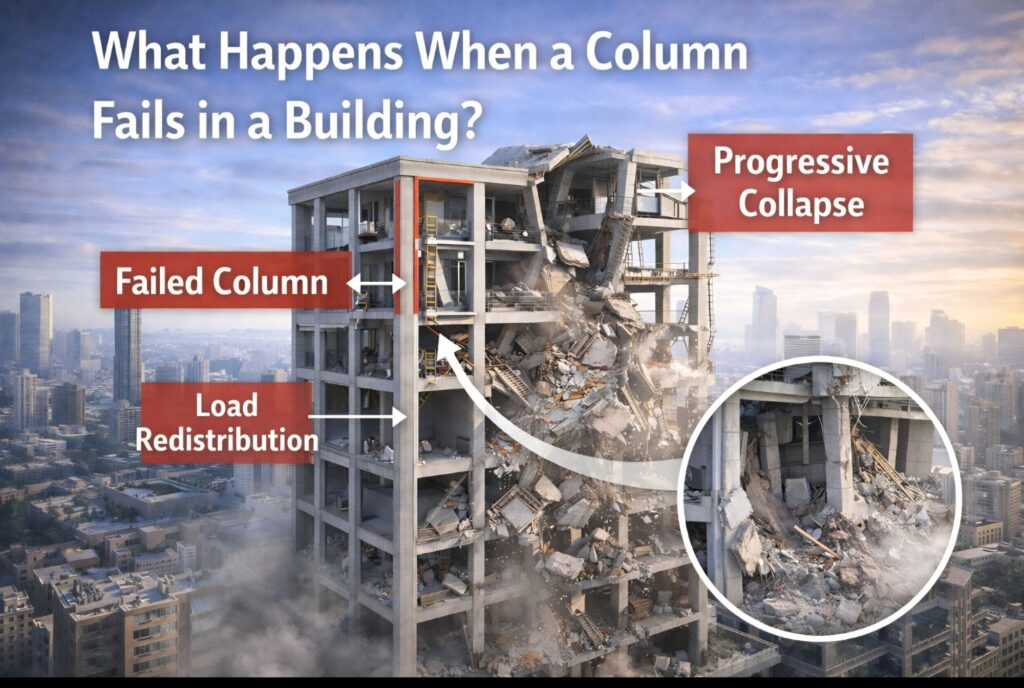
Columns are among the most critical structural elements in any building. While beams distribute loads and slabs provide usable floor space, columns act as the primary vertical load-carrying members that transfer forces safely down to the foundation. Every floor, wall, and structural component ultimately relies on columns to maintain stability. Because of this, the failure of even a single column can have consequences that extend far beyond its immediate location.
In many cases, buildings appear robust and immovable, giving a false sense of permanence. However, structural systems are carefully balanced networks of load paths. When one element fails, the loads it was carrying must be redistributed elsewhere. If the surrounding structure cannot accommodate this sudden change, a localized failure can escalate into a much larger structural problem. This chain reaction is what engineers refer to as progressive collapse.
Understanding what happens when a column fails is not just an academic exercise. It is central to safe design, construction, and structural assessment. Real-world failures, such as the Ronan Point collapse and the World Trade Center collapse, demonstrate how local damage can propagate through a structure with devastating consequences. These events highlight the importance of understanding load paths, redundancy, and structural behaviour under abnormal conditions.
The Role of Columns in Structural Systems
To understand the consequences of column failure, it is necessary to first appreciate the role columns play in a building. Columns are designed to carry vertical loads from slabs, beams, and other structural elements. These loads include the self-weight of the structure, as well as imposed loads from occupants, furniture, and equipment.
In a typical reinforced concrete or steel building, loads follow a predictable path. Floor slabs transfer loads to beams, beams transfer loads to columns, and columns transfer loads to the foundation. This sequence forms the primary load path of the structure. As long as each element performs its function, the building remains stable.
Columns also contribute to overall structural stiffness, particularly in framed structures. While they are primarily associated with gravity loads, they can also play a role in resisting lateral forces depending on the structural system. Their removal therefore affects not only vertical load transfer but also the global behaviour of the building.
Immediate Effects of Column Failure
When a column fails, the first and most critical effect is the sudden loss of load-carrying capacity at that location. The loads that were previously carried by the column do not disappear. Instead, they must be redistributed to adjacent structural elements.
This redistribution occurs almost instantaneously. Beams connected to the failed column experience a sudden increase in bending moments and shear forces. If these beams were not designed to carry such additional loads, they may begin to deform excessively or fail.
Imagine a simple scenario in a multi-storey building where a ground-floor column is accidentally removed during renovation. The floors above that column lose their direct vertical support. The beams spanning over the missing column are suddenly forced to act as transfer elements, attempting to bridge the gap. If these beams lack sufficient capacity, they may crack, deflect, and ultimately fail.
At this stage, the failure is still localized. However, whether it remains localized or spreads depends on the ability of the surrounding structure to absorb and redistribute the additional loads.
Load Redistribution and Structural Response
After the initial failure, the structure enters a critical phase where load redistribution determines its fate. Structural systems are not perfectly rigid; they possess some degree of flexibility that allows them to adapt to changes in loading conditions.
If the building has sufficient redundancy, alternative load paths may exist. Adjacent columns and beams may take on additional loads, redistributing forces throughout the structure. In well-designed systems, this redistribution can prevent collapse, limiting damage to a localized area.
However, this redistribution is not without consequences. Elements that were originally designed for specific loads may now be subjected to forces far beyond their capacity. Beams may experience increased bending, connections may be overstressed, and slabs may begin to crack under unexpected stress patterns.
A useful way to visualize this is to imagine a table supported by four legs. If one leg is removed, the table may remain standing temporarily, but the remaining legs must carry additional load. If they are strong enough, the table survives. If not, the entire system collapses.
Progressive Collapse Mechanism
If the redistributed loads exceed the capacity of adjacent structural elements, additional failures may occur. This can lead to a progressive collapse, where the failure of one element triggers a chain reaction of failures throughout the structure.
Progressive collapse is particularly dangerous because it can occur rapidly and without significant warning. A single column failure can lead to the collapse of entire floors if the structure lacks the ability to redistribute loads effectively.
The Ronan Point collapse is a classic example. A localized gas explosion caused the failure of a load-bearing wall, leading to the collapse of an entire corner of the building. The structure lacked sufficient redundancy to prevent the spread of failure.
In progressive collapse scenarios, the structure essentially loses its ability to find alternative load paths. Each failed element increases the demand on the remaining structure, leading to a cascading sequence of failures.
Factors That Influence the Outcome
The consequences of a column failure depend on several key factors, including structural redundancy, material behaviour, and connection detailing.
Redundancy plays a crucial role in determining whether a building can survive a local failure. Structures with multiple load paths are better able to redistribute forces and prevent collapse. For example, continuous frames and well-connected systems provide alternative routes for load transfer.
Material behaviour is also important. Ductile materials such as steel can undergo significant deformation before failure, allowing time for load redistribution. Brittle materials, on the other hand, may fail suddenly without warning, increasing the risk of progressive collapse.
Connection design is another critical factor.
Connections between beams and columns must be capable of transferring forces even under abnormal conditions. Poorly designed connections can become weak points that trigger further failures.
Engineering Measures to Prevent Collapse
Structural engineers design buildings with the understanding that unexpected events can occur. To prevent catastrophic failures, modern design codes include provisions for robustness and progressive collapse resistance.
One approach is to ensure continuity in structural elements so that loads can be redistributed effectively. Another is to design key elements to withstand abnormal loads, providing additional safety margins.
In some cases, engineers explicitly consider the removal of a column as a design scenario. The structure is analysed to determine how it would respond, and measures are taken to ensure that collapse does not propagate beyond a limited area.
These strategies are particularly important in critical structures such as high-rise buildings, hospitals, and public facilities where the consequences of collapse would be severe.
Conclusion
The failure of a single column can have consequences that extend far beyond its immediate location. What begins as a localized loss of support can trigger complex structural responses involving load redistribution, increased stresses, and potential progressive collapse.
The outcome depends on the ability of the structure to adapt to the sudden change. Buildings with sufficient redundancy and well-designed connections may survive with limited damage, while others may experience cascading failures.
Also See: Initial Imperfections and Slender Column Design
Sources & Citations
- Starossek, U. Progressive Collapse of Structures. Thomas Telford Publishing, 2009.
- Ellingwood, B.R. Mitigating Risk from Abnormal Loads and Progressive Collapse. Journal of Performance of Constructed Facilities, ASCE, 2006.
- UFC 4-023-03. Design of Buildings to Resist Progressive Collapse. U.S. Department of Defense, 2016.
- ASCE/SEI 7-16. Minimum Design Loads and Associated Criteria for Buildings and Other Structures. American Society of Civil Engineers, 2016.
- BS EN 1991-1-7. Eurocode 1: Actions on Structures – Accidental Actions. European Committee for Standardization.
