The fundamental principle behind the tube structural system is the concentration of structural strength and stiffness along the building’s perimeter.
The rapid development of tall buildings during the twentieth century forced structural engineers to rethink traditional structural systems. As buildings increased in height, conventional moment-resisting frames became increasingly inefficient in resisting lateral loads such as wind and earthquakes. The stiffness required to control drift often demanded large structural members, which reduced architectural flexibility and increased construction costs. This challenge led to the development of innovative structural systems that could provide greater lateral resistance while maintaining material efficiency.
One of the most significant breakthroughs in tall building engineering was the development of the tube structural system. Introduced in the 1960s, this concept revolutionized skyscraper design by allowing buildings to behave structurally like hollow cantilevered tubes fixed at the ground. Instead of relying primarily on interior frames or cores to resist lateral loads, the exterior structure itself becomes the main structural element. This approach allows the entire building perimeter to contribute to resisting wind and seismic forces, dramatically improving structural efficiency.
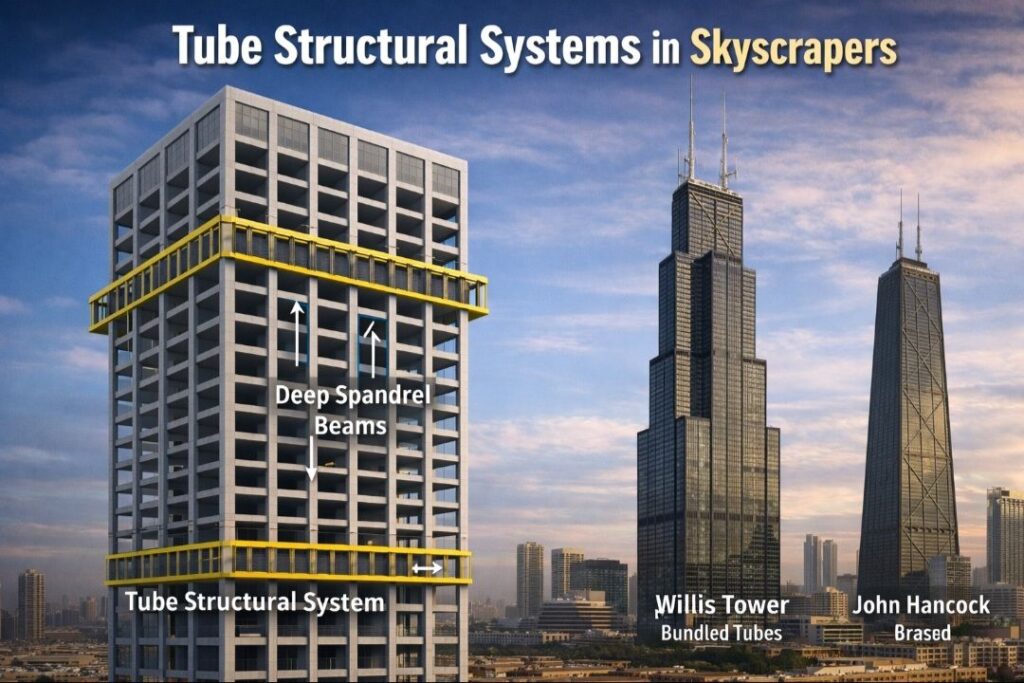
The tube system became widely recognized through its application in iconic skyscrapers such as the Willis Tower and the John Hancock Center. These buildings demonstrated that tall structures could achieve both height and structural efficiency through innovative structural systems.
The Concept of the Tube System
The fundamental principle behind the tube structural system is the concentration of structural strength and stiffness along the building’s perimeter. Closely spaced exterior columns are connected by deep spandrel beams, forming a rigid frame that acts like a continuous tube around the building.
When wind forces act on the structure, the building behaves as a vertical cantilever fixed at its base. The perimeter frame resists lateral loads primarily through bending, similar to how the walls of a hollow tube resist bending when subjected to lateral forces. Because the perimeter structure is located far from the building’s center, it provides a large lever arm to resist overturning moments, making the system highly efficient.
This configuration allows interior columns to carry mainly gravity loads while the exterior structural frame handles most lateral forces. The result is a structural system that uses material more efficiently and allows greater flexibility in interior floor planning.
Structural Behaviour Under Lateral Loads
Under wind loading, the tube system distributes stresses around the entire perimeter of the building. Columns on the windward side experience compression, while those on the leeward side may experience tension. The closely spaced columns and connecting beams act together to resist these forces through frame action.
The stiffness of the exterior frame significantly reduces lateral drift, which is critical in tall buildings where excessive movement can cause discomfort for occupants and damage to non-structural components. Because the structural resistance is distributed around the building envelope, tube systems can achieve high levels of lateral stiffness without requiring excessively large interior structural elements.
Types of Tube Structural Systems
As skyscrapers grew taller, engineers developed several variations of the basic tube concept to improve efficiency and adapt to different architectural forms. One common variation is the framed tube system, where the exterior consists of closely spaced columns connected by deep beams forming a rigid frame.
Another development is the braced tube system, which incorporates diagonal bracing across the exterior frame to further enhance stiffness. The John Hancock Center is one of the most famous examples of this approach, where the exterior X-bracing visibly forms part of the building’s architectural identity.
A further advancement is the bundled tube system, which consists of several tubes connected together to form a single structural unit. This configuration allows buildings to achieve greater heights while maintaining structural efficiency. The Willis Tower is a classic example of a bundled tube structure, where multiple vertical tubes combine to form the overall building shape.
Advantages of Tube Systems
The tube structural system offers several important advantages in tall building design. By placing the primary structural elements at the perimeter, it maximizes the structural depth available to resist lateral loads. This improves efficiency and reduces the amount of material required compared to conventional frame systems.
Another advantage is the increased flexibility of interior spaces. Since many of the lateral load-resisting elements are located on the exterior, fewer interior columns are required, allowing architects greater freedom in designing open floor plans.
Tube systems also contribute to architectural expression. The structural pattern of exterior columns, beams, and bracing often becomes a defining visual feature of the building, blending structural performance with architectural aesthetics.
Limitations and Design Challenges
Despite their advantages, tube structural systems also present several design challenges. Closely spaced perimeter columns can restrict the size of window openings, potentially affecting architectural design. Engineers must balance structural requirements with the need for natural lighting and façade aesthetics.
Another challenge involves shear lag, a phenomenon where not all perimeter columns share the bending stresses equally. Columns near the corners tend to carry more load than those located along the mid-span of building faces. Engineers must carefully consider this behaviour during analysis and design to ensure structural efficiency.
Construction complexity can also increase due to the large number of perimeter structural elements and the need for precise connections between beams and columns. Nevertheless, modern construction techniques and advanced structural analysis methods have made it possible to overcome these challenges effectively.
Applications in Modern Skyscrapers
Tube structural systems have played a central role in the development of modern skyscrapers. Many iconic buildings constructed during the late twentieth century adopted variations of the tube concept due to its efficiency and structural performance.
The structural innovation introduced by engineers such as Fazlur Rahman Khan transformed skyscraper design and enabled buildings to reach heights that were previously considered impractical. His pioneering work on tube structures laid the foundation for many of the tall building systems used today.
Even though modern skyscrapers now incorporate advanced systems such as outrigger frames and diagrid structures, the tube concept remains one of the most influential developments in the history of structural engineering.
Conclusion
Tube structural systems represent a major milestone in the evolution of tall building design. By transforming the building perimeter into the primary structural element resisting lateral loads, engineers were able to achieve greater heights with improved efficiency and stability. The system not only improved structural performance but also influenced architectural design by integrating structure and aesthetics.
Although newer structural systems continue to emerge, the tube concept remains fundamental to the engineering of tall buildings. Its influence can still be seen in many modern skyscrapers, reflecting the enduring impact of this innovation on structural engineering and urban architecture.
Also See: Outrigger Structural Systems in Tall Buildings
Sources & Citations
- Khan, F.R. Evolution of Structural Systems for High-Rise Buildings in Steel and Concrete. Council on Tall Buildings and Urban Habitat.
- Taranath, B.S. Structural Analysis and Design of Tall Buildings. CRC Press, 2016.
- Ali, M.M., & Moon, K.S. Structural Developments in Tall Buildings: Current Trends and Future Prospects. Architectural Science Review, 2007.
- Smith, B.S., & Coull, A. Tall Building Structures: Analysis and Design. Wiley, 1991
