Outrigger structural systems represent a key innovation in the design of tall buildings. By linking the core to perimeter columns, they transform structural behaviour, reduce bending stresses in the core, enhance lateral stiffness, and improve overall structural efficiency.
The rapid growth of urban populations has driven the construction of increasingly tall and slender buildings across major cities. With the need for tructures to grow taller, structural engineers face a fundamental challenge: controlling lateral forces.
Wind and seismic loads generate large overturning moments and lateral displacements that can significantly affect both the safety and serviceability of buildings. Controlling structural drift, limiting acceleration experienced by occupants, and ensuring long-term stability become central concerns in the design process.
Among the various structural strategies developed to address these challenges, the outrigger structural system has emerged as one of the most effective and widely adopted solutions. By linking the central core of a building to its perimeter columns through stiff horizontal structural members, outrigger systems allow the full width of the structure to participate in resisting overturning forces.
This redistribution of structural forces significantly increase lateral stiffness while reducing the bending demands on the building’s core. Modern skyscrapers frequently rely on this structural concept to achieve both efficiency and stability. Many prominent tall buildings such as the Burj Khalifa and Shanghai Tower employ sophisticated outrigger systems as part of their primary structural framework, demonstrating the critical role of this system in modern tall building engineering.
Structural Challenges in Tall Buildings
The structural behaviour of tall buildings differs fundamentally from that of low-rise structures. While gravity loads dominate shorter buildings, lateral loads become increasingly significant as height increases. Wind forces, in particular, tend to govern the structural design of tall buildings because their magnitude grows with height while the building’s slenderness amplifies lateral displacement. A building that relies solely on a central reinforced concrete core behaves structurally like a vertical cantilever fixed at its base.
When lateral forces act on such a structure, the core must resist large bending moments generated by the overturning action. As building height increases, the lever arm associated with these moments grows dramatically, resulting in higher stresses and lateral deflections. This behaviour can lead to inefficient designs if the core alone is responsible for resisting lateral loads, often requiring excessively thick walls and heavy reinforcement that may conflict with architectural requirements and usable floor space.
For this reason, engineers developed systems that allow additional structural elements to participate in lateral resistance. The outrigger system is particularly effective because it engages perimeter columns in resisting overturning forces while improving the efficiency and stiffness of the overall building.
Concept of the Outrigger System
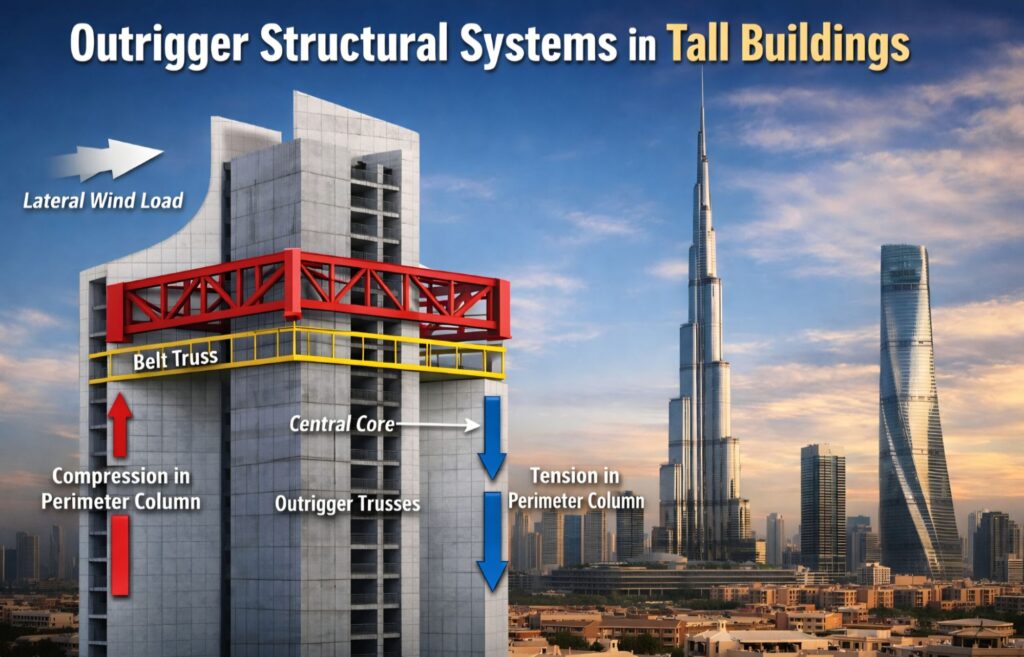
An outrigger structural system functions by creating a rigid connection between the building’s central core and its exterior columns at one or more levels. These horizontal structural elements, referred to as outriggers, extend outward from the core and connect to columns near the building perimeter. When wind or seismic forces act on the structure, the core tends to rotate slightly due to the bending moment created by the lateral load. The outrigger beams resist this rotation by transferring forces to the perimeter columns. One column experiences an increase in compression while the column on the opposite side develops tension.
Together, these axial forces form a resisting couple across the width of the structure, reducing the bending demand on the core and significantly increasing lateral stiffness. Through this interaction, the building behaves as a much wider structural system than the core alone would provide, effectively mobilizing the strength of perimeter columns to improve overall performance.
Structural Behaviour and Load Redistribution
Outriggers fundamentally alter the distribution of forces within tall buildings. In a core-only structure, most lateral forces are resisted by bending in the core walls. Introducing outriggers redirects a portion of these forces into axial forces in perimeter columns, reducing bending stresses in the core. This redistribution enhances structural efficiency and reduces lateral drift, improving occupant comfort by limiting building sway and acceleration under wind loads. The improved stiffness allows engineers to design taller and more slender structures while maintaining serviceability requirements, demonstrating the significant functional advantages of the system.
Belt Trusses and Structural Integration
In many tall buildings, outriggers are combined with belt trusses encircling the perimeter at outrigger levels. These trusses distribute the forces transferred from the outriggers across multiple columns, increasing redundancy and structural efficiency. The belt truss acts as a ring connecting the perimeter columns, ensuring that the forces generated by the outrigger action are shared collectively, reducing stress concentrations and enhancing robustness. This combined outrigger and belt truss system has become a common solution in modern high-rise buildings, providing both stability and architectural flexibility.
Placement of Outriggers
The vertical location of outriggers significantly influences their effectiveness. Engineers often position outriggers near the building’s mid-height, where core rotation under lateral loads is greatest. In very tall buildings, additional outrigger levels may be located closer to the top, further enhancing lateral resistance. Mechanical floors are frequently used to house outrigger structures, allowing large structural elements to be integrated without compromising usable interior space. Optimal placement is determined through detailed structural analysis and design optimization to maximize stiffness and minimize lateral drift.
Design and Construction Challenges
While outriggers provide significant advantages, they also introduce design and construction complexities. Differential shortening between the core and perimeter columns due to creep and shrinkage can generate unintended stresses in the outrigger connections if not properly accounted for. Construction sequencing is critical to ensure that the structure behaves as intended during both the construction phase and in service. Connections between outriggers, cores, and perimeter columns must be designed to accommodate very large axial forces, making careful detailing essential. Coordination between architects, structural engineers, and contractors is necessary to resolve these challenges and integrate outrigger elements without disrupting architectural and functional requirements.
Applications in Modern Skyscrapers
The outrigger system has been widely adopted in modern skyscrapers to control lateral behaviour and improve structural efficiency. Many of the world’s tallest buildings incorporate this concept as a key structural strategy. The Burj Khalifa, for example, uses multiple outrigger levels to link the reinforced concrete core to perimeter columns, significantly enhancing lateral stiffness. Similarly, the Shanghai Tower relies on advanced outrigger systems to maintain stability under extreme wind conditions. These examples illustrate how outriggers enable the construction of taller, more slender, and more efficient buildings while ensuring safety and comfort.
Also See: Lateral Stability of Tall Buildings
Conclusion
Outrigger structural systems represent a key innovation in the design of tall buildings. By linking the core to perimeter columns, they transform structural behaviour, reduce bending stresses in the core, enhance lateral stiffness, and improve overall structural efficiency. Their use in supertall buildings demonstrates how strategic structural connectivity can optimize performance, enabling architects and engineers to push the limits of height and slenderness. As urban skylines continue to evolve, outrigger systems will remain a central strategy in the design of stable, efficient, and resilient high-rise structures.
Sources & Citations
- Taranath, B.S. Structural Analysis and Design of Tall Buildings: Steel and Composite Construction. CRC Press, 2016.
- Ali, M.M., & Moon, K.S. Structural Developments in Tall Buildings: Current Trends and Future Prospects. Architectural Science Review, 50(3), 2007, pp. 205–223.
- Guo, X., & Li, Q.S. Outrigger-Belt Truss Systems in High-Rise Buildings: Behavior and Design Considerations. Journal of Structural Engineering, ASCE, 140(5), 2014, 04013088.
- Breen, J.E., & Smith, B.S. Advanced Tall Building Design: Lateral Load-Resisting Systems and Outrigger Applications. Engineering Structures, 98, 2015, pp. 151–164.
