Structural joints are not secondary details; they define how structures behave. Pinned, rigid, and semi-rigid joints determine internal force distribution.
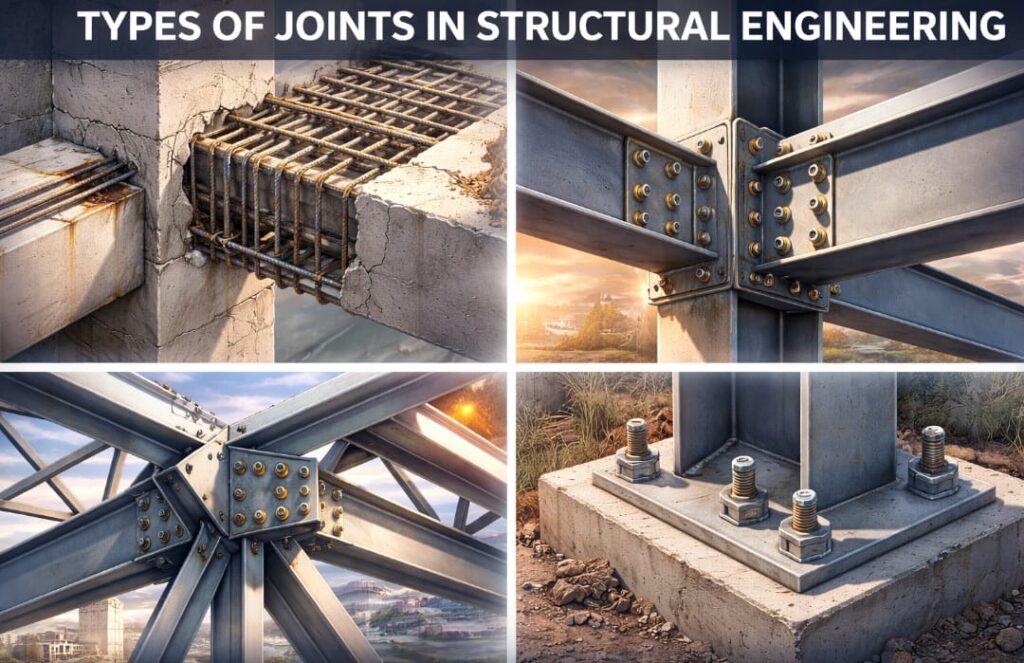
Structures rarely behave as isolated members. Every beam, column, slab, truss, or cable only performs because it is connected to something else. The joint is the location where force changes direction, where stiffness transitions, and where continuity is either preserved or deliberately broken. Many structural failures have shown that it is not the member that fails first but the joint that was underestimated.
When engineers analyse structures, they often idealise joints as either pinned or rigid. In reality, every joint possesses measurable stiffness, deformation capacity, and stress concentration characteristics. The difference between a safe structure and a vulnerable one frequently lies in how accurately the engineer understands joint behaviour under axial load, shear, bending moment, torsion, temperature variation, and dynamic excitation.
In structural engineering, joints serve three fundamental purposes. They transfer forces between members. They control movement caused by temperature, shrinkage, creep, and settlement. They ensure stability by maintaining geometric compatibility within the structural system. To design joints properly, one must understand not only their classification but also their mechanics.
Structural Behaviour-Based Classification of Joints
The most fundamental classification of structural joints is based on how they transfer moment and rotation. This classification applies across steel, reinforced concrete, timber, and composite systems.
Pinned (Hinged) Joints
A pinned joint resists axial force and shear but allows rotation. It does not transfer bending moment. In structural analysis, a hinge creates zero moment at the connection and simplifies internal force distribution.
In practice, a perfectly frictionless hinge does not exist. However, steel truss connections bolted through gusset plates approximate pinned behaviour closely. The design assumption of zero moment ensures that truss members carry primarily axial forces. This allows slender tension and compression members to perform efficiently without bending stress.
Consider a 25 m steel roof truss over an industrial warehouse. If the connections were fully rigid instead of pinned, bending would develop at the joints. Compression members designed for pure axial load would experience combined bending and compression, increasing buckling risk. The pinned assumption therefore ensures predictable axial force paths.
Pinned joints are also common at bridge bearings, where rotation must occur due to load deflection or temperature movement. Restricting rotation in such cases would induce unintended bending stresses.
Rigid (Moment-Resisting) Joints
Rigid joints transfer axial force, shear, and bending moment. They restrict relative rotation between connected members. These joints provide continuity and increase overall structural stiffness.
In reinforced concrete frames, beam-column joints are designed as rigid. Reinforcement from beams extends into columns with proper anchorage length. The concrete core of the joint must resist high shear stresses, particularly under lateral loading such as wind or seismic action.
In steel moment-resisting frames, rigid joints are achieved through full-penetration welds or bolted end-plate connections. The stiffness of such joints influences lateral drift and redistribution of internal forces.
A practical scenario illustrates the importance of rigid joints. Consider a 10-storey reinforced concrete office building designed for lateral wind loads. If beam-column joints behave semi-rigidly instead of fully rigid as assumed, lateral drift increases. Excessive drift may cause non-structural damage such as cracking in partitions and facade distress. Therefore, joint stiffness directly influences serviceability performance.
Semi-Rigid Joints
Most real joints fall between ideal pinned and perfectly rigid conditions. Semi-rigid joints possess finite rotational stiffness. They transfer some moment but allow partial rotation.
Modern structural analysis increasingly incorporates semi-rigid joint modelling using rotational springs. This approach produces more realistic predictions of deflection and force distribution.
In portal frame steel structures used for industrial buildings, bolted end-plate connections often exhibit semi-rigid behaviour. Ignoring this behaviour may either overestimate or underestimate bending moments in columns and rafters.
Reinforced Concrete Joints
Reinforced concrete joints require particular attention because concrete is weak in tension and relies heavily on reinforcement anchorage for force transfer.
Beam-Column Joints
Beam-column joints are critical regions in moment-resisting frames. They must transfer large shear forces resulting from opposing beam moments. During seismic loading, cyclic forces reverse repeatedly, demanding ductility and confinement.
The joint core must be adequately confined using closely spaced transverse reinforcement. Without confinement, brittle shear failure may occur before beams yield, leading to catastrophic collapse.
Imagine a four-storey building subjected to earthquake excitation. If beam-column joints lack proper stirrup confinement, diagonal cracking may form within the joint core. Once shear capacity is exceeded, the connection loses integrity and the structural frame mechanism collapses.
Design codes therefore specify joint shear strength checks and minimum reinforcement detailing in seismic zones.
Construction Joints
Construction joints occur when concrete casting is interrupted. These joints must ensure continuity of force transfer between previously hardened and newly placed concrete.
If placed at high-moment regions without proper surface preparation, construction joints may behave as weak planes. Shear keys or roughened surfaces are often used to enhance bond strength.
In large raft foundations, construction joints are carefully located at zones of lower bending moment to minimise structural risk.
Expansion Joints in Concrete Structures
Long reinforced concrete structures expand and contract due to temperature variation and shrinkage. When total building length exceeds approximately 40 to 60 metres, expansion joints may be required depending on climatic conditions.
Without expansion joints, restrained thermal movement generates tensile stress and cracking. These cracks may compromise durability by allowing moisture ingress.
Bridges illustrate this effect clearly. A 300 m concrete bridge exposed to a 30°C temperature variation can experience expansion exceeding 90 mm. Expansion joints and bearings accommodate this movement safely.
Control and Contraction Joints
In slabs-on-grade, control joints guide shrinkage cracking. Rather than preventing cracking, they control its location. Saw-cut grooves weaken specific lines so that cracks form predictably.
Poorly placed control joints often result in random cracking patterns that affect durability and aesthetics.
Structural Steel Joints
Steel structures rely heavily on connection design because steel members are typically fabricated separately and assembled on site.
Bolted Connections
Bolted joints may function in bearing or friction. In bearing-type connections, bolts resist shear through contact with the hole surface. In friction-type connections, high-strength bolts create clamping force, and load transfer occurs through friction between plates.
Friction-type connections are preferred in bridges and dynamic structures because they prevent slip under service load.
Improper bolt tightening reduces friction capacity and may lead to joint slip, fatigue cracking, and eventual failure.
Welded Connections
Welded joints create continuous metal fusion between elements. They can provide full moment transfer when designed correctly.
However, welding introduces residual stresses due to rapid heating and cooling. Poor weld quality may initiate fatigue cracks, particularly in bridges subjected to cyclic loading.
Inspection procedures such as ultrasonic testing ensure weld integrity in critical structures.
Base Plate and Anchor Bolt Joints
Steel columns transfer load to foundations through base plates anchored by bolts. The joint must resist axial load, shear, and sometimes bending moment.
If anchor bolts are misaligned or improperly embedded, stress concentration develops at the base plate. Cracking of surrounding concrete may follow.
Movement Joints in Bridges
Bridges experience larger movements than buildings due to span length and exposure conditions.
Expansion Joints
Bridge expansion joints accommodate longitudinal deck movement caused by temperature, creep, and shrinkage.
In long-span bridges exceeding 200 m, total movement may reach several hundred millimetres. Failure of expansion joints can lock deck movement, transferring unintended forces into piers and bearings.
Bearings as Functional Joints
Bridge bearings act as controlled joints. They allow rotation and translation while transferring vertical load.
If bearings seize due to corrosion or debris accumulation, thermal expansion forces may accumulate in the superstructure. Cracking and pier distress can result.
Seismic and Settlement Joints
Seismic joints separate adjacent structures to prevent pounding during earthquakes. Settlement joints allow differential foundation movement without inducing stress in connected blocks.
Large infrastructure projects often incorporate settlement joints when constructed in phases to accommodate soil consolidation.
Failure Mechanisms Associated with Joints
Many structural failures originate at connection points rather than within members. Common failure mechanisms include inadequate anchorage, insufficient shear reinforcement, fatigue cracking in welded joints, corrosion at bolt interfaces, and excessive rigidity in movement joints.
Engineers must consider durability as carefully as strength. Joints are often exposed to environmental conditions that accelerate corrosion and deterioration.
Design Philosophy for Structural Joints
Effective joint design follows several principles. The joint should be stronger or more ductile than the connected members, particularly in seismic design. It must provide clear force transfer mechanisms. It must allow intended movement while restraining unintended displacement. It must remain durable throughout the structure’s service life.
Ignoring joint behaviour compromises structural reliability. Over-designing joints unnecessarily increases cost and stiffness, potentially introducing stress concentration elsewhere.
Conclusion
Structural joints are not secondary details; they define how structures behave. Pinned, rigid, and semi-rigid joints determine internal force distribution. Construction, expansion, seismic, and settlement joints manage movement and continuity. Reinforced concrete joints require careful confinement and anchorage. Steel connections demand precision in bolting and welding.
Also See: Movement Joints in Concrete Buildings
Sources & Citations
- American Concrete Institute (2019). Building Code Requirements for Structural Concrete (ACI 318-19) and Commentary. Farmington Hills, MI: ACI.
- American Institute of Steel Construction (2022). Steel Construction Manual, 16th Edition. Chicago, IL: AISC.
- European Committee for Standardization (2005). Eurocode 3: Design of Steel Structures – Part 1-8: Design of Joints (EN 1993-1-8). Brussels: CEN.
- European Committee for Standardization (2004). Eurocode 2: Design of Concrete Structures – Part 1-1: General Rules and Rules for Buildings (EN 1992-1-1). Brussels: CEN.
