This article examines the I-90 Tunnel collapse as a methodological failure rather than a singular technical mistake. It explores how design assumptions, specification gaps, material behaviour, organisational fragmentation, and missed warning signs aligned over time.
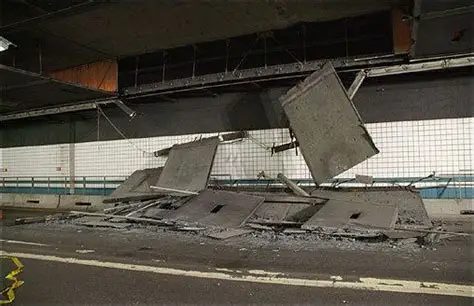
Structural failures rarely announce themselves through dramatic overloads or extreme external events. More often, they develop quietly within details that appear compliant, tested, and accepted. The collapse of ceiling panels in Boston’s Interstate 90 Connector Tunnel in 2006 remains one of the clearest examples of how infrastructure can meet design intent at handover yet fail catastrophically in service. The incident exposed uncomfortable weaknesses in how engineers specify, approve, and monitor systems that rely on long-term material performance.
Six years after the tunnel opened, a suspended ceiling system failed without warning under normal traffic conditions. The collapse killed a passenger and injured others, undermining confidence in one of the most ambitious infrastructure projects in the United States. When a similar ceiling collapse occurred in Japan’s Sasago Tunnel in 2012, the parallels became impossible to ignore. Different locations and organisations shared the same fundamental oversight: insufficient consideration of long-term behaviour in suspended structural systems.
This article examines the I-90 Tunnel collapse as a methodological failure rather than a singular technical mistake. It explores how design assumptions, specification gaps, material behaviour, organisational fragmentation, and missed warning signs aligned over time.
Why the I-90 Tunnel Collapse Still Demands Attention
The most disturbing aspect of the I-90 failure is not how the ceiling collapsed, but when it collapsed. The tunnel had been open to traffic for over six years. The ceiling system had passed inspections and proof tests. No exceptional event triggered the failure. Instead, the system deteriorated invisibly until collapse became inevitable.
This challenges a deeply embedded assumption in structural engineering practice. Engineers often treat compliance at installation as a proxy for long-term safety. Once a system meets design loads and passes testing, attention shifts elsewhere. The I-90 collapse demonstrates that this mindset fails when materials behave differently over time.
Modern infrastructure increasingly relies on adhesives, composite systems, and proprietary fixings. These systems often perform well under short-term loads but behave unpredictably under sustained stress. Without explicit consideration of time-dependent behaviour, engineers risk repeating the same mistakes.
Understanding the Tunnel Ceiling System
The D Street portal formed part of Boston’s Central Artery/Tunnel project, commonly referred to as the “Big Dig.” This vast infrastructure programme aimed to improve traffic flow through Boston by placing major highways underground. The I-90 Connector Tunnel represented one component of this complex system.
Within the D Street portal, a suspended ceiling system concealed ventilation and services above the roadway. Precast concrete ceiling panels sat on a steel support frame, which hung from the tunnel roof using stainless steel adhesive anchors. Epoxy bonded each anchor into drilled holes within the concrete roof slab (Figure 1).
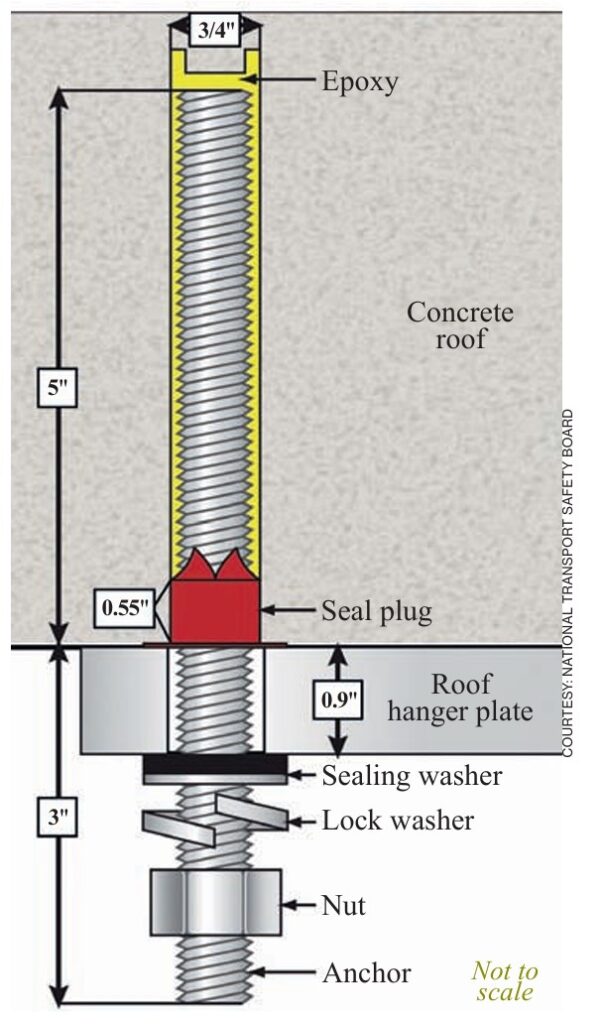
At face value, the system appeared robust. Adhesive anchors had seen widespread use in construction. Stainless steel offered corrosion resistance. Proof load testing confirmed short-term capacity. Design loads remained well below published ultimate values. Nothing about the system raised immediate concern.
Yet the entire ceiling depended on the sustained performance of adhesive anchors in tension. That dependence proved fatal.
Adhesive Anchors and Time-Dependent Behaviour
Adhesive anchors inspire confidence because they behave predictably during installation testing. Pull-out tests produce reassuring results. Installers observe no visible movement. Engineers record compliance and move on.
However, adhesives do not behave like steel or concrete under sustained load. Many formulations exhibit creep, meaning they deform slowly over time when subjected to constant stress. This deformation does not appear during short-term testing and remains invisible without targeted inspection.
In the I-90 tunnel, the epoxy used was a fast-setting formulation. While suitable for temporary or short-duration loads, it exhibited poor creep resistance under sustained tension. Over time, the adhesive slowly deformed, allowing anchors to displace incrementally.
This displacement accumulated across multiple anchors. Load redistribution increased stress on remaining fixings until the system could no longer maintain equilibrium. The ceiling then collapsed suddenly, despite years of apparent stability.
Specification Gaps and Design Responsibility
One of the most significant failures lay not in construction, but in specification. The ceiling design did not define performance requirements for long-term anchor behaviour. It assumed that meeting short-term capacity and proof testing was sufficient.
This assumption reflects a broader issue within structural engineering practice. Engineers often specify loads but fail to specify behaviour. Serviceability, creep resistance, and durability receive secondary attention, particularly when proprietary products enter the design.
In this case, the design did not restrict epoxy formulation choice. It did not require sustained load testing. It did not demand creep performance data. As a result, installers unknowingly used a product unsuitable for permanent loading.
The absence of explicit requirements transferred critical decisions to parties least equipped to make them.
Product Information and the Limits of Trust
The epoxy supplier’s documentation contributed significantly to the failure chain. Testing data existed that demonstrated poor creep performance in the fast-setting formulation. However, this information did not reach designers or contractors in a clear, unequivocal form.
Product literature often emphasises strength while downplaying limitations. Engineers may assume that compliance with published standards implies suitability for all applications. The I-90 collapse shows how dangerous this assumption can be.
Structural engineers must interrogate proprietary products rigorously. Where systems support life-critical elements, reliance on supplier assurances alone is insufficient. Independent verification becomes essential.
Why Installation Was Not the Root Cause
Initial responses to the collapse focused on installation quality. Investigators considered whether improper drilling, cleaning, or adhesive placement caused the anchors to fail. Evidence ultimately rejected this explanation.
Proof testing confirmed adequate installation. Displacement occurred even in anchors that met all installation requirements. Improper workmanship alone could not explain the scale or pattern of failure.
This finding matters because it challenges a common industry reflex. When failures occur, organisations often default to blaming contractors. The I-90 case demonstrates that competent installation cannot compensate for inappropriate system selection.
Engineering responsibility does not end at installation oversight.
Missed Warning Signs and Organisational Fragmentation
Perhaps the most troubling aspect of the I-90 collapse involves missed opportunities. Years before the failure, workers observed anchor displacement in nearby tunnels. Engineers replaced anchors and performed further proof testing, but they did not investigate the underlying cause.
Later, additional anchor movement appeared elsewhere in the tunnel network. Again, teams treated symptoms rather than mechanisms. No one asked why anchors that passed testing continued to move.
Large infrastructure projects fragment responsibility. Designers, contractors, asset owners, and operators each manage different phases. Without clear ownership of systemic risk, anomalies become isolated issues rather than warning signs.
The collapse exposed the cost of this fragmentation.
Inspection Regimes and the Illusion of Control
Inspection manuals existed for the tunnel network. However, inspections above the suspended ceilings did not occur for several years. The most critical components remained hidden and unchecked.
Inspection regimes often focus on visible deterioration. Hidden systems receive less attention because access proves difficult or disruptive. In the I-90 tunnel, this neglect allowed anchor creep to progress unnoticed.
Effective inspection requires targeting failure mechanisms, not convenience. If failure depends on concealed components, inspection must reach them. Manuals alone do not ensure safety without enforcement and accountability.
Why Similar Failures Continue to Occur
The Sasago Tunnel collapse in Japan reinforced the lessons of the I-90 failure. Ceiling panels suspended above traffic failed years after construction. Investigations again pointed to support and anchorage issues under sustained load.
Different materials, different contractors, and different regulatory systems produced similar outcomes. These parallels suggest systemic weaknesses rather than isolated mistakes.
Engineers continue to underestimate time-dependent behaviour. Organisations continue to prioritise delivery over durability. Lessons remain local rather than global.
Methodological Lessons for Structural Engineers
The I-90 collapse offers several critical lessons. Engineers must design for service life, not just installation. Systems relying on adhesives or composite action demand explicit long-term performance criteria.
Specifications must define behaviour, not merely capacity. Product data must undergo critical review. Inspection regimes must target hidden vulnerabilities. Anomalies must trigger investigation, not replacement alone.
Most importantly, engineers must accept responsibility for systems, not components. Safety emerges from how elements interact over time.
Conclusion
The Interstate 90 Tunnel ceiling collapse was not an unpredictable accident. It resulted from assumptions left unchallenged, warnings left unexplored, and behaviours left un-examined. The failure demonstrates that structural safety depends as much on methodology as on calculation.
As infrastructure grows older and systems become more complex, these lessons gain urgency. Future failures will not excuse ignorance of past ones. The responsibility rests firmly with the profession.
Also See: Lessons from the De Grolsch Veste Stadium Roof Failure
Sources & Citations
- National Transportation Safety Board (2007). Highway Accident Report: Ceiling Collapse in the Interstate 90 Connector Tunnel, Boston, Massachusetts.
- Brady, S. (2013). Interstate 90 Connector Tunnel ceiling collapse. Engineers Australia Magazine.
- fib (2010). Model Code for Concrete Structures – Serviceability and Durability.
- ISO 2394:2015. General principles on reliability for structures.
- Health and Safety Executive (HSE). Structural failure and investigation guidance.
