Diagrid structural systems represent one of the most significant developments in modern tall building engineering. By replacing conventional vertical columns with a triangulated network of diagonal members, the system creates a stiff structural shell capable of efficiently resisting both gravity and lateral loads.
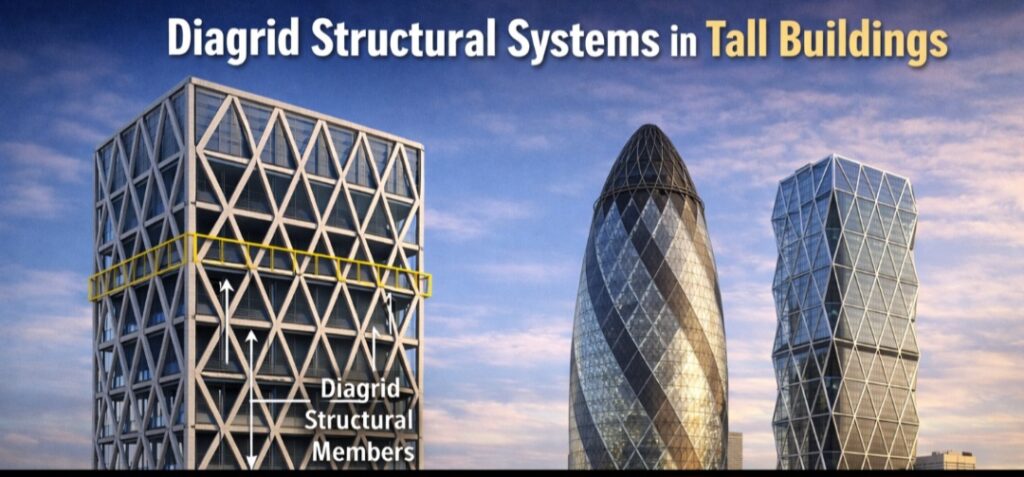
The continuous pursuit of taller and more efficient buildings has led structural engineers to develop innovative structural systems capable of resisting increasingly complex loads. As building heights increase, lateral forces generated by wind and seismic activity become dominant design considerations. Conventional frame systems often become inefficient for very tall buildings because they require large structural members to control drift and maintain stability. As a result, engineers have explored alternative structural concepts that provide higher stiffness and efficiency while also allowing architectural flexibility.
One of the most notable structural innovations developed for modern skyscrapers is the diagrid structural system. The term “diagrid” combines the words diagonal and grid, referring to a network of diagonal structural members arranged across the building façade. These diagonal elements form a triangulated structural framework that replaces many traditional vertical columns and horizontal beams. By using triangular configurations, the system can resist both gravity and lateral loads efficiently, creating a stiff structural shell around the building.
The adoption of diagrid structures has become increasingly popular in contemporary skyscrapers because of their structural efficiency and architectural expression.
Buildings such as the and the demonstrate how diagrid systems can combine structural performance with striking architectural design. These buildings illustrate how modern engineering approaches can transform structural systems into defining architectural features.
Structural Challenges in Tall Buildings
Tall buildings behave fundamentally differently from low-rise structures. In shorter buildings, gravity loads such as the weight of floors, walls, and occupants usually dominate the structural design. However, as height increases, lateral loads from wind and earthquakes become the governing factor in structural performance.
Wind loads generate large overturning moments that attempt to rotate the building about its base. If the structure is not sufficiently stiff, excessive lateral deflection may occur, resulting in discomfort for occupants and potential damage to non-structural elements such as partitions, façades, and mechanical systems. Controlling drift and acceleration therefore becomes a major objective in the design of tall buildings.
Traditional structural systems often rely on moment-resisting frames or shear walls to resist these loads. However, these systems can become inefficient for very tall buildings because the required structural members grow excessively large.
Engineers therefore seek systems that distribute structural forces more efficiently throughout the building. Diagrid structures address this challenge by allowing the exterior structure to act as the primary load-resisting system.
Concept of the Diagrid Structural System
The defining feature of a diagrid structure is the arrangement of diagonal members across the building façade. Instead of using vertical columns connected by horizontal beams, the structural framework consists primarily of diagonally oriented steel or composite members that form a series of triangular modules.
Triangles are inherently stable geometric shapes because their form prevents deformation without changing the length of the structural members. This characteristic allows diagrid structures to resist lateral loads primarily through axial forces rather than bending. Structural members that carry loads in axial tension or compression can do so more efficiently than those subjected to bending moments, which improves material efficiency.
When lateral forces act on the building, the diagonal members transmit these forces through axial compression and tension along the triangulated network. The system behaves as a continuous structural shell that distributes loads around the entire building perimeter. Because the structural elements are located far from the building’s center, they provide a large lever arm to resist overturning forces, increasing the stiffness of the structure.
Structural Behaviour Under
Lateral Loads
The behaviour of diagrid structures under lateral loading is fundamentally different from that of conventional frame systems. In traditional moment frames, beams and columns resist lateral loads through bending action at rigid connections. This approach often results in significant bending stresses and requires large member sizes to achieve the necessary stiffness.
In contrast, diagrid structures resist lateral loads primarily through axial forces within the diagonal members. When wind forces act on the building, some diagonal members experience compression while others develop tension. The triangulated configuration ensures that these forces are transmitted efficiently through the structural network.
This axial force mechanism allows the structure to achieve greater stiffness using less material. Because bending moments are reduced, the structural members can often be lighter and more slender than those in conventional frame systems. The result is a structural system that is both efficient and capable of supporting extremely tall buildings.
Another important advantage of this behaviour is the reduction of lateral drift. Since the diagonal members form a stiff structural shell, the building experiences smaller horizontal displacements under wind loading. This improvement in stiffness contributes to better occupant comfort and reduces the likelihood of serviceability problems.
Structural Efficiency and Material Optimization
One of the primary reasons for the growing popularity of diagrid structures is their exceptional structural efficiency. By utilizing diagonal members to resist both gravity and lateral loads, the system eliminates the need for many conventional vertical columns. This reduction in the number of structural elements can lead to significant material savings.
The triangulated framework also allows forces to be distributed more evenly throughout the structure. Instead of concentrating loads in a few large structural members, the diagrid network spreads forces across multiple elements. This load-sharing mechanism improves the overall performance of the structure and enhances redundancy.
Studies have shown that diagrid structures can reduce structural steel consumption by a considerable margin compared to traditional framed systems. This reduction in material not only lowers construction costs but also contributes to sustainability by decreasing the environmental impact associated with structural materials.
Architectural Integration
In addition to their structural advantages, diagrid systems offer unique architectural opportunities. Because the diagonal structural members are located on the building exterior, they become visible elements of the architectural design. This allows the structural system to play a central role in shaping the building’s appearance.
The distinctive pattern created by the diagonal grid often becomes a defining feature of the building’s identity. For example, the curved diagrid façade of the gives the building its recognizable form. Similarly, the exposed diagrid structure of the creates a striking visual expression while simultaneously performing a structural function.
This integration of structure and architecture demonstrates how engineering innovation can influence architectural design. Rather than hiding the structural system within the building envelope, diagrid structures celebrate the structural framework as an integral part of the building’s aesthetic character.
Design Considerations
Designing a diagrid structural system requires careful analysis and optimization. Engineers must determine the appropriate angle and spacing of diagonal members to achieve the desired balance between structural stiffness and material efficiency.
The angle of the diagonal members influences the way forces are distributed throughout the structure. Steeper angles tend to improve resistance to gravity loads, while shallower angles may enhance lateral stiffness. Achieving the optimal configuration requires detailed structural analysis and often involves iterative design processes using advanced computational tools.
Connection design also plays a critical role in the performance of diagrid systems. Because many diagonal members converge at common nodes, the structural joints must be capable of transferring large axial forces between members. These nodes often require complex fabrication and precise construction techniques to ensure proper alignment and structural integrity.
Construction Challenges
While diagrid systems offer significant advantages, they also introduce certain construction challenges. The geometry of the structural framework can be complex, requiring precise fabrication and assembly of structural members. The joints where multiple diagonal elements meet can be particularly intricate, often requiring custom-designed steel nodes.
Construction sequencing must also be carefully planned to ensure that the structure remains stable during erection. Temporary supports may be necessary until the full diagrid network is completed and capable of carrying loads as intended.
Despite these challenges, advances in digital design tools and modern fabrication techniques have made it increasingly feasible to construct complex diagrid structures efficiently.
Applications in Modern Skyscrapers
Diagrid structural systems have been used in several iconic buildings around the world. The is widely regarded as one of the earliest examples of a modern diagrid skyscraper. Its distinctive curved shape and exposed diagonal framework demonstrate the aesthetic and structural potential of the system.
Another prominent example is the , which uses a steel diagrid structure to achieve significant material efficiency while creating a visually striking architectural form. The building reportedly used substantially less steel than a conventional framed structure of similar size, highlighting the economic advantages of the system.
These examples illustrate how diagrid structures can enable innovative architectural designs while maintaining high levels of structural performance and efficiency.
Conclusion
Diagrid structural systems represent one of the most significant developments in modern tall building engineering. By replacing conventional vertical columns with a triangulated network of diagonal members, the system creates a stiff structural shell capable of efficiently resisting both gravity and lateral loads.
The ability of diagrid structures to carry loads primarily through axial forces improves material efficiency and reduces structural weight. At the same time, the distinctive geometric pattern of the system provides architects with new opportunities for creative expression.
Also See: Tube Structural Systems in Skyscrapers
Sources & Citations
- Moon, K.S. Diagrid Structures for Complex-Shaped Tall Buildings. Procedia Engineering, 2011.
- Taranath, B.S. Structural Analysis and Design of Tall Buildings. CRC Press, 2016.
- Ali, M.M., & Moon, K.S. Structural Developments in Tall Buildings: Current Trends and Future Prospects. Architectural Science Review, 2007.
- Smith, B.S., & Coull, A. Tall Building Structures: Analysis and Design. Wiley, 1991.
