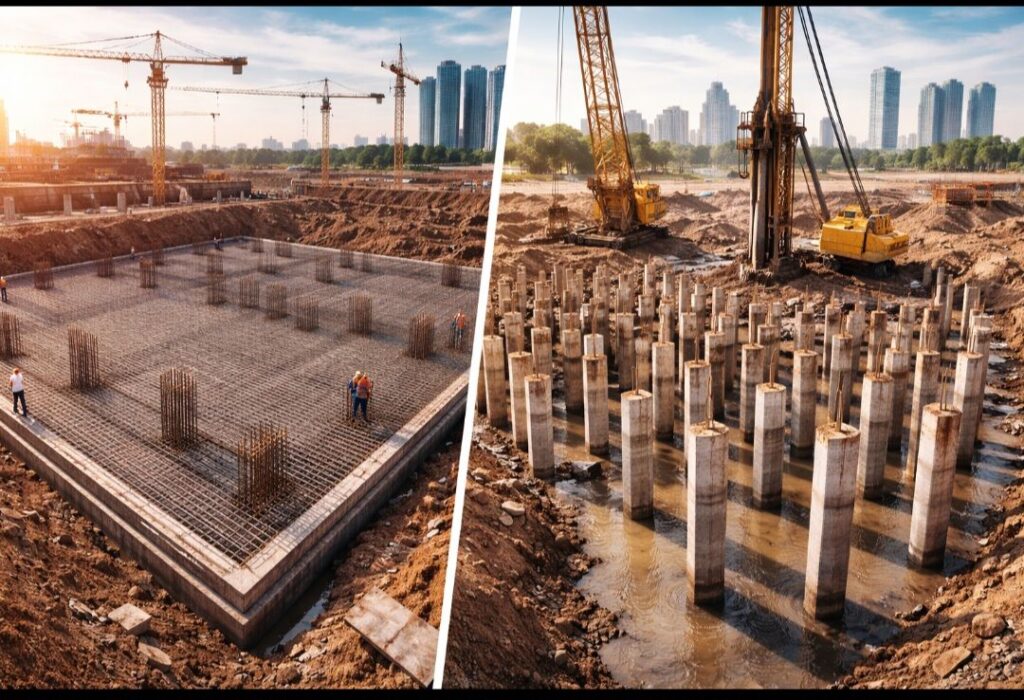
Raft and pile foundations approach the same problem from different directions. A raft foundation spreads structural load over a large surface area near the ground surface. A pile foundation transfers load deeper into stronger soil or rock layers.
Foundations determine whether a structure stands safely for decades or begins to fail within a few years. Every building transfers its load to the ground, and the behavior of that ground controls the performance of the entire structure. In regions with soft or compressible soils, this relationship becomes even more critical. Engineers must choose a foundation system that can control settlement, maintain stability, and remain economical. Two of the most common solutions in such conditions are raft foundations and pile foundations.
Soft soils present unique engineering challenges. Clay, peat, loose sand, and organic deposits often lack the strength required to support shallow foundations. These soils compress significantly under load, leading to uneven settlement and structural distress. Buildings constructed without proper geotechnical understanding may develop cracks, tilting, or even partial collapse. Because of this risk, engineers must carefully evaluate soil properties, groundwater conditions, and structural loads before selecting a foundation type.
Raft and pile foundations approach the same problem from different directions. A raft foundation spreads structural load over a large surface area near the ground surface. A pile foundation transfers load deeper into stronger soil or rock layers. Each system has advantages, limitations, and cost implications. Understanding when to use one instead of the other is essential for safe and economical construction, especially in rapidly developing urban environments where soft soils are common.
Understanding Soft Soil Behavior
Soft soil does not fail suddenly in most cases. Instead, it deforms gradually as load increases. This deformation appears as settlement at the ground surface. When settlement occurs uniformly, buildings may remain structurally safe even though they sink slightly. Problems arise when settlement becomes uneven. Differential settlement introduces bending stresses in beams, slabs, and walls. Cracks appear in finishes first, but structural members may eventually become distressed.
Water content plays a major role in soft soil performance. High moisture reduces shear strength and increases compressibility. Seasonal groundwater changes can therefore influence foundation behavior long after construction ends. In coastal or swampy regions, engineers often encounter soils that continue consolidating for many years. This long-term settlement must be considered during design.
Load intensity also matters. Light residential buildings may tolerate shallow foundation systems even on weak soils. Heavy multistorey buildings demand deeper or more distributed support. Engineers must therefore match the foundation strategy to both soil condition and structural demand rather than relying on habit or cost alone.
Concept of Raft Foundations
A raft foundation, sometimes called a mat foundation, consists of a large reinforced concrete slab that supports multiple columns and walls simultaneously. Instead of placing isolated footings under each column, the raft spreads the total building load across the entire footprint. This distribution reduces contact pressure on soft soil and limits differential settlement.
Raft foundations work best when soil bearing capacity is low but relatively uniform. By covering the full building area, the raft allows the structure to “float” slightly on the soil. Small settlements may occur, yet the building moves as a single unit. Structural damage therefore reduces significantly compared to isolated footings.
We often choose raft foundations for medium-rise residential or commercial buildings where excavation to deep strong layers would be expensive. Construction also remains straightforward. After excavation and ground preparation, workers place reinforcement across the entire slab and cast concrete in a continuous operation. This simplicity makes rafts attractive in projects with tight timelines.
However, raft performance depends heavily on soil uniformity. If part of the soil compresses more than another, bending stresses develop within the raft slab. Thickened zones, ribs, or beams may therefore be required to increase stiffness. In extremely weak soils, even a raft may not prevent excessive settlement, making alternative systems necessary.
Concept of Pile Foundations
Pile foundations transfer structural load to deeper, stronger soil or rock. Engineers drive or bore long, slender members into the ground until they reach a competent layer or develop sufficient friction along their length. The building load then travels through the piles rather than the weak surface soil.
This approach bypasses the main weakness of soft ground. Instead of trying to improve shallow soil performance, piles rely on deeper strata that possess higher bearing capacity and lower compressibility. Settlement therefore reduces dramatically, which becomes critical for heavy or sensitive structures such as hospitals, bridges, or high-rise buildings.
Pile foundations introduce additional complexity. Construction requires specialized equipment, skilled supervision, and careful quality control. Installation noise, vibration, and cost may also increase. Despite these challenges, piles often provide the safest and most reliable solution where soft soil thickness is large or unpredictable.
Engineers must also design pile caps or raft-pile combinations to distribute column loads among multiple piles. Structural interaction between piles and surrounding soil requires detailed geotechnical analysis. Poor pile design can lead to group settlement or structural overstress even when individual piles appear adequate.
Load Transfer Mechanisms
Raft foundations rely primarily on bearing pressure at shallow depth. The soil directly beneath the slab carries the structural load. Settlement occurs as soil particles rearrange and compress. Engineers therefore focus on reducing contact stress and ensuring uniform pressure distribution.
Pile foundations rely on end bearing, skin friction, or a combination of both. Some piles rest on hard strata and transfer load directly downward. Others develop resistance along their shaft through friction with surrounding soil. Understanding which mechanism dominates is essential for accurate capacity prediction.
In practice, soil conditions rarely behave perfectly. Engineers must interpret site investigation data carefully. Conservative assumptions help maintain safety, especially where soil variability is high.
Settlement Performance Co6mparison
Settlement often governs foundation choice in soft soils. Raft foundations usually allow larger total settlement but aim to keep it uniform. Buildings supported by rafts may sink slightly yet remain serviceable. Cracking risk reduces when movement occurs evenly.
Pile foundations aim to minimize settlement altogether. Because loads transfer to deeper stiff layers, vertical movement becomes small. This characteristic is vital for tall buildings, precision equipment facilities, or structures connected to rigid utilities.
However, piles are not immune to settlement. Compression of pile material, deformation of surrounding soil, and group interaction can still produce movement. Engineers must therefore calculate both short-term and long-term settlement even for deep foundations.
Cost Considerations in Real Projects
Cost often influences foundation decisions as strongly as engineering theory. Raft foundations usually require large volumes of concrete and reinforcement but minimal specialized equipment. Labor remains relatively simple. For moderate loads and shallow weak soils, rafts often provide the most economical solution.
Pile foundations involve drilling rigs or driving equipment, testing procedures, and longer construction duration. Material cost per unit load may therefore increase. Yet when settlement risk threatens structural safety, piles become more economical in the long term by preventing failure or repair.
In many urban developments, engineers adopt pile-raft systems. This hybrid approach uses a raft to share load while a limited number of piles control settlement. Such solutions balance cost and performance effectively.
Durability and Long-Term Performance
Durability extends beyond initial construction. Raft foundations may experience long-term settlement due to soil consolidation, especially in clay. Engineers must predict this movement during design to avoid future serviceability problems.
Pile foundations face durability concerns such as corrosion, chemical attack, or negative skin friction from settling soil layers. Proper material selection, concrete cover, and protective measures ensure long service life.
Maintenance access also differs. Rafts remain visible at ground level, while piles remain hidden underground. This invisibility makes correct initial construction even more critical for pile systems.
Choosing Between Raft and Pile Foundations
.No universal rule determines the better option. Engineers must evaluate:
• Soil strength and thickness of weak layers
• Magnitude of structural load
• Allowable settlement limits
• Construction cost and timeline
• Environmental and site constraints
Balanced judgment, supported by geotechnical investigation and structural analysis, leads to the safest decision.
Conclusion
Soft soils challenge structural stability, but proper foundation selection transforms risk into manageable design. Raft foundations distribute load across wide areas and provide economical solutions where settlement remains tolerable. Pile foundations transfer load to deeper strong layers and protect structures requiring strict movement control. Each system carries benefits and limitations shaped by soil conditions, structural demand, and project economics.
