This technique has been widely used in modern bridge engineering, particularly for prestressed concrete box girder bridges.
Modern bridge construction often requires engineers to work in environments where traditional construction methods are no longer practical. Rivers, deep valleys, busy highways, and environmentally sensitive areas create significant constraints that make the use of falsework or ground-supported scaffolding difficult or impossible. In such situations, engineers must adopt construction techniques that allow structures to be built efficiently without relying on support from below.
Balanced cantilever construction is one of the most important methods developed to address these challenges. It allows bridge spans to be constructed segment by segment, extending outward from piers in a controlled and stable manner. By maintaining balance during construction, the method ensures that forces are properly distributed, preventing instability or excessive stress on partially completed structures.
This technique has been widely used in modern bridge engineering, particularly for prestressed concrete box girder bridges. Iconic projects such as the Forth Road Bridge approaches and sections of the Millau Viaduct demonstrate how cantilever principles can be applied to construct long spans efficiently while minimizing disruption to the environment.
Concept of Balanced Cantilever Construction
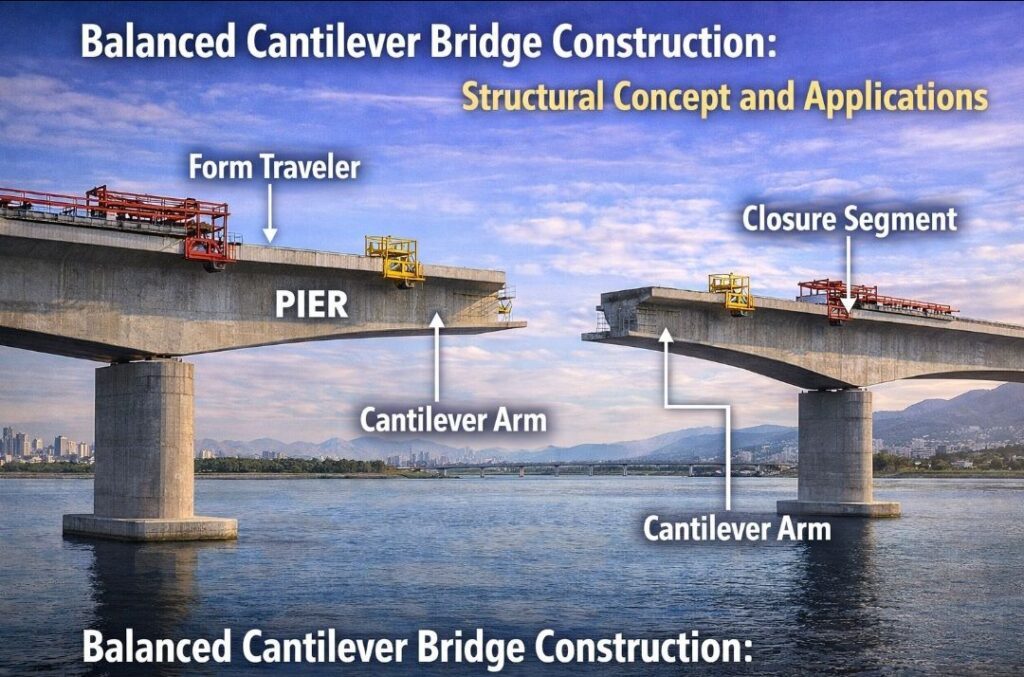
Balanced cantilever construction involves building a bridge outward from a central support, usually a pier, by adding segments alternately on either side. Each new segment is supported by the previously constructed portion of the bridge, creating a cantilever that extends progressively until it meets another cantilever from an adjacent pier.
The key principle behind this method is balance. By adding segments symmetrically on both sides of the pier, the moments generated by the weight of the segments counteract each other.
This reduces the net bending moment at the pier and ensures that the structure remains stable throughout the construction process.
The method eliminates the need for extensive temporary support systems beneath the bridge, making it particularly suitable for challenging site conditions. It also allows construction to proceed with minimal interference to traffic, waterways, or natural landscapes below the structure.
Structural Behaviour During Construction
The structural behaviour of a bridge during balanced cantilever construction differs significantly from its behaviour after completion. During construction, each cantilever acts as a partially completed structure subjected to its own weight and construction loads.
As segments are added, bending moments develop at the pier due to the cantilever action. These moments increase with the length of the cantilever, making it essential to control the sequence of construction carefully. By adding segments equally on both sides, engineers ensure that the moments remain balanced, reducing the risk of excessive stresses or instability.
Prestressing plays a crucial role in this process. Tendons are installed within each segment and stressed to introduce compressive forces that counteract tensile stresses caused by bending. This allows the structure to maintain adequate strength and stiffness even in its partially completed state.
Once the cantilevers from adjacent piers meet at mid-span, a closure segment is installed to complete the structural system. At this stage, the bridge begins to behave as a continuous structure, and the distribution of forces changes accordingly.
Materials and Structural Forms
Balanced cantilever construction is most commonly used with prestressed concrete box girders. The box girder form is particularly well suited to this method because of its high torsional stiffness and efficient distribution of stresses.
The hollow section of the box girder reduces self-weight while providing sufficient strength to resist bending and torsion. It also offers space for prestressing tendons and facilitates inspection and maintenance.
Steel bridges can also be constructed using cantilever methods, although the technique is more commonly associated with concrete structures. In both cases, the structural form must be carefully designed to accommodate the loads and stresses that occur during construction as well as in the final structure.
Construction Process
The construction process begins with the completion of bridge piers, which serve as the primary supports for the cantilever segments. Form travelers or erection equipment are then installed at the pier head to facilitate the casting or placement of segments.
Segments may be cast in place using formwork or prefabricated off-site and transported to the location. In cast-in-place construction, each segment is formed, reinforced, and prestressed before the next segment is added. In precast construction, segments are lifted into position and connected using prestressing tendons.
As construction progresses, the cantilever extends outward on both sides of the pier. Careful control of alignment and geometry is essential to ensure that the two advancing cantilevers meet accurately at mid-span. Any deviation can lead to difficulties during closure and affect the overall performance of the bridge.
The final stage involves placing the closure segment, which connects the cantilevers from adjacent piers. Additional prestressing is then applied to ensure continuity and structural integrity.
Advantages of Balanced Cantilever Construction
One of the most significant advantages of balanced cantilever construction is its ability to eliminate the need for falsework. This makes it ideal for constructing bridges over obstacles such as rivers, highways, and railways, where temporary supports would be impractical or disruptive.
The method also allows for efficient use of materials. Because the structure is built progressively and supported by its own components, less temporary material is required compared to traditional construction methods.
Another advantage is the ability to construct long spans with high precision. The use of segmental construction techniques ensures that each part of the bridge is carefully controlled, resulting in a high-quality finished structure.
Balanced cantilever construction also offers flexibility in design, allowing engineers to accommodate complex alignments and varying span lengths.
Engineering Challenges
Despite its advantages, balanced cantilever construction presents several challenges that must be addressed during design and construction. One of the primary challenges is controlling the stresses that develop during construction. Since the structure is partially completed at each stage, it must be designed to withstand loads that differ from those in the final configuration.
Another challenge is maintaining alignment. Small errors in the positioning of segments can accumulate over time, leading to significant deviations at the closure point. Engineers use precise surveying techniques and monitoring systems to ensure that alignment is maintained throughout the construction process.
Prestressing operations also require careful control. The timing and magnitude of prestressing forces must be accurately determined to ensure that the structure performs as intended.
Application in Modern Bridge Engineering
Balanced cantilever construction has been widely used in modern bridge projects around the world. It is particularly suitable for medium to long-span bridges where ground access is limited or environmental considerations are important.
Many prestressed concrete box girder bridges use this method because it combines structural efficiency with practical construction advantages. The technique has been applied in numerous highway and railway bridges, contributing to the development of modern transportation networks.
Projects such as the Millau Viaduct demonstrate how cantilever construction principles can be integrated into complex bridge systems, enabling the construction of large and visually striking structures.
Conclusion
Balanced cantilever bridge construction represents a major advancement in modern bridge engineering. By allowing structures to be built segment by segment without the need for temporary supports, it provides an efficient and practical solution for constructing bridges in challenging environments.
The method relies on careful control of structural behaviour during construction, particularly the balance of forces and the application of prestressing. When properly executed, it results in durable, efficient, and aesthetically pleasing bridge structures.
Also See: Box Girder Bridges: Structural Behaviour, Principles, and Applications
Sources & Citations
- Podolny, W., & Muller, J. Construction and Design of Prestressed Concrete Segmental Bridges. Wiley, 1982.
- Hewson, N. Prestressed Concrete Bridges. Thomas Telford, 2003.
- Barker, R.M., & Puckett, J.A. Design of Highway Bridges. Wiley, 2013.
- fib Bulletin 55. Precast Segmental Bridges. International Federation for Structural Concrete, 2010.
