This article explores how wind loads affect bridges, and practical strategies for safer, resilient structures.
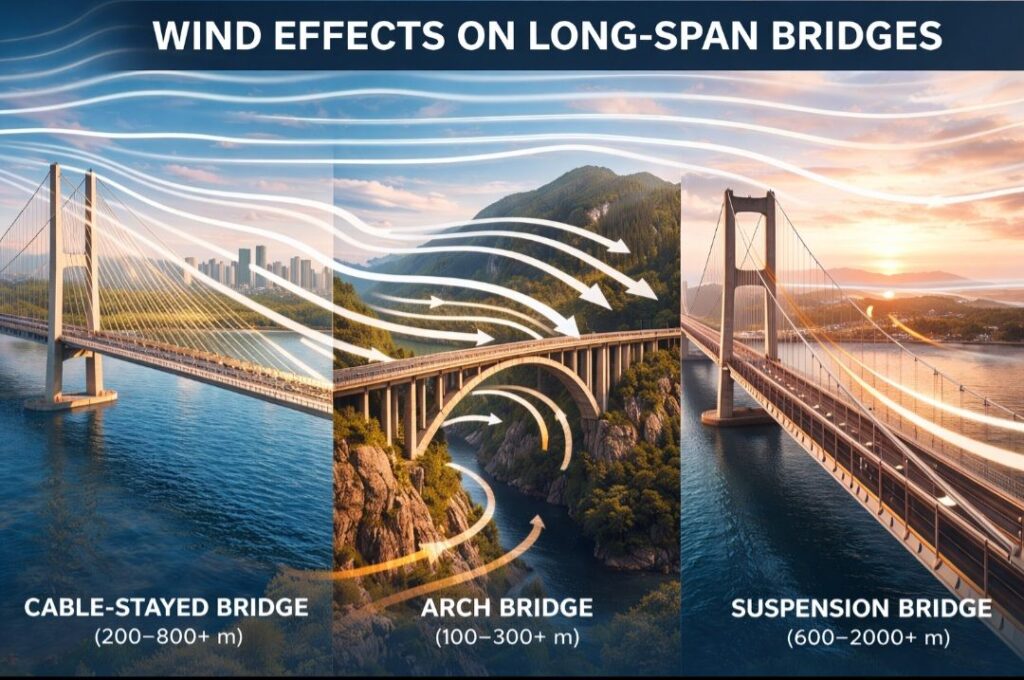
Wind does not need to be extreme to damage a bridge. It only needs to interact with the structure in the wrong way. Many long-span bridges have experienced excessive vibration, deck instability, or serviceability problems not because of traffic overload but because of aerodynamic effects. Engineers who design bridges beyond 150 m spans must treat wind as a primary design load, not a secondary consideration.
Long-span bridges behave differently from short-span beam bridges. Their decks are slender. Their stiffness reduces as span increases. Their natural frequencies become lower. These characteristics make them sensitive to dynamic wind actions. What may appear as gentle wind at ground level can generate significant structural response at deck elevation, especially over water or open terrain.
Therefore, understanding wind effects on long-span bridges requires more than applying a static wind pressure value. Engineers must consider aerodynamic stability, vibration modes, damping capacity, and construction stage vulnerability. This article explains how wind interacts with beam, arch, cable-stayed, and suspension bridges, using realistic span ranges and practical design reasoning.
Why Wind Becomes Critical in Long Spans
For short bridges below 30 m, wind typically acts as a static lateral load. The structure is stiff enough that deflection remains small. As span increases beyond 150 m, stiffness reduces rapidly. The deck becomes slender to control dead load. Slenderness increases flexibility. Flexibility increases dynamic response.
Consider a cable-stayed bridge with a 400 m main span. The deck depth may be only 2.5–3.5 m. The span-to-depth ratio becomes large. This makes the bridge efficient structurally but more sensitive to aerodynamic excitation.
Wind effects become critical due to:
- Increased exposed surface area
- Reduced structural stiffness
- Lower natural frequency
- Longer vibration period
- Reduced inherent damping
These factors combine to create conditions where wind can excite structural motion.
Types of Wind Effects on Bridges
Wind interaction with bridges generally falls into four major categories: static wind load, vortex shedding, flutter, and buffeting. Each behaves differently and
requires different engineering checks.
1. Static Wind Load
Static wind load is calculated using wind pressure formulas based on velocity, exposure category, and height. For medium-span bridges between 50 m and 150 m, this is often sufficient.
However, for spans beyond 200 m, static analysis alone becomes inadequate. Dynamic amplification must be considered.
2. Vortex Shedding
When wind flows past a bluff body such as a bridge deck, alternating vortices form behind it. These vortices create oscillating forces perpendicular to the wind direction. If the vortex shedding frequency matches the bridge’s natural frequency, resonance can occur.
Imagine a 300 m cable-stayed bridge located in an open coastal region.
Moderate wind speeds of 10–20 m/s can produce periodic oscillations in stay cables. Over time, repeated vibration may cause fatigue damage in cable anchorages.
This is why modern cable-stayed bridges use:
- Helical fillets on cables
- Surface modifications
- Tuned mass dampers
- Cross-ties between cables
These devices increase damping and reduce oscillation amplitude.
3. Flutter
Flutter is one of the most dangerous aerodynamic phenomena. It occurs when wind-induced motion feeds energy back into the structure, causing self-excited oscillation. Unlike vortex shedding, flutter can grow rapidly and become unstable.
Flutter was responsible for the collapse of the collapse of the Tacoma Narrow Bridge in 1940. The bridge had a main span of approximately 853 m. Under moderate wind conditions of about 19 m/s, torsional oscillations developed and amplified until structural failure occurred.
This event permanently changed bridge engineering practice. After this collapse, aerodynamic testing in wind tunnels became mandatory for long-span bridges.
Flutter risk increases when:
- Deck torsional stiffness is low
- Damping is insufficient
- Span exceeds 600 m
- Wind velocity approaches critical flutter speed
Modern suspension bridges above 1,000 m spans are carefully shaped with streamlined deck sections to prevent flutter.
4. Buffeting
Buffeting refers to irregular vibration caused by turbulent wind. Unlike vortex shedding, it is not periodic. Buffeting effects become significant in suspension bridges above 600 m and cable-stayed bridges above 400 m.
Engineers evaluate buffeting through time-history dynamic analysis using site wind data.
Wind Effects on Different Bridge Types
Beam Bridges (Below 50 m)
Wind rarely governs design. Structural mass and stiffness are sufficient to control movement. Design checks typically focus on lateral load combinations.
Arch Bridges (30 m – 200 m)
Wind can affect construction stages when the arch is incomplete. A 120 m arch under erection behaves differently from its final form. Temporary bracing is often required.
In deep valleys, wind speed increases with elevation. Engineers must assess wind amplification at deck level.
Cable-Stayed Bridges (150 m – 1,000 m)
These bridges are particularly sensitive to cable vibration. Stay cables are slender tension elements with low damping. Rain-wind-induced vibration is common in humid regions.
For example, in a 500 m main span cable-stayed bridge, cable lengths may exceed 250 m. Long cables act like tensioned strings. Without damping devices, oscillation amplitude can exceed acceptable limits, leading to fatigue over time.
Suspension Bridges (300 m – 2,000 m+)
Suspension bridges are most sensitive to wind because:
- Deck stiffness is lower
- Mass per unit length is smaller
- Main cables allow flexibility
A 1,200 m suspension bridge crossing a sea channel must undergo wind tunnel testing to verify aerodynamic stability.
Construction Stage Vulnerability
Wind risk increases during construction. Before full structural continuity is achieved, stiffness is reduced.
Imagine constructing a 400 m cable-stayed bridge. At mid-stage, only part of the deck is connected to pylons. Wind acting on this partially completed structure may cause excessive deflection. Temporary stay cables and erection sequencing are carefully designed to control this.
Construction wind speeds are often limited. Contractors may halt lifting operations when wind exceeds 15–20 m/s depending on project specifications.
Wind Tunnel Testing
For bridges exceeding 200–300 m spans, wind tunnel testing becomes essential. Scaled models are tested to evaluate:
- Flutter speed
- Vortex response
- Aerodynamic coefficients
- Pressure distribution
Testing allows engineers to modify deck geometry before construction. Streamlined box girders significantly improve performance compared to flat plate decks.
Mitigation Measures
Engineers apply several techniques to reduce wind effects:
- Increasing torsional stiffness
- Using aerodynamic deck sections
- Installing tuned mass dampers
- Adding cable dampers
- Increasing structural damping
- Optimizing pylon stiffness
Modern long-span bridges are shaped as much by aerodynamics as by structural strength.
Conclusion
Wind is not merely a lateral load. For long-span bridges, it is a dynamic partner that can either remain harmless or trigger instability. As span increases beyond 150 m, wind behavior transitions from static to dynamic concern. Cable-stayed bridges between 200 m and 600 m require vibration control for stay cables. Suspension bridges above 600 m demand rigorous aerodynamic verification.
The history of bridge engineering demonstrates that ignoring wind leads to catastrophic consequences. Proper analysis, wind tunnel testing, and aerodynamic design is therefore required to ensure that modern bridges remain safe, serviceable, and durable even under severe wind conditions.
Also See: Vortex Shedding in Tall Buildings
Sources & Citations
- Chen, W.-F., & Duan, L. . CRC Press.
- Troitsky, M. S. . John Wiley & Sons.
- Hambly, E. C. . E & FN Spon.
- Barker, R. M., & Puckett, J. A. . John Wiley & Sons.
