This article presents a detailed discussion of common types of concrete defects encountered in construction practice.
Concrete remains the backbone of modern construction. It forms the foundations of buildings, bridges, pavements, and critical infrastructure across the world. Despite its widespread use and apparent simplicity, concrete is a highly sensitive material. Its performance depends not only on design strength but also on materials selection, workmanship, curing, and long-term exposure conditions. When any of these factors are poorly controlled, defects emerge.
Concrete defects are not merely cosmetic problems. Many defects indicate deeper issues related to durability, structural performance, or long-term safety. Some defects appear immediately after casting, while others develop slowly over years of service. In many cases, what starts as a minor surface imperfection becomes a major maintenance or structural problem if ignored.
This article presents a detailed discussion of common types of concrete defects encountered in construction practice. It explains how these defects manifest, why they occur, and what underlying failures in materials, design, or workmanship usually cause them. Understanding these defects is essential for engineers, site supervisors, and contractors who aim to deliver durable, efficient, and responsible structures.
Cracking in Concrete
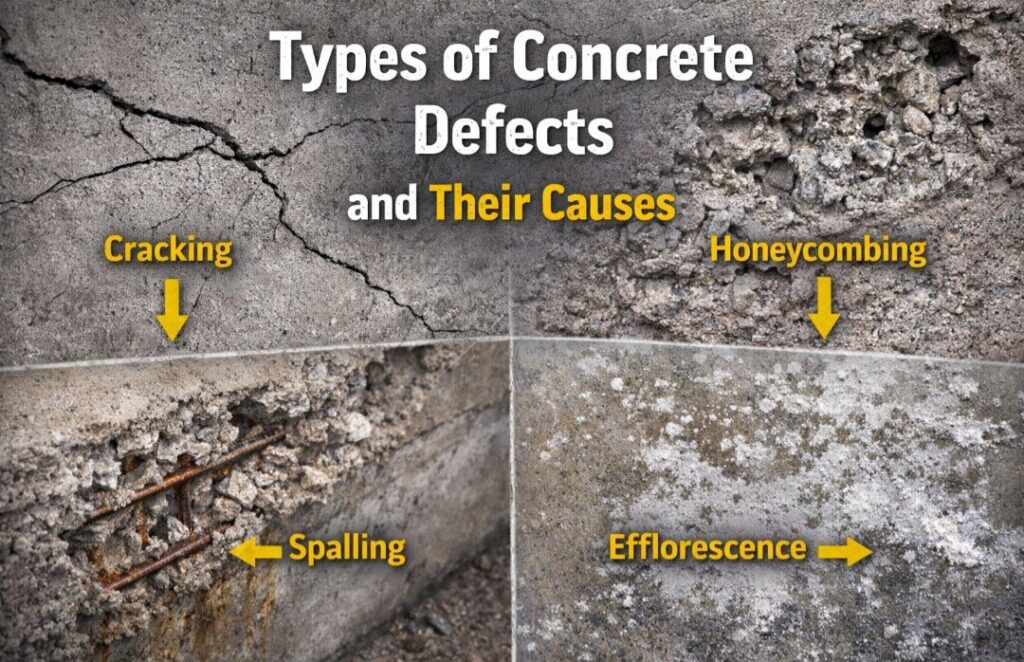
Cracking is the most common and visible defect in concrete structures. While not all cracks are structurally dangerous, every crack tells a story about stress, restraint, or poor control during construction or service.
Cracks occur when tensile stresses exceed the tensile capacity of concrete. Since concrete is inherently weak in tension, even modest restraint or volume change can result in cracking. These stresses may arise from shrinkage, thermal effects, applied loads, or differential settlement.
Plastic shrinkage cracks form shortly after placement when surface water evaporates faster than it is replaced by bleeding. This often happens in hot, windy, or dry conditions, especially when curing is delayed or inadequate. These cracks usually appear as shallow, irregular lines on the surface and indicate poor site control rather than structural failure.
Drying shrinkage cracks develop over time as hardened concrete loses moisture and contracts. If the concrete is restrained by reinforcement, foundations, or adjacent elements, tensile stresses build up and cracks form. Poor joint detailing, excessive water content, and lack of proper curing significantly increase the risk.
Structural cracks result from overloading, poor structural design, or incorrect reinforcement placement. These cracks often follow predictable patterns, such as flexural cracks in beams or vertical cracks in columns. Unlike shrinkage cracks, structural cracks demand immediate investigation because they may indicate compromised load-carrying capacity.
Honeycombing and Voids
Honeycombing refers to the presence of voids or cavities within concrete where mortar has failed to fill the spaces between aggregates. This defect is typically visible after formwork removal and appears as rough, porous areas with exposed aggregate.
The primary cause of honeycombing is inadequate compaction. When concrete is not properly vibrated, trapped air remains within the mix, preventing full consolidation. Poor access for vibrators, congested reinforcement, or inexperienced site personnel often contribute to this problem.
Incorrect mix design also plays a role. Concrete with insufficient fines or poor workability struggles to flow around reinforcement and fill formwork corners. Excessively stiff mixes, used in an attempt to “control bleeding,” often worsen the issue.
Honeycombing reduces concrete strength, compromises durability, and exposes reinforcement to moisture and aggressive agents. In severe cases, it can significantly reduce effective cross-sectional area, leading to long-term structural concerns.
Segregation of Concrete
Segregation occurs when the components of concrete separate during handling, transportation, or placement. Heavier aggregates settle while cement paste rises, resulting in non-uniform material distribution.
This defect commonly arises from overly wet mixes with high water content. Excess water reduces cohesion and allows aggregates to separate easily. Poor handling practices, such as dropping concrete from excessive heights or improper chute use, also contribute.
Segregation leads to weak zones within concrete elements. Areas rich in paste shrink excessively, while aggregate-rich zones lack sufficient cementitious material for strength and bonding. Over time, this uneven composition reduces durability and increases cracking potential.
Proper mix proportioning, controlled placement methods, and adequate supervision are essential to prevent segregation. Once hardened, segregation defects are difficult and costly to repair.
Bleeding and Laitance
Bleeding is the upward movement of water to the surface of freshly placed concrete. While some bleeding is normal, excessive bleeding creates serious surface problems.
When bleed water accumulates on the surface, it weakens the top layer of concrete. If finishing operations are performed while bleed water is present, the surface becomes rich in water and cement paste, leading to laitance. Laitance is a weak, chalky layer that easily wears or flakes off.
High water-cement ratios, poorly graded aggregates, and insufficient fines increase bleeding risk. Delayed finishing and proper curing reduce the severity of this defect.
Bleeding compromises surface durability, reduces abrasion resistance, and weakens bond with toppings, screeds, or coatings. In industrial floors and pavements, this defect often leads to premature surface failure.
Spalling of Concrete
Spalling refers to the breaking away of concrete surface layers, often exposing reinforcement beneath. It is one of the most serious durability-related defects and is frequently associated with reinforcement corrosion.
When steel reinforcement corrodes, it expands due to rust formation. This expansion generates internal tensile stresses that exceed concrete’s capacity, causing cracking and eventual spalling. Carbonation and chloride ingress are the most common triggers of reinforcement corrosion.
Poor concrete cover, inadequate compaction, and high permeability accelerate this process. In marine environments or de-icing salt exposure, spalling can develop rapidly if durability requirements are ignored.
Spalling reduces structural capacity, compromises fire resistance, and poses safety risks from falling debris. Repair typically requires removal of damaged concrete, corrosion treatment, and reinstatement with repair mortars.
Efflorescence
Efflorescence appears as a white, powdery deposit on concrete surfaces. While often dismissed as cosmetic, it indicates moisture movement through the concrete.
This defect occurs when water dissolves soluble salts within concrete and carries them to the surface. As the water evaporates, salts crystallize, leaving visible deposits. Porous concrete, poor curing, and inadequate waterproofing increase susceptibility.
Although efflorescence does not directly affect structural strength, it signals high permeability and potential long-term durability problems. Persistent moisture movement can lead to freeze-thaw damage, corrosion, and internal deterioration.
Proper mix design, low water-cement ratios, and effective moisture control significantly reduce efflorescence risk.
Delamination
Delamination occurs when thin layers of concrete detach from the surface, usually just below the finished layer. This defect is common in slabs and pavements.
It often results from premature finishing that traps bleed water or air beneath the surface. As the concrete hardens, these trapped pockets create planes of weakness. Traffic loads or thermal movement later cause surface layers to separate.
High finishing speeds, power troweling too early, and excessive air entrainment contribute to delamination. Proper timing of finishing operations is critical to avoid this defect.
Delaminated surfaces exhibit reduced durability, poor appearance, and early surface failure under service loads.
Scaling and Surface Deterioration
Scaling refers to the gradual flaking or peeling of concrete surfaces, often caused by freeze-thaw cycles. It is especially common in exposed slabs, pavements, and bridge decks.
Concrete with high water content, inadequate air entrainment, or insufficient curing is highly vulnerable. When water within the concrete freezes, it expands and creates internal pressures that break down the surface.
De-icing salts further accelerate scaling by increasing saturation and chemical attack. Proper air entrainment, durable mix design, and adequate curing are essential for resistance.
Scaling reduces serviceability, aesthetics, and long-term performance, often requiring extensive surface repairs.
Conclusion
Concrete defects rarely occur by accident. They are almost always the result of poor decisions, inadequate supervision, or shortcuts taken during design and construction. While concrete is a forgiving material, it is not immune to negligence.
Therefore, understanding the types of concrete defects and their causes allows engineers and contractors to prevent problems rather than repair them.
Also See: Reinforcement Corrosion and Its Remediation
Sources & Citations
- Neville, A.M. Properties of Concrete, 5th Edition, Pearson Education Limited.
- Mehta, P.K. & Monteiro, P.J.M. Concrete: Microstructure, Properties and Materials, McGraw-Hill.
- Kosmatka, S.H., Kerkhoff, B. & Panarese, W.C. Design and Control of Concrete Mixtures, Portland Cement Association.
- Mindess, S., Young, J.F. & Darwin, D. Concrete, 2nd Edition, Prentice Hall.
