Structural engineering is not defined by calculations alone. It is defined by the engineer’s responsibility, judgement, and professional courage.
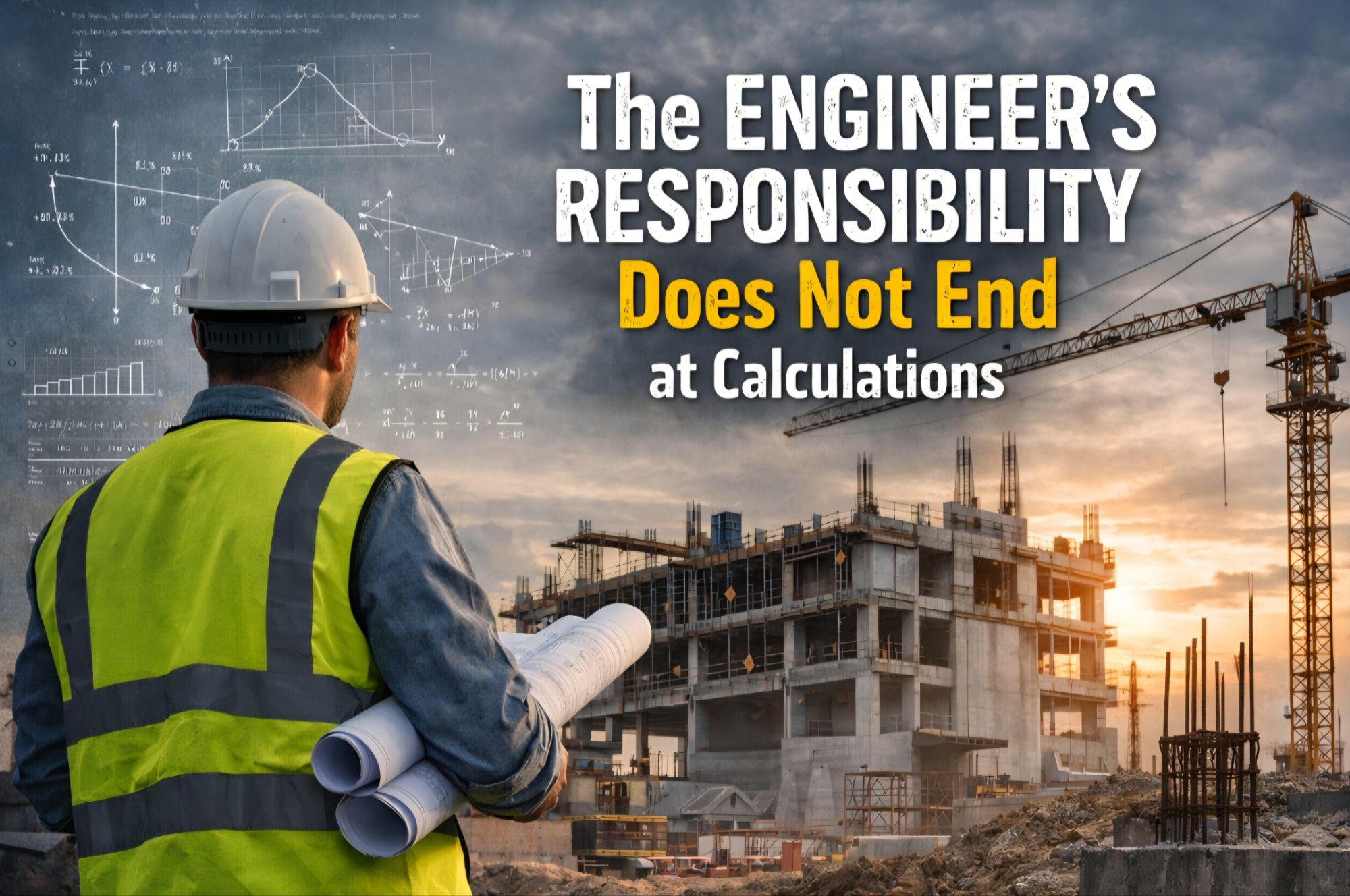
Structural engineering is increasingly treated as a transactional exercise: produce calculations, issue drawings, apply a stamp, and move on. Once the numbers close and the design complies with the code, many engineers mentally detach from the project, believing their responsibility has been fulfilled. What follows on site is often framed as someone else’s concern—construction, supervision, workmanship, or “means and methods.”
This mindset is convenient, but it is fundamentally flawed. Structures do not fail because equations were unsolved or load combinations were misunderstood. They fail because assumptions were violated, details were misinterpreted, construction sequences were unsafe, or warning signs were ignored. And when failures occur, investigations do not stop at the spreadsheet. They trace decisions, omissions, and silences back to the engineer.
The uncomfortable truth is that structural engineering is not merely analytical work. It is applied responsibility. The duty of care does not end when calculations are complete; it ends only when the structure performs safely under real conditions, not theoretical ones.
Calculations Are Necessary, but
They Are Not the Work
Calculations are evidence of engineering reasoning, not proof of safety. They describe how a structure is expected to behave under defined assumptions, materials, tolerances, and construction conditions. They do not enforce those conditions on site, nor do they guarantee they will be met.
Concrete does not place itself according to design intent. Reinforcement does not arrange itself neatly because a drawing shows it that way. Bolts are not tightened correctly simply because a specification demands it. Every calculation rests on assumptions that must be realised physically, and ignoring that gap between design and execution is where many engineers fail professionally.
A design that only works if everything goes perfectly is not robust. It is optimistic. And optimism is not a safety strategy.
Silence Is Not Neutral, It Is a Decision
Engineers often wait to be asked before raising concerns. They treat communication as reactive rather than proactive, believing that if something was not formally requested, it falls outside their responsibility. This belief is dangerous.
When an engineer observes unsafe sequencing, misunderstood details, or construction practices that undermine design assumptions and chooses not to speak, that silence becomes an active decision. Courts and inquiry panels understand this very clearly. They do not ask what was written in the scope; they ask what a competent engineer in that position should reasonably have foreseen and acted upon.
Silence may feel safe in the moment. It rarely survives scrutiny after failure.
Site Engagement Is Where Design Is Proven or Exposed
Site involvement is often treated as an administrative obligation rather than a technical necessity. Yet the site is where design intent either survives contact with reality or collapses under it. It is the only place where engineers can see how their assumptions interact with workmanship, sequencing, logistics, and human behaviour.
Congested reinforcement, impractical details, inaccessible connections, and unsafe temporary states are rarely obvious in calculations alone. They reveal themselves during construction. Engineers who disengage from site reality surrender the opportunity to correct problems before they harden into defects or failures.
Good engineering anticipates imperfection. Great engineering confronts it early.
“Means and Methods” Is Not a Professional Shield
The phrase “means and methods” is frequently used to draw a convenient line between design and construction responsibility. While contractors control execution, engineers cannot pretend that their designs exist in a vacuum. If a design implicitly requires a specific construction sequence, temporary stability condition, or load path during erection, responsibility does not disappear simply because it was not explicitly stated.
Many structural failures occur before completion, not after. Wind during erection, incomplete bracing, early-age concrete loading, and partial stability conditions often govern real risk. Treating these issues as someone else’s problem is not delegation; it is abdication.
If the design creates the risk, the engineer owns part of the responsibility.
Code Compliance Is Not the Same as Professional Judgment
Design codes define minimum standards. They do not replace engineering judgement, nor do they absolve engineers from ethical responsibility. Meeting clause requirements does not automatically produce good engineering, just as exceeding them does not guarantee safety.
Professional competence involves understanding when compliance is sufficient and when intervention is necessary. It requires confidence in analysis, clarity in communication, and the courage to challenge unsafe decisions, even when doing so is uncomfortable.
Hiding behind paperwork may protect egos in the short term, but it damages the profession in the long term.
Responsibility Extends Beyond Issued Drawings
Engineering decisions continue to influence a project long after drawings are issued. Design changes, material substitutions, value engineering proposals, and site deviations all interact with original design assumptions. Engineers who disengage entirely at this stage relinquish control over how their design is realised.
Remaining engaged does not mean supervising construction. It means protecting design intent, responding critically to change, and ensuring that safety assumptions remain valid as the project evolves.
Engineering is not finished when documents are sent. It is finished when the structure stands, performs, and endures safely.
Also See: [Viewpoint] Structural Overdesign is an Excuse, Not a Solution.
Conclusion
Structural engineering is not defined by calculations alone. It is defined by responsibility, judgement, and professional courage. Engineers who rely solely on numbers and paperwork reduce the discipline to arithmetic, stripped of accountability.
True Safety comes only from engagement, clarity, and ownership. Anything less is not engineering. It is avoidance disguised as professionalism.
Sources & Citations
- European Committee for Standardization (CEN). EN 1993-1-1: Eurocode 3 – Design of steel structures – Part 1-1: General rules and rules for buildings. Brussels: CEN.
- British Standards Institution. BS 5975:2019 Code of practice for temporary works procedures and the permissible stress design of falsework. London: BSI.
- Institution of Structural Engineers (IStructE). Structural Engineering Handbook: Principles and Applications of Structural Analysis, Design and Construction. London: IStructE.
- European Committee for Standardization (CEN). EN 1993-3-1: Eurocode 3 – Design of steel structures – Part 3-1: Towers, masts, and chimneys. Brussels: CEN.
- CIRIA. CIRIA C680: Design of Foundations for Wind Turbine Generators. London: CIRIA.
