This article examines temporary works risks specific to precast concrete construction.
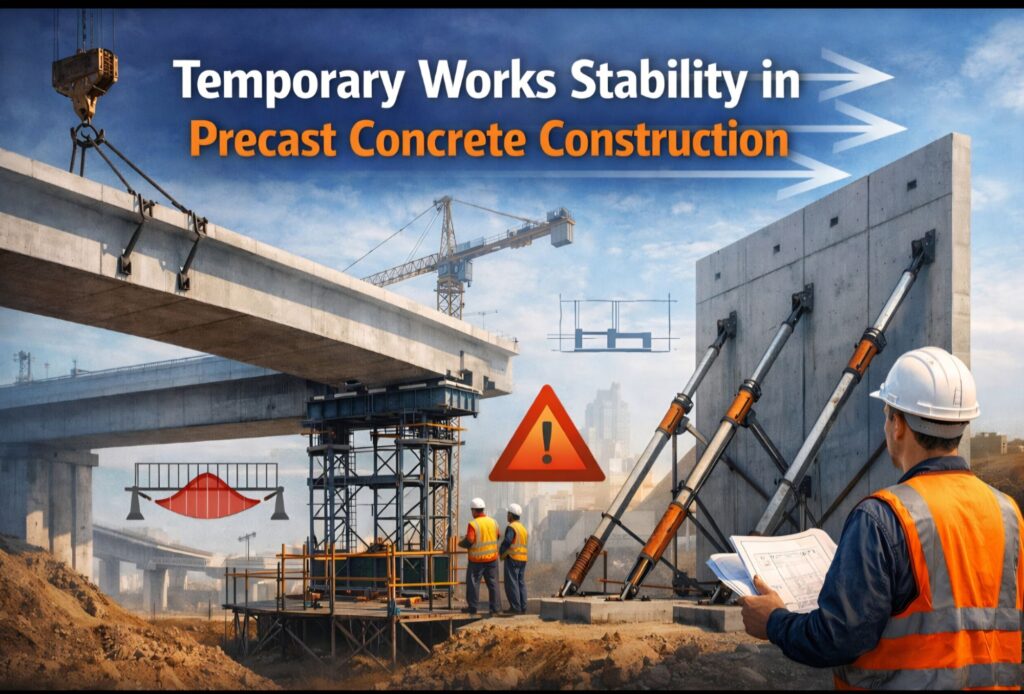
Precast concrete construction depends on temporary works more than most engineers admit. The structure that finally stands often behaves safely only because a short-lived system worked correctly during erection. When that temporary system fails, the permanent design becomes irrelevant.
We often focus on the finished precast structure. They check ultimate capacity, serviceability, and durability. Meanwhile, the most unstable condition occurs days or weeks earlier, when beams, panels, or slabs stand partially restrained. That gap between focus and reality creates risk.
Temporary works failures in precast construction rarely result from ignorance. They arise from familiarity. Engineers see similar systems repeatedly and assume stability will exist again. This assumption becomes dangerous when site conditions, sequencing, or loads differ slightly.
This article examines temporary works risks specific to precast concrete construction. It explains how instability develops during erection stages, why engineers underestimate it, and how real projects fail before permanent load paths activate.
Temporary Behaviour Is Not Permanent Behaviour
Precast concrete elements behave very differently during erection than in service. During installation, each element functions as an incomplete structure. It lacks continuity, restraint, and composite action.
Consider a precast bridge beam lifted into position. In its final state, adjacent beams, diaphragms, and deck concrete provide lateral stability. During erection, none of those restraints exist. The beam relies entirely on temporary bearings and bracing.
Engineers sometimes assume the beam carries only self-weight during this stage. In reality, the beam experiences torsion from lifting eccentricities, bending from uneven bearing contact, and lateral forces from wind. These actions often exceed service conditions.
Failures occur when engineers design for the final state but ignore the temporary one. The structure does not care whether instability occurs temporarily or permanently. Collapse during erection still counts as failure.
Temporary Load Paths Control Safety
Temporary works create load paths that differ completely from permanent ones. Loads pass through props, bearings, frames, and ground interfaces that disappear after construction. These elements often carry forces they were never designed to resist.
A common example involves temporary propping under precast slabs. Engineers may assume the slab distributes load evenly. In practice, uneven ground settlement causes one prop to attract disproportionate load. That prop buckles, and load redistributes suddenly.
Another example appears during panel erection. A tall precast wall panel may rely on diagonal braces fixed to the ground. If the ground softens after rain, brace stiffness reduces. The panel then behaves like a vertical cantilever under wind.
Temporary load paths remain sensitive to small changes. A minor construction adjustment can shift forces significantly. Engineers must identify and design for these paths explicitly.
Sequencing Turns Construction into Structural Design
Erection sequence determines structural behaviour at every stage. Each step creates a new structural system with different restraints and load paths.
Consider a precast frame erected bay by bay. If beams install before columns receive full restraint, the frame behaves as a series of unstable cantilevers. If installation order changes to meet programme pressure, stability changes immediately.
Engineers sometimes approve sequences without analysing intermediate stages. They assume the contractor will maintain stability intuitively. This assumption has caused numerous collapses worldwide.
Sequencing must become part of structural design. Engineers must ask what resists load at each stage. If the answer is unclear, the structure is unsafe.
Temporary Supports and Ground Reality
Temporary supports often look adequate on drawings. In reality, their performance depends on ground conditions, alignment, and installation quality.
For example, a precast beam may rest temporarily on bearing packs placed on in-situ concrete. If those packs sit unevenly, load concentrates on one edge. Local crushing occurs, rotation follows, and stability reduces.
Ground bearing frequently receives insufficient attention. Temporary props placed on fill or poorly compacted soil settle unevenly. That settlement introduces rotation and increases bending in supported elements.
Engineers must design temporary supports as real structures. They must check strength, stiffness, and foundation behaviour. Treating supports as accessories invites failure.
Wind as a Governing Temporary Action
Wind often governs precast temporary works design. During erection, precast elements present large exposed surfaces
with minimal restraint.
A precast wall panel standing alone behaves like a vertical cantilever. Even moderate wind produces significant overturning moments. Temporary bracing must resist these forces continuously.
Many failures occur because engineers consider average wind conditions. Gusts, directional effects, and construction delays increase exposure. A panel that stands safely in calm weather may fail suddenly during a storm.
Thus, designing for realistic wind scenarios during erection is essential. Temporary stability cannot rely on good luck or favourable forecasts.
Lifting, Handling, and Hidden Damage
Lifting introduces stresses that permanent design never sees. Incorrect lifting points create bending and cracking before installation.
Consider a long precast beam lifted from two points placed incorrectly. The beam cracks at midspan during lifting. That crack reduces stiffness permanently. Once installed, the beam deflects excessively and redistributes load unexpectedly.
Handling damage often goes unnoticed. Cracks close under self-weight after placement, hiding evidence. Engineers then assume the element performs as designed.
Temporary works design must include lifting and handling checks. Damage during erection compromises every subsequent stage.
Connections and Temporary Fixings as Failure Triggers
Temporary connections carry disproportionate responsibility. A few bolts or welds often resist global instability during erection.Bolted braces may loosen under vibration. Welded tabs may crack under cyclic loading. Once a temporary connection fails, collapse can propagate rapidly.
Engineers must specify temporary connections clearly. They must ensure accessibility for inspection and tightening. Assuming temporary fixings will “hold” remains a dangerous habit.
Human Factors and Communication Breakdown
Many temporary works failures involve human factors rather than calculations. Engineers design one scenario. Contractors execute another. Programme pressure drives changes in sequence. Site teams adjust details to suit access. These changes alter structural behaviour instantly.
If engineers remain disconnected from site reality, assumptions fail. Clear communication and documented constraints reduce this risk.
Temporary works safety depends on shared understanding. When responsibility fragments, failure probability rises.
Why Temporary Works Fail Repeatedly
Temporary works fail because engineers underestimate temporary conditions. They treat erection as a brief inconvenience rather than a governing stage. Precast construction compresses risk into short windows. When failure occurs, it escalates rapidly. There is little time for correction.
Every major precast collapse shares common traits. Incomplete restraint, underestimated loads, sequencing changes, and overlooked ground behavior appear repeatedly.
The lesson remains clear. Temporary does not mean unimportant.
Conclusion
Temporary works govern safety in precast concrete construction. They control stability before the permanent structure exists. Ignoring this reality causes failure.
Engineers must design erection stages with the same rigor as permanent works. Load paths, sequencing, wind, ground, and handling require deliberate assessment.
Precast construction succeeds when engineers respect temporary behaviour. Structures fail when temporary conditions receive temporary thinking.
Also See: Integrating Temporary and Permanent Works in Construction
Sources & Citations
- Temporary Works Toolkit: Precast Concrete (Part 11). The Structural Engineer, IStructE Journal, 2017.
- BS EN 13670: Execution of Concrete Structures. British Standards Institution.
- EN 1991-1-6: Eurocode 1 – Actions on Structures – Actions During Execution.
- CROSS Report 2017/05: Design and Erection of Prefabricated Precast Concrete.
- Fairhurst, C., & Kemp, M. Structural Engineering Practice: Temporary Works for Construction. ICE Publishing.
