This article sets out a practical methodology for the analysis and design of guyed towers in accordance with European practice.
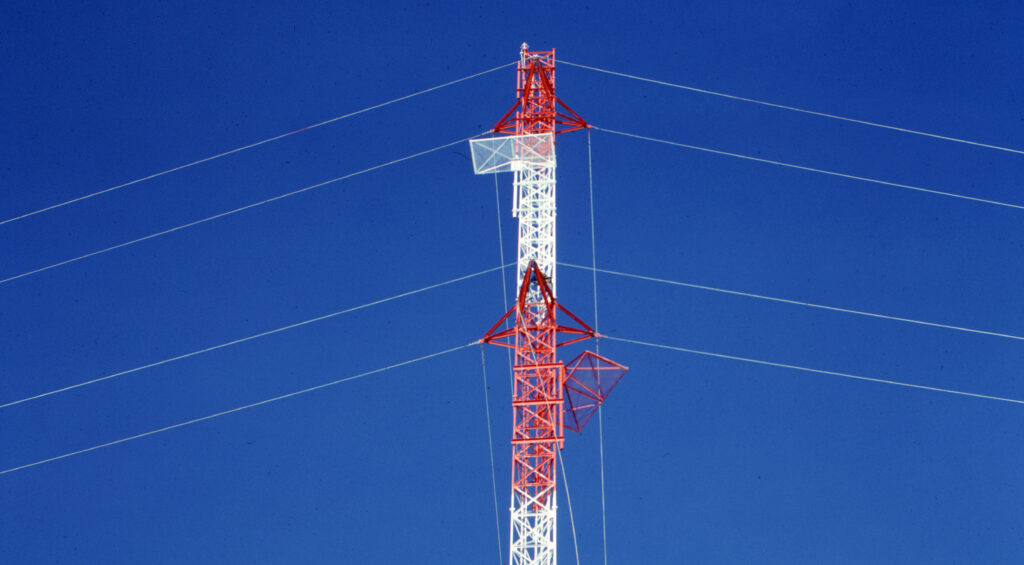
Guyed towers provide an efficient structural solution where height is required with minimal material use. They achieve stability through a balance between a slender mast in compression and inclined guy cables in tension, anchored into the ground. This arrangement produces a structure that is materially efficient but structurally sensitive. Small changes in geometry, stiffness, or loading can lead to significant redistribution of forces.
Unlike conventional framed structures, guyed towers behave as highly interactive systems. The mast, guys, and anchors cannot be designed independently. Each component influences global response, and failure or softening in one element affects the entire structure. For this reason, the design of guyed towers demands careful global analysis, realistic modelling assumptions, and detailed member verification.
This article sets out a practical methodology for the analysis and design of guyed towers in accordance with European practice. It addresses global structural analysis, load modelling, member design of the mast and guys, anchorage considerations, and robustness verification, while referencing the governing Eurocodes and relevant clauses where appropriate.
Governing Codes and Design Framework
The design of guyed towers draws on several Eurocode parts. Structural verification follows the principles of EN 1990, which establishes the basis of design, including reliability formats, actions, and combinations. Actions on the structure are derived primarily from EN 1991, particularly wind actions under EN 1991-1-4, which will almost always govern design.
Member resistance and stability checks depend on material choice. Steel masts and components follow EN 1993, with global stability addressed under EN 1993-1-1, and cable elements designed in accordance with EN 1993-1-11. Concrete anchor blocks and foundations reference EN 1992, while geotechnical verification of anchors relies on EN 1997.
The designer must integrate these documents into a coherent system-level design rather than treating them as isolated checks.
Structural System and Load Paths
A guyed tower consists of a vertical mast restrained laterally by multiple levels of inclined guy cables. Loads applied to the mast transfer into the guys through mast deflection and then into the ground via anchors. The mast carries primarily axial compression with secondary bending, while the guys carry axial tension only.
The structure remains stable only while the guy system maintains tension. Loss of tension, whether due to temperature effects, creep, or accidental damage, reduces lateral stiffness dramatically. The load path therefore depends on sustained tension in the guys and adequate stiffness in the anchorage.
This behaviour creates a non-linear structural system. Deflections influence forces, and forces influence deflections. Linear analysis often fails to capture this interaction accurately.
Actions and Load Modelling
Permanent actions include self-weight of the mast, guys, fittings, platforms, antennas, and cable trays. These loads influence mast compression and define baseline guy tension requirements. Permanent actions also affect second-order effects, particularly in slender masts.
Wind action usually governs design. Wind loads act on the mast, guys, and attached equipment. EN 1991-1-4 provides the basis for calculating wind pressure, exposure, terrain roughness, and height-dependent effects. The projected area of the guy cables must be included, as long inclined cables can contribute significantly to total wind load.
Ice loading may govern in certain climates. Ice increases both weight and wind-exposed area, often producing more severe combinations than wind alone. Where relevant, ice actions should combine with wind in accordance with EN 1990 combination rules.
Temperature actions influence guy tension significantly. Seasonal and daily temperature variation can increase or reduce cable forces and must be considered when defining pretension levels.
Accidental actions include the loss of a single guy or anchor. These scenarios govern robustness checks and often control mast strength.
Global Structural Analysis
Global analysis of guyed towers requires a geometrically non-linear approach. Second-order effects dominate behaviour due to slenderness and large deflections. EN 1993-1-1 requires second-order analysis where deformations significantly influence internal forces, which is almost always the case for guyed towers.
Guy cables must be modelled as tension-only elements with defined axial stiffness. Initial pretension should be applied explicitly in the model. Cable slackening must be allowed to occur naturally under unfavourable load combinations.
Anchor stiffness influences global response and should not be assumed rigid without justification. Flexible anchors reduce system stiffness and increase mast deflections. Where anchor stiffness remains uncertain, sensitivity studies help identify critical scenarios.
Load combinations follow EN 1990, with persistent, transient, and accidental design situations analysed separately. Accidental combinations involving guy failure should demonstrate that the structure remains stable without disproportionate collapse.
Mast Design and Verification
The mast primarily resists axial compression from self-weight, equipment, and guy forces, combined with bending induced by wind and imperfections. Slenderness typically governs design.
Member verification follows EN 1993-1-1, with combined axial force and bending checks performed using interaction expressions. Effective length depends on guy level spacing and stiffness rather than physical segmentation alone.
Assuming full lateral restraint at guy levels often overestimates mast stability. In reality, guy stiffness provides elastic restraint rather than a fixed point. Non-linear analysis captures this behaviour more accurately than simplified effective length methods.
Local checks must address shell buckling for tubular masts, connection forces at guy attachment points, and fatigue where stress ranges are significant.
Guy Cable Design
Guy cables act purely in tension and require careful design to maintain serviceability and robustness. Design follows EN 1993-1-11, which addresses tension elements and cable systems.
Ultimate limit state verification checks maximum tension under governing combinations, including wind, ice, and temperature effects. Serviceability checks ensure that cables do not slacken under unfavourable conditions.
Pretension selection represents a critical design decision. Too little pretension allows excessive deflection and dynamic response. Too much pretension increases mast compression and anchor demand. Pretension must consider temperature extremes and long-term relaxation.
Fatigue verification may govern for exposed sites. Wind-induced tension cycling can significantly reduce cable life if not addressed through appropriate detailing and material selection.
Anchor and Foundation Design
Anchors provide the final load transfer into the ground and often govern overall capacity. Their design must address strength, stiffness, and long-term performance.
Geotechnical verification follows EN 1997, considering ultimate resistance, serviceability displacement, and creep effects. Anchor displacement affects guy tension and global stiffness, making serviceability critical.
Different anchor types behave differently. Gravity anchors rely on self-weight and bearing resistance. Rock anchors rely on bond strength. Helical anchors rely on installation torque and soil conditions. Each requires appropriate design models and partial factors.
Concrete anchor blocks follow EN 1992, with reinforcement designed to resist cracking, splitting forces, and anchorage loads.
Robustness and Accidental Design Situations
Guyed towers possess limited redundancy. Loss of a single guy produces significant force redistribution and increased mast bending. Robustness verification must therefore demonstrate that the structure survives this scenario without collapse.
Accidental combinations under EN 1990 apply reduced partial factors, but force redistribution often offsets this reduction. These checks frequently govern mast and connection design.
Where consequences of failure are high, designers may also introduce additional guys, increased safety margins, or monitoring systems to improve resilience.
Construction, Erection, and Tensioning
Construction stages influence final behaviour. Guy installation order and tensioning sequence affect mast alignment and force distribution. Temporary instability during erection represents a significant risk.
Design assumptions must align with achievable construction tolerances. Tensioning procedures should include measurement, adjustment, and verification, with records retained for future inspection.
Conclusion
Guyed towers demand a systems-based design approach. Their behaviour depends on interaction between mast, guys, anchors, and ground rather than individual member strength. Reliable design requires non-linear analysis, realistic modelling, and detailed member verification.
By integrating global analysis with rigorous member design and anchorage verification, engineers can achieve safe, efficient, and durable guyed towers that perform as intended throughout their service life.
Also See: Derivation of Wind Load to Signage Structures | Worked Example
Sources & Citations
- EN 1990: Eurocode – Basis of Structural Design
- EN 1991-1-4: Actions on Structures – Wind Actions
- EN 1993-1-1: Design of Steel Structures – General Rules
- EN 1993-1-11: Design of Structures with Tension Components
- EN 1992-1-1: Design of Concrete Structures
- EN 1997-1: Geotechnical Design
